
- 2 Jet Dies Coming to a Stop
- Hesitation Off Idle
- Rochester 2 Jet Lack of Power
- Rochester 2 Jet Carburetor Hard Starting
- My 2 Jet Carburetor Won't Idle
- 2 Jet is Flooding (gas leaking out the top)
- 2 Jet Engine Pops Through the Carburetor
- Rochester 2 Jet Idle Screws Not Working? Diagnose & Fix the Problem
- 2 Jet Venturi is Dripping At Idle.
Rochester 2G, 2GC, 2GV, 2 Jet Carburetor Questions & Answers.
User post questions to us in a variety of ways.
This could be caused by a couple of things.
Percolation - gas has a lower boiling point these days. After getting the engine hot and turning it off, the gas boils out of the carburetor. This is called percolation. Check this by feeling the carburetor after running the vehicle and getting the engine hot. Feel the carburetor to see if it is hot to the touch. If it is then the problem is probably percolation. This is a tough thing to correct, but cooler gas is the answer. Make sure the fuel lines are away from the exhaust manifold. You somehow need to get the heat away from the carburetor.
Add Ethanol Defender to your gas. They don't claim it will help the heat problem, but it does help with the ethanol problem.

Make sure all of the small passages around the venturi and on top of the carburetor are clear. Run thin wire down all passages.
Make sure any vents on the top of the carburetor are clear. Without a vent you can get a siphoning action.
There is always a chance that gas is leaking out of the bottom of the carburetor. Remove the carburetor, fill with gas and let it sit overnight on a piece of paper. Any leaks will easily show up.
If the car has been sitting for a long time, the gas could have varnished the inside of the carburetor including the needle & seat.
A long shot would be the fuel pump. You can eliminate this by disconnecting the fuel line after stopping, then hook it back up when you want to start the engine. Obviously if the problem goes away, the issue is with either the fuel pump, or gas tank. Some gas tanks are vented.
The wrong gas cap could cause a non vent action. Loosen the cap and see if this cures the problem.
Fuel may be simply evaporating through the top vent. This is due to the lousy gas we now have. There isn't anything you can do, but crank the engine until the fuel bowl fills again. Don't pump the pedal at 1st. That will only make the accelerator pump squirt some fuel, which will not be enough.
slotted hole in the float lever assy. Which hole does the wire clip on the needle hook into on the copper
float?
Doesn't matter. Just be sure the needle is pulled straight up and down, or it will bind.
I have a 1967 chevy C-20, 283, 2g carb.. i think. The accelerator cup keeps tearing or rupturing.. I need to order a new rebuild kit however i would love to solve this problem first. Is it ethanol? I cant feel any burrs in the chamber.. its about my 4th or 5th accel pump since my last rebuild and i have damaged the the gaskets taking it apart as many times.. Any help would be much appreciated. thanks
1st of all add Ethanol Defender to your gas. This will eliminate a lot of your problems.
Polish the accelerator well so that the cup glides smoothly using crocus cloth.
Wash all chemicals out of the carburetor after cleaning with hot water. Almost all chemicals react with Ethanol.
Even ethanol ready rubber will fail if the ethanol is strong enough. Ethanol separates from gas when it sits resulting in more that 15% concentration. The kit contains multiple check balls. Which goes where?
The smaller and usually aluminum check ball resides in the bottom of the accelerator pump well. The larger stainless steel resides in the main discharge tube along with the brass colored spring and the T retainer. Keep in mind that not all 2G carburetors use a check ball in the bottom of the well. A well with only 1 hole at the bottom will not use a ball. Those with 2 holes (1 slightly on the side) will use a ball.
Yes it is, but follow the manufactures instructions. Some cleaners will discolor your carburetor if left soaking too long. Due to restrictions cleaners these days won't do much more than remove the oil and grease.
After soaking wash with hot water, blow out passages with compressed air, then run thin wire down all passages. Ethanol leaves deposits behind. The small holes are especially prone to plugging. We used to recommend against the wire cleaning because it could result in making holes bigger, but because of ethanol, it is the lesser of 2 evils.
Most likely this is due to too much air, or not enough fuel. Look for a vacuum leak. Check all connections that might have vacuum. Also check any vacuum hoses. You can use a spray carburetor cleaner and spray around the connections. If the idle smooths out, then you probably found the problem.
Next look for reasons the carburetor isn't getting enough fuel.
Check fuel pump pressure (compare the number with your motors manual).
Check the float level.
The needle may be sticking in the seat, not letting enough fuel in.
You could have plugged passages. Ethanol will leave deposits behind that cleaners and compressed air will not remove. Use a thin wire to run down all passages.
Are the idle mixture screws way out of adjustment?
If the carburetor hasn't been rebuilt, then do that if you suspect dirt is your problem.
More from my friend Jim:
My first thought is a "BUNA" black rubber accelerator pump cup that has enlarged due to alcohol contamination. With little or no accelerator pump function there would be a lean pop or backfire or sever stumble. When there is a vacuum leak, unwanted air enters the fuel mix stream and causes either high idle or rough idle and stalling. Closing the choke butterfly eliminates some of the normal air flow and the fuel mixture becomes more normal. I would remove the air horn to inspect the accelerator pump cup. I would also to see if an inlet pump check is required and/or present.(some "2G" carbs don't require a check ball and refill from a slot inside the main body). I would remove the Venturi cluster and blow the cluster and the passages in the main body. If its an early "2G" I would check to make sure the carb has the correct flange gasket. Some early "2G" carbs used exhaust crossover to preheat the cast iron base and if the incorrect gasket is used it will inject exhaust gases into the fuel stream.
UPDATE: Customer found the holes leading from the carburetor throat and idle mixture screw was plugged. This would mean little to no fuel from the idle circuit.
My carburetors are running rich at idle
Here are a few things to check. Not in any particular order.
Float level.
Bad float. For brass floats, heat some water and immerse the float. Any bubbles indicate a leak and the float should be replaced. Nitrophyl floats should be replaced. The only test is to weight them.
Fuel pump pressure.
Power valve is not seating, allowing fuel past it when in non power mode.
Fuel is leaking past needle & seat. Be sure you cleaned the old gasket material off completely.
Main discharge check ball is not seating. Hold the ball down with a brass drift punch. Put fluid (like mineral spirits) in the pump well. Press the accelerator pump down. You should feel some pressure. If the ball is not seating, fluid will be siphoned at idle. You an seat the ball by hitting it gently with brass drift punch and hammer.
Run thin wire down all small passages, especially the venturi.
Seat was damaged when installing. Too much pressure on the seat when adjusting the float is a common problem. Inspect the viton tip closely for any marks.
Should I use a sealant on the gaskets
NO, nothing. There are a few cases where we use Permatex Anarobic, but that is only for extreme cases where we need to get a leak stopped. Tri

This is the power valve adjustment. Leave it alone and it should be plugged.
In some 2-bore carburetor applications main well inserts are used. They are larger than the main well tubes and set in a recess beneath the venturi cluster. The main well inserts surround the main well tubes and have calibrated holes that are similar to those in the main well tubes. The purpose of the main well inserts is to break up vapor bubbles which may form in the main well during hot engine operation. This prevents the vapor bubbles in the fuel, caused by heat, from disrupting carburetor metering and provides even fuel flow from the main well tubes and discharge nozzles. The main well inserts are used only on applications where engine heat causes excessive vapor bubbles in the main well area.
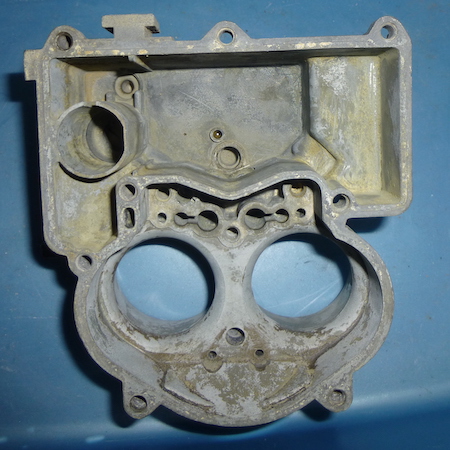 This extra hole is a bleed hole for the power jet. Make sure it is clean and leave it alone.
 Mike,
Thanks for your quick response. I have re-adjusted my floats on all three carbs. The check balls are in the main discharge (new check ball, spring and keeper). I ran wire throught small passages in the venturi cluster. After putting everything back together, I ran engine and only the front secondary carb dripped during idle and shut off. I pulled the top off again, checked float and replaced the venturi cluster with another one. I started the engine and no drips were visible. After three or four starts the front venturi cluster started dripping on one side. When I removed my fuel lines again, there seemed to be a lot of line pressure at the front carb. I have a Mr. Gasket fuel pressure regulator inline set at 3 lbs. Everything that has been done to this carb also has been done to the rear carb and it does not drip. Any suggestions would be greatly appreciated. Very frustrating.
Also check the venturi gasket to be sure it is laying flat. They sometimes are made a bit too big and need to be trimmed.
There could be multiple problems. Assuming it runs ok once the vehicle is powered up would mean there is a problem in the accelerator pump circuit.
Look down the carburetor bore and pump the throttle. You should see a strong squirt of gas coming out of the venturi.
Little or no gas indicates you have a stoppage, or something is installed incorrectly. To troubleshoot the pump check out the Rochester 2G, 2GC Accelerator Pump article.
Now if you are having problems on power after accelerating, then you problem is elsewhere, probably not enough fuel.
This is normal on some carburetors. The power circuit uses the jets and vacuum to supply extra fuel on power. Hi. First of all thank you for your videos I found them to be very helpful.
We have a 1968 Chevy Caprice with the 307 and the noted carburetor above. Car was hesitating and been sitting for a while so I got a rebuild kit cleaned it out and put in the new parts. It starts great, choke is working fine and has good power but the engine stumbles and the accelerator pump is not working correctly. I took it apart a couple of times and verified the orifices were pen (first try they were blocked and cleaned them out). Now when I push the accelerator the fuels kind of trickles out of the orifices. I disconnected the accelerator pump rod and when I manually pushed it down into the chamber farther it seems to squirt the fuel correctly?? Carb number is 7028103. Any suggestions would be greatly appreciated. After removing and trying different things and cleaning it numerous times I am about ready to give up. Thank you!!!
1st of all, the distributor can cause the same symptom.
Did you test the check balls. Don't know if you have one in the pump well or not, but they need to be tested.
Here are some pages with this information:
Resulting solution
I found out that the rebuild kit had an accelerator pump that was too small.
Buying my next carb parts from you guys!
Hey i have a rochester 2 barrel marine carb and the issue im having is we cant keep it running with out holding the choke butterly in a certain position. As soon as the choke fully opens it dies even if we have the throttle at say 2 thousand rpm any insite on this.
You could have a vacuum leak somewhere.
Using carburetor cleaner spray around the carburetor mounting gasket and around all vacuum lines and the intake manifold gasket. If this help the RPM then you have found the problem.
More likely you are not getting enough fuel. Passages may be getting plugged up with dirt and/or ethanol residue. Marine engine tend to sit around a lot, which allows for ethanol build up in the carburetor. The needle & seat may be sticking shut not allow enough fuel into the float bowl.
This is assuming the carburetor has not been rebuilt recently.
If it has been rebuilt then you have other problems. For example maybe the fuel pump isn't putting out enough pressure. Venturi passages are very small and may be plugged. Clean out with thin wire. The float level may be incorrect not allowing the needle to open. Fuel filter may be plugged not allowing fuel to flow into the carburetor. Along with the in line filter, there is probably a filter inside the carburetor .
The bottom line is that you are getting too much air (vacuum leak), or not enough fuel. It's hard to be any more specific not know the history of the carburetor.
Gas dribbles out of the throttle shaft when I turn the engine off.
It may be flooding and there could be many reasons for that.
Car bogs or hesitates
- Electrical not up to par (especially distributor advance)
- Accelerator pump cup damaged, or worn.
- Plugged accelerator pump circuit.
- Off Idle circuit plugged.
- Does the venturi drip gas at idle. If so then the pump circuit is leaking. Try seating the main discharge check ball by tapping on it lightly to seat it. Is there a spring above the check ball?
- Using spray carburetor cleaner, spray through all small passages in the venturi and in the main body. Make sure they all go through.
- Check float adjustment. Do no fudge, set to specs.
- Check or replace the fuel filter.
- If the engine sat for months then the gas probably turned and coated the inside of the carburetor with varnish. Cleaning the carburetor without cleaning the gas tank and fuel lines will result in the same problem.
Lack of Power on the High End
- Low fuel pump pressure. Should be 4.5 lbs prox. Check your motors manual for the exact pressure required.
- Kink in the fuel line before the fuel pump, or between the fuel pump and carburetor.
- Spark plugs and/or plug wires may need replacing.
- Fuel filter may be plugged. Check for an inline filter and a filter in the fuel inlet of the carburetor.
- Vacuum leak. Lack of power can be too much air, or not enough fuel.
- Float may need adjustment.
- Move the float up and down by hand to see if there is any binding or catching.
- Does the needle come out of the seat easily. The viton tip can get swelled and stick closed with the lousy gas we have these days.
- Had the carburetor been sitting for months. If so, then the gas probably turned to varnish and coated the inside of the carburetor causing restriction in the small passages. Clean the carburetor and replace the parts in our rebuild kit.
- Power piston may be frozen. The power piston moves to let extra gas through at higher speeds. The piston moves using vacuum and can get stuck easily.
