
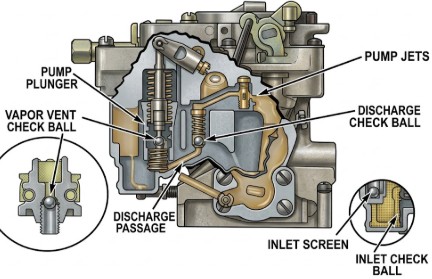
Testing the accelerator pump circuit on a Rochester 2 Jet carburetor.
This article only refers to the type of 2 jet that uses a check ball in the bottom of the pump well. Not all carburetors do.
When rebuilding your 2 jet you may want to test the accelerator pump circuit before closing up the carburetor. Here are the steps you need to take.
Place the smaller and aluminum (when provided), check ball into the bottom of the accelerator pump well. Not all 2 jets will have this check ball and a few will use a bigger aluminum check ball. Fill the float bowl and the pump well with mineral spirits.Put the pump in the well and push it down toward the bottom of the well. The check ball will seal the hole, keeping the fluid from going back into the float bowl and the fluid will be forced through the 2nd hole through the main discharge. You should see fluid come out of the main discharge.
The main discharge should have the bigger stainless steel check ball, then the gold colored spring (don't worry if it is bent), then the T. Stake the T so that it doesn't pop out.
Now test to see if the check ball seals by holding your finger over the main discharge hole and pressing down on the pump again. You should feel a slight pressure on the accelerator pump and there should not be any bubbles or some other sign that would indicate the check ball is leaking and fluid is being forced backwards.
The larger check ball in the main discharge tube must also be tested. Hold the check ball down with a brass drift punch and push the accelerator pump down. You might get but a slight amount of fluid past the check ball, but you should also feel a slight pressure.
Replace the venturi cluster and test again by pushing the pump down. You should get a strong squirt out of both sides of the cluster. If not run thin wire through the small passages. They may be plugged with ethanol residue and cleaners will not remove the residue.
To re seat a check ball, using a brass drift punch, hold the check ball down into the hole with the drift punch and tap a few times with a hammer. Don't get carried away, or you will get the check ball stuck. The hole in the carburetor you are trying to form is soft metal and doesn't take much to change.
Now you can be confident your accelerator pump circuit is doing what it should.
Is the check ball stuck in either hole? Turn the carburetor over and while heating the bottom where the check ball resides tap the carburetor bowl on the bench. It will most likely fall out when hot enough.
Which Rochester 2 Jet Uses a Garter Spring?
The Rochester 2 Jet carburetors that use a garter spring on the accelerator pump cup are typically those equipped with a 3/4" diameter pump cup.
Where They're Commonly Found:
-
These larger accelerator pump cups—and the corresponding garter springs—are usually found on big block V8 applications.
-
Specifically, they’re more common on high-displacement engines where increased fuel volume is required for throttle response.
Why the Garter Spring Is Used:
-
The garter spring helps the leather or rubber pump cup expand and maintain contact with the pump well.
-
This ensures consistent fuel delivery under quick throttle movements.
-
It’s especially important in larger-diameter accelerator pump wells, where maintaining cup tension is more difficult without the spring.
How to Identify If Yours Uses One:
-
Measure the diameter of the accelerator pump cup.
-
3/4" pump cups almost always use a garter spring.
-
Smaller 5/8", or 21/32" cups typically do not.
-
-
If your carb came from a big block Chevy, Pontiac, Oldsmobile, or Buick, there’s a good chance it uses the larger 3/4" cup and spring.

Why Your Rochester 2 Jet Has No Intake Check Ball at the Bottom of the Pump Well?
Some Rochester 2 Jet carburetors—especially earlier or specific variations—do not have a hole at the bottom of the accelerator pump well for an intake check ball. Instead, these versions fill the pump well through a small slot cut into the side of the well.
How It Works:
-
When the accelerator pump moves upward (as the throttle closes), fuel flows from the float bowl through the side slot into the pump well.
-
There’s no need for a check ball at the bottom because the slot acts as the fuel entry path.
-
As the pump moves downward (when you open the throttle), it forces fuel out through the pump circuit and into the main discharge nozzle.
How to Test This Type of Pump System:
You can test the function using mineral spirits or carb cleaner:
-
Fill the float bowl with mineral spirits.
-
Pull the pump up manually to allow the well to fill through the side slot.
-
Press the pump down.
-
Watch the main discharge nozzle inside the carburetor bore:
-
If fuel squirts out, the pump circuit is working.
-
If nothing happens, the discharge passage or check ball (upstream) may be clogged.
-
Important Notes:
-
These carbs rely on side-feed design, not a check ball at the bottom.
-
You still may have a discharge check ball and spring at the top of the pump circuit to prevent backflow.
-
It's a common design on certain mid-'50s to early '60s Rochester 2 Jet applications.
