
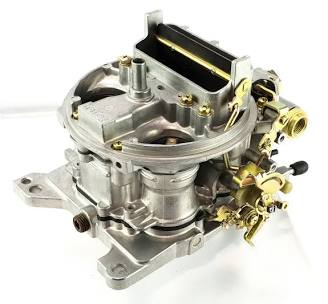
The Holley Model 4360 is a unique, compact 4-barrel carburetor that stands out significantly from Holley’s traditional modular designs like the 4150 or 4160 series. Introduced primarily as an aftermarket upgrade during the fuel-conscious late 1970s and 1980s, it is best known by its marketing name: the Holley Economaster.
Designed specifically for small-to-medium displacement V8 engines and inline-6s, its main objective was maximizing fuel economy without sacrificing the drivability of a 4-barrel configuration.
Key Design Characteristics
Unlike standard Holley carburetors that feature separate, modular fuel bowls bolted to the sides of a main body, the 4360 uses a monolithic design.
-
One-Piece Main Body: It features a single-piece aluminum main body with a unified, internal wrap-around fuel bowl wrapper. This layout is structurally much closer to a Rochester Quadrajet or a Carter AFB than a standard Holley.
-
Air Horn / Air Shield Cover: The fuel bowl is completely enclosed from above by a clean, cast aluminum air horn cover. This wrap-around design minimizes gasket seams below the fuel level, greatly reducing the risk of external fuel leaks.
-
Airflow Rating: It is rated at 450 CFM (Cubic Feet per Minute), making it small by V8 performance standards, but perfectly sized for efficiency and crisp throttle response on small blocks (like 283-307 Chevys or 289-302 Fords) and larger six-cylinders.
Internal Systems & Functionality
The internal architecture of the 4360 was engineered to deliver fine fuel atomization and tight fuel metering control.
1. Metering & Jets
Instead of traditional removable metering blocks, the 4360 utilizes fixed internal metering channels cast directly into the main body. It features a mechanical power valve circuit and utilizes standard Holley main jets, though accessing them requires removing the top air horn assembly rather than a side bowl.
2. Secondary Operation
The 4360 features mechanical secondaries, but with a crucial caveat for drivability: it uses a weighted airflow-velocity valve over the secondary throttle bores. Even when you mash the throttle mechanically, the secondary air valve only opens as the engine's vacuum and airflow demand warrant it. This prevents the classic engine "bog" or hesitation common when over-carbureting a small engine with mechanical secondaries.
3. Spread-Bore and Square-Bore Versatility
The baseplate is highly adaptable. It features a universal bolt pattern designed to bolt directly onto common square-bore intake manifolds, but the physical throttle bore orientation is slightly spread-bore in nature (smaller primaries for economy, larger secondaries for top-end airflow).
Technical Summary
Because it was only produced for a limited window during the fuel-crisis era and differs entirely from the ubiquitous 4150 series, parts like specialized top air-horn gaskets and specific choke linkages can be more difficult to source today compared to standard Holley components. However, its design remains a fascinating milestone in Holley's engineering history, blending the compact integrity of OE-style carburetors with Holley's signature fuel circuits.
