
The accelerator pump circuit on the Holley 4360 is a mechanical injection system designed to eliminate "lean stumble."
When you suddenly mash the throttle pedal, the carburetor’s butterflies snap open, causing an immediate rush of air into the intake manifold. Because gasoline is much heavier than air, it lags behind, causing a temporary, momentarily lean condition. The accelerator pump solves this by mechanically forcing a direct squirt of raw fuel into the primary venturis the exact instant the throttle moves.
Here is a breakdown of how the 4360's internal pump circuit operates.
1. The Mechanical Linkage & Spring-Loaded Duration
The process starts outside the carburetor body. The primary throttle shaft is connected to a mechanical pump lever. When you open the throttle, this lever pushes down on the accelerator pump operating rod.
However, rather than pushing directly on the pump plunger, the rod compresses a duration spring sitting on top of the plunger shaft.
-
If it pushed the plunger directly, the fuel would shoot out all at once in a harsh, fraction-of-a-second blast.
-
Instead, the compressed duration spring acts as a mechanical buffer. It steadily forces the plunger downward, overriding the resistance of the heavy fuel underneath it. This stretches the fuel squirt out into a smooth, continuous stream that lasts for a couple of seconds—matching the engine's transition up to higher RPMs.
2. The Internal Fuel Path: Intake, Check, and Discharge
Inside the main body casting, the accelerator pump operates through a three-stage hydraulic cycle:
A. The Intake Stroke (Filling the Well)
When the engine is idling or at a steady cruise, the throttle lever is up, and a return spring pushes the pump plunger to the top of its cylinder (the pump well). As the plunger rises, it creates a low-pressure area beneath it. This suction draws fuel from the main fuel bowl, through an intake check valve (typically a small stainless steel ball or a rubber umbrella valve at the bottom of the well), filling the pump chamber with fuel.
B. The Discharge Stroke (Pressurizing the System)
The moment the throttle opens and the plunger is forced downward, the fuel in the well is pressurized. This downward pressure instantly forces the intake check valve closed, trapping the fuel and preventing it from backing up into the fuel bowl.
With the intake path blocked, the pressurized fuel is forced up through an internal discharge passage cast into the main body and air horn.
C. The Discharge Weight and Nozzle (The Squirt)
Before the fuel can reach the air stream, it must push past a discharge check needle or weighted check ball located directly beneath the pump shooters (nozzles).
-
This weighted check needle is critical: it prevents engine vacuum from pulling ("siphoning") raw fuel straight out of the pump nozzles during steady high-speed driving.
-
Once the hydraulic pressure from the pump stroke lifts this check needle off its seat, the fuel rushes into the discharge nozzle (or shooter). The tiny, precision-drilled orifices in the shooter atomize the fuel into fine streams directed straight down into the primary venturis.
Tuning and Adjustment on the 4360
Unlike high-performance Holley 4150s that use customizable plastic cams and interchangeable colored pump shooters, the 4360 relies on a more classic approach for tuning the pump shot:
-
Linkage Holes: The external pump operating rod can usually be placed into different holes on the throttle lever. Moving the rod closer to the throttle shaft center yields a shorter, quicker stroke; moving it outward increases the total volume of the fuel shot.
-
The Clearance Screw: There is an adjustment screw and spring on the pump linkage assembly. It is critical to adjust this so that at Wide Open Throttle (WOT), the pump plunger is not completely bottomed out. There must be a small amount of remaining clearance (typically around 0.015" to 0.020") to prevent bending the linkage or cracking the internal pump casting when the pedal is floored.
How To Adjust the Acelerator Pump on Holley 430
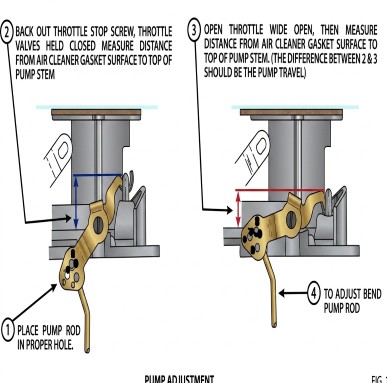
Adjusting the accelerator pump on a Holley 4360 involves two distinct settings: stroke volume (tuning out a stumble) and pump override clearance (preventing mechanical damage at full throttle).
Because the 4360 uses a integrated metal override lever arm rather than a traditional plastic pump cam, the procedure requires a set of feeler gauges and simple hand tools.
Technical Specifications
-
WOT Override Clearance: 0.015 inch (Minimum safety cushion)
-
Standard Stroke Linkage Position: Inner hole on the throttle lever (factory baseline)
Adjustment Procedure
Before beginning, ensure the engine is off and the choke plate is fully open so the fast idle cam doesn't hold the throttle partially open.
Locate where the pump operating rod connects to the primary throttle lever.
Inner Hole (Closest to shaft): Provides a standard, standard-duration shot for stock or mild engines.
Outer Hole: Increases the mechanical sweep, delivering a larger total volume of fuel. Use this hole if the engine experiences a hesitation or lean pop right off idle.
Manually rotate the main throttle lever all the way down to its absolute mechanical stop (Wide Open Throttle). If the carburetor is mounted on the vehicle, have an assistant hold the gas pedal completely to the floorboard.
With the throttle wide open, compress the pump plunger down by hand to see how much travel it has left. Insert a 0.015-inch feeler gauge into the gap between the pump override arm and the adjustment screw head.
Turn the pump over-ride adjustment screw located on the spring-loaded pump arm until you achieve a light drag on that 0.015" feeler gauge at WOT.
Critical Clearance Check: This 0.015" gap is vital buffer space. It ensures that when your foot bottoms out the throttle pedal, the pump plunger inside the cylinder isn't slamming violently into the bottom of the fuel bowl, which will bend your external linkages or crack the internal casting.
Release the throttle back to curb idle. Peer down into the primary venturis and gently wiggle the throttle lever. The instant the throttle moves, fuel should spray cleanly out of the discharge nozzles. If there is a delay, check for a bent operating rod or an overtightened override spring.
