
- Float System Dualjet
- Idle Circuit Dualjet
- Choke Circuit Dualjet
- Main Metering System Dualjet
- Power Circuit Dualjet
- Mixture Control Solenoid Dualjet
- Air Bleed Valve Dualjet
- Buick 3.2L (196"), 3.8L (231") V6
- Chevrolet Passenger 3.2L (196"), 3.3L (200"), 3.8L (231") V6
- Oldsmobile 3.8L (231") V6
- Pontiac 3.8L (231") V6
- Buick 4.9L (301"), 5.0L (305") V8
- Chevrolet Passenger 4.4L (267"), 5.0L (305") V8
- Chevrolet and GMC Truck 5.0L (305") V8
- Oldsmobile 4.3L (260"), 4.9L (301"), 5.0L (305") V8
- Pontiac 4.9L (301"), 5.0L (305") V8
The Dualjet 210 model carbuetors include carryover design features except as follows:
- Specific calibration to meet 1979 emissions and fuel economy standards
- On carryover models for the 4.9L engine, the clean air purge feature, with internal delay valve, is not used on the front (primary) vacuum break unit and the choke housing is changed from aluminum to zinc material. These changes are made for improved control of choke mixtures during the engien warm-up period.
- The black plastic limiter caps on the idle mixture needles are no longer used. To provide a tamper-resistant idle mixture setting, a hardened steel plug is staked in the idle mixture needle opening. These plugs are not to be removed unless required for cleaning or part replacement.
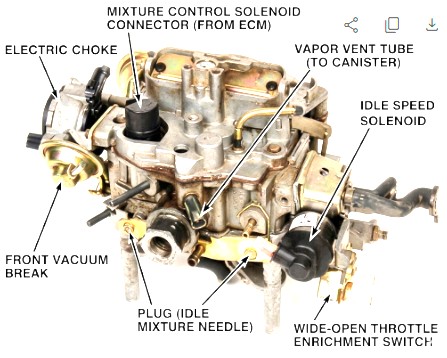
- Buick 3.8L (231") V6 California Automatic
- Chevrolet Passenger 3.8L (231") V6 California Automatic
- Oldsmobile 3.8L (231") V6 California Automatic
- Pontiac 3.8L (231") V6 California Automatic
Rochester Dualjet Carburetor FAQ
Q: What is the Rochester Dualjet carburetor?
A: The Rochester Dualjet is a two-barrel (2GC) carburetor produced by Rochester Products, a division of General Motors. It is designed to provide efficient fuel delivery and improved throttle response in a compact package, commonly found on many GM vehicles from the mid-1970s through the 1980s.
Q: What makes the Dualjet carburetor unique compared to other carburetors?
A: Unlike conventional two-barrel carburetors, the Dualjet features two identical primary venturis and omits the secondary barrels entirely, making it lighter, simpler, and easier to service. It offers a good balance between performance and fuel economy for small- and mid-size engines.
Q: Which vehicles commonly used the Rochester Dualjet carburetor?
A: The Dualjet was used on various General Motors cars, including Chevrolet, Pontiac, Oldsmobile, Buick, and GMC light trucks, especially during the late 1970s and 1980s.
Q: How does the choke system work on the Dualjet carburetor?
A: The Dualjet can use either a manual or automatic choke. The automatic choke typically operates with a thermostatic spring (sometimes heated by an electric element or hot air from the manifold), closing the choke plate for cold starts and gradually opening it as the engine warms up.
Q: What are the main adjustments on the Rochester Dualjet?
A: Typical adjustments include idle speed, idle mixture screws, and (on some models) the choke and fast idle. Float height, accelerator pump stroke, and the choke pull-off are also adjustable according to the vehicle’s service manual.
Q: What are common symptoms of a faulty Dualjet carburetor?
A: Common symptoms include rough idle, stalling, poor acceleration, hard starting, excessive fuel consumption, or hesitation during throttle application. These issues often relate to clogged jets, vacuum leaks, incorrect adjustments, or worn components.
Q: How do you clean and maintain a Rochester Dualjet carburetor?
A: Regular maintenance includes checking and adjusting the float, inspecting the accelerator pump, and cleaning all jets, passages, and filters. During a rebuild, all gaskets and rubber components should be replaced using an appropriate kit, and all parts should be cleaned with carburetor-safe solvent.
Q: Are there any special considerations when rebuilding a Dualjet carburetor?
A: Yes. Always use new gaskets, O-rings, and rubber parts from a quality rebuild kit. Avoid using metal tools to clear jets or passages, as this may damage them. Pay attention to float settings and ensure all linkages move freely.
Q: Where can I find more detailed instructions or diagrams for the Rochester Dualjet?
A: Detailed service procedures, exploded diagrams, and specifications are available in the official service manual and reputable sources such as carburetor-parts.com.
