
- Before proceeding:
- Set paking brake and block drive wheels
- Disconnect and plug hoses as directed on the emission control information label under the hood
- Check ignition timing as shown on the emmision contol label
- Connect dwell meter and tachometer as noted in your service manual
- Start the engine and run at idle until fuly warm
- NOTE: It is absolutely essential that the engine is operated for sufficient length of time to ensure the engine coolant sensor, and the oxygen sensor in the exhaust, are at full operational temperature
- Adjust curb idle speed if necessary. With engine idling in drive, observe dwell reading on the 6 cylinder scale. If varying somewhere within the 10-50* range, adjustment is correct. If not, perform the following:
- With engine off, remove staking around plug covering the idle air bleed valve and remove plug. Discard plug after removal
- While idling in drive, slowly turn valve up or down until dwell reading varies within the 25-35* range, attempting to be as close to 30* as possible.
- CAUTION: Perform this step carefully. The idle air bleed valve is very sensitive and should be turned only in 1/8 turn increments.
- If after adjusting, the dwell reading is not within the 25-35* range, it will be necessary to remove the carburetor to gain access to the plugs covering the idle mixture needles, and readjust the idle mixture.
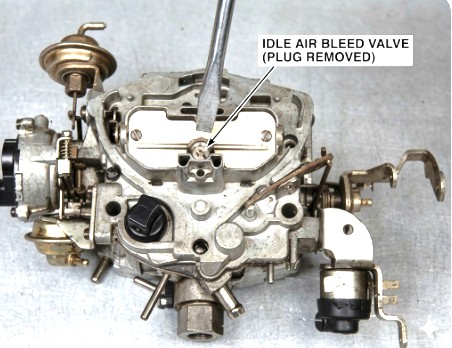
What is the Air Bleed For?
On a Rochester Dualjet (specifically the electronic E2ME or E2MC models found in many late 70s and 80s GM vehicles), the Idle Air Bleed Valve is a critical component used to fine-tune the engine's air-to-fuel ratio at idle.
Think of it as a "fine-adjustment" screw for air. While the main fuel jets and mixture screws handle the bulk of the fuel delivery, this valve controls how much air is "bled" into the idle circuit to lean out or richen the mixture.
Key Functions
-
Emissions Control: It works in tandem with the Mixture Control (MC) Solenoid. While the solenoid pulses to move fuel metering rods up and down, the idle air bleed valve provides a manual baseline adjustment for the air side of that equation to keep emissions within spec.
-
Idle Quality: It allows you to stabilize a rough idle by adjusting the air-fuel "dwell" (the ratio of time the solenoid is in the rich vs. lean position).
-
Correction for Wear: As an engine ages or develops minor vacuum leaks, this valve can be used to compensate and bring the idle mixture back to the "center" of what the computer (ECM) can control.
How it Works
-
Turning it IN (Clockwise): Decreases the amount of air bleeding into the system, making the idle mixture richer.
-
Turning it OUT (Counter-clockwise): Increases the air bleed, making the idle mixture leaner.
Why is there a "Plug"?
In your image, the "Plug Removed" note is significant because these were factory-sealed with a metal plug to prevent tampering. This was done to ensure the car stayed compliant with EPA emissions standards. Mechanics would only remove the plug during a major overhaul or if the engine could no longer reach its "dwell" specifications (usually 30° on a 6-cylinder scale).
Pro Tip: This valve is extremely sensitive. If you are adjusting it, only move it in 1/8 turn increments while monitoring a dwell meter or a high-quality vacuum gauge.
