
Quadrajet Accelerator Pump Circuit
Engine Hesitates
- Accelerator pump itself may be bad. The cup curled, or is damaged. Some chemicals added to the fuel, or left in the carburetor can cause this. Letting the engine sit for months at a time is a sure way to damage the pump cup
- Do a quick test of the accelerator pump circuit.
- The pump passage way to the main discharge may be plugged.
- Check ball is missing from the main discharge.
- Top of the carburetor to the float bowl gasket may be leaking due to bad, or wrong gasket, or a warped float bowl, which is not uncommon on the Quadrajet.
- Check the float level.
- Carburetor mounting bolts are loose.

Quadrajet Electronic Version Accelerator Pump
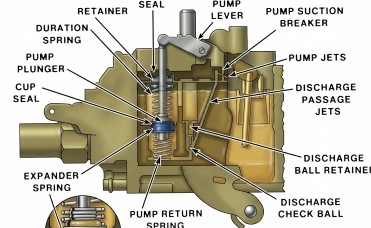
During quick accelerations when the throttle is opened rapidly, air flow through the carburetor bores and intake manifold change almost instantaneously. However, the fuel, which is heavier, tends to lag behind causing a momentary leanness. To prevent this, the accelerator pump system is used to provide the extra fuel necessary for smooth acceleration.
The accelerating pump system consists of a spring loaded pump plunger and pump return spring (operating in a fuel well), fuel passage, discharge check ball, retainer, and pump jets (one in each bore).
An expander (garter) spring is used in the pump cup for constant pump cup to pump wall contact. The pump cup is of the "floating" design: i.e., the up and down movement of the cup on the plunger head either "seats" to provide a solid charge of fuel on the downstroke, or "unseats" on the filling of the pump well (upstroke). The cup remains unseated when there is no pump plunger movement which allows vapor to vent from the pump well.
The pump system operates as follows:
The pump plunger is operated by a pump lever on the air horn which is connected directly to the throttle lever by a pump rod or link.
During throttle closing, the pump plunger is forced upward in the pump well and fuel flows through a vertical slot located in the side of the pump well. It flows past the "unseated" pump cup to fill the bottom of the pump well and pump discharge passage.
When the throttle valves are opened, the pump rod and lever forces the pump plunger downward. The pump cup seats against the pump plunger head forcing fuel through the pump jets where it sprays into the venturi area of the carburetor bores.
The pump plunger duration spring is balanced against the pump well return spring so that a smooth, sustained charge of fuel is delivered during acceleration. The duration spring is selected by the factory to control the differences in rate of movement between the pump linkage and the plunger head for correct pump fuel delivery.
The pump discharge check ball seats in the pump discharge passage so that air will not be drawn into the pump passage during upward movement of the accelerator pump and prevent proper pump fill.
Movement of the pump lever also controls the position of the throttle position sensor plunger in the air horn (See description TPS under Main Metering System).
During higher air flow through the carburetor bores, a vacuum exists at the pump jets. A passage which is located just behind the pump jets leads to the top of the air horn to vent the pump fuel circuit outside the carburetor bores. This acts as a suction breaker so that when the pump is not in operation, fuel will not be pulled out of the pump jets into the venturi area. This insures a full pump stream when needed and prevents any fuel "pull-over" from the pump discharge passage.
A pump plunger stem seal and TPS plunger seal are included in the air horn assembly to reduce the possibility of fuel vapor losses to meet evaporative emission requirements. The retainers and seals must be removed from the air horn assembly whenever the air horn is to be submerged in carburetor cleaner.
FAQ: Rochester Quadrajet Carburetor Accelerator Pump Circuit
1. What is the purpose of the accelerator pump circuit in a Rochester Quadrajet carburetor? The accelerator pump circuit in a Rochester Quadrajet carburetor is designed to provide a temporary fuel enrichment to the engine during acceleration. This helps prevent hesitation or stalling by ensuring a smooth transition from idle to higher speeds.
2. How does the accelerator pump circuit work? When the throttle is opened rapidly, the accelerator pump is activated by a linkage that compresses the pump, forcing a measured amount of fuel directly into the carburetor’s throat. This extra fuel compensates for the momentary lean condition that occurs when the airflow into the engine increases suddenly.
3. What are common signs of a malfunctioning accelerator pump circuit? Common signs include hesitation or stumbling when accelerating, a rough transition from idle to higher speeds, and sometimes an audible backfire. These symptoms indicate that the engine isn't receiving the necessary extra fuel during acceleration.
4. How can I test the accelerator pump circuit in my Quadrajet carburetor? A simple test involves removing the air cleaner and observing the squirt of fuel from the accelerator pump nozzle inside the carburetor throat when the throttle is rapidly opened. If there is no squirt of fuel, the accelerator pump circuit may be malfunctioning.
5. What maintenance does the accelerator pump circuit require? Regular maintenance includes checking the condition of the pump diaphragm or piston, ensuring the nozzle and passages are clean and free of debris, and verifying that the linkage operates smoothly. Replacement of worn or damaged parts is also recommended as needed.
6. Can I replace or repair the accelerator pump circuit components myself? Yes, with basic mechanical skills, you can replace or repair components of the accelerator pump circuit. Kits are available that include necessary parts like the pump diaphragm, springs, and seals. However, care must be taken to ensure correct installation and adjustment according to the manufacturer's specifications.
7. Where can I find replacement parts for the Quadrajet's accelerator pump circuit? Replacement parts can be found at Mike's Carburetor Parts in the Rochester Quadrajet Accelerator Pump Section. Enter your carburetor number in the search box to find the correct parts for your carburetor.
8. How often should the accelerator pump circuit be serviced? Service frequency can depend on usage, fuel quality, and storage conditions. It's a good practice to inspect the accelerator pump circuit annually or anytime symptoms of a malfunction appear.
For detailed procedures, adjustments, and troubleshooting, always refer to the service manual specific to your vehicle and carburetor model. If you're unsure or uncomfortable performing maintenance or repairs, consulting a professional mechanic is recommended.
