
- Holley 885 Float System
- Holley 885 Idle Circuit
- Holley 885 Accelerator Pump Circuit
- Holley 885 Metering
- Holley 885 Troubleshooting Problems
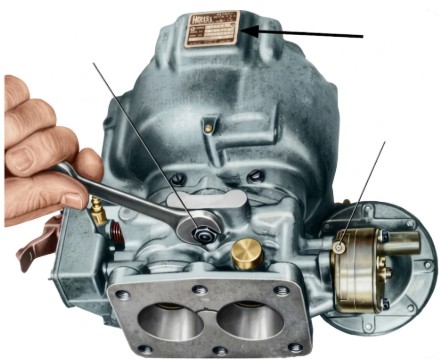
Holley 885-FFG Carburetor FAQ
Q: What is the Holley 885-FFG carburetor?
A: The Holley 885-FFG is a dual concentric downdraft carburetor designed for heavy-duty operation, especially on trucks and industrial engines. It features rugged construction and is engineered for reliability under severe conditions.
Q: What vehicles or applications commonly used the Holley 885-FFG?
A: This carburetor was commonly used on White Motor Company trucks and other heavy-duty vehicles produced in the 1950s and 1960s.
Q: How does the choke system work on the Holley 885-FFG?
A: The choke system is designed to enrich the air-fuel mixture during cold starts. It features a choke plate that restricts airflow, helping the engine run smoothly until it warms up. Always check for smooth operation of the choke linkage, as binding can cause hard starting or stalling.
Q: What are common symptoms of a carburetor problem with the 885-FFG?
A: Common symptoms include hard starting, rough idle, stalling, hesitation on acceleration, poor fuel economy, and flooding. Many of these issues are related to clogged passages, incorrect adjustments, or vacuum leaks.
Q: How do I adjust the idle on the Holley 885-FFG?
A: Idle adjustment is done by turning the idle adjusting needles for the highest steady manifold vacuum or smoothest idle. Adjust both needles equally, and then set the throttle stop screw to achieve the specified idle RPM. Final fine-tuning should be done with the engine fully warmed up.
Q: What maintenance is recommended for the Holley 885-FFG?
A: Routine maintenance includes cleaning the carburetor, replacing gaskets and seals with each overhaul, checking and adjusting the float level, cleaning the air cleaner, and inspecting all linkages. Avoid using harsh solvents on rubber or leather parts, and use only recommended carburetor cleaners.
Q: What should I do if the carburetor only runs with the choke closed?
A: This usually indicates a lean condition—often caused by clogged idle circuits, vacuum leaks, low float level, or a fuel delivery issue. Clean all fuel and air passages thoroughly, check for vacuum leaks, and ensure the float level is set to specifications.
Q: What are typical causes of rough idle or stalling in the 885-FFG?
A: Rough idle or stalling can be caused by improper idle adjustment, damaged or dirty idle needles, clogged idle tubes or air bleeds, vacuum leaks, or carbon deposits in the throttle bores. Cleaning, adjustment, and replacing worn parts are usually required.
Q: How do I properly clean and inspect the Holley 885-FFG?
A: Disassemble the carburetor and soak all metal parts (except bearings) in a carburetor-safe cleaning solution. Rinse with hot water, dry with compressed air, and avoid harsh tools that could damage the protective plating. Never soak rubber or leather parts in solvent. Inspect all passages with compressed air for blockage.
Q: Where can I find the correct float level and adjustment specifications?
A: Refer to the Holley service manual and catalog sheets for the proper float gauge and specifications for your exact 885-FFG model. Adjust the float by bending the lever as shown in the manual illustrations.
Q: What should I do if the accelerating pump is weak or inoperative?
A: Inspect the pump cup and linkage, clean the pump circuit, and replace any worn parts. Check the pump discharge valve and check balls for proper seating and operation, as outlined in the manual.
The main difference between the Holley 885-JJ and the Holley 885-FFG comes down to their internal configuration, upgrades, and how their governor/internal systems are designed for specific heavy-duty vintage truck applications.
Both belong to the same 2-barrel concentric "Teapot" family—where the fuel bowl is suspended inside the air horn to keep the fuel cool and prevent percolation—but they feature distinct design evolutions:
1. Internal Structure & Venturi Setup
-
885-JJ Series: This is an upgraded, later design. It is built as a true "twin carburetor" cast as one, fusing two distinct carburetor systems together.
It features completely individual venturi tubes, throttle plates, main metering circuits, and idling systems for each side, though they share a single central fuel and air chamber. -
885-FFG Series: This represents the earlier, more classic dual-concentric setup.
While it feeds two barrels, the layout of the internal pathways, metering, and fuel bowl transitions are cast differently compared to the reworked, modular architecture of the later JJ variants.
2. Throttle Bearings & Contamination Sealing
-
885-JJ: Features upgraded, enlarged throttle shaft ball bearings.
They provide a wider bearing surface for durability under heavy fleet use, and they are entirely shielded/sealed against dirt, dust, and humidity, meaning they never require external lubrication. -
885-FFG: Utilizes the older style throttle shaft configuration and standard bushings, which are more prone to wear, vacuum leaks, and moisture intrusion over decades of service.
3. Governor & Control Integration
-
885-FFG (Flyball/Integral Governor): The "FFG" designation explicitly calls out its native design for an integrated mechanical or velocity-style governor setup common on early heavy-duty International Harvester (like the Red Diamond RD372, 406, 450) and Continental engines.
-
885-JJ: Reworked the governor linkages. The external throttle lever is built much more robustly and is completely isolated on the opposite side of the carburetor from the governor compartment. Specific subsets of the JJ series (like the JJSG or JJG) switch over to the Holley Centri-Vac governor system, which relies on an external distributor-driven centrifugal valve rather than purely integral mechanical throttle-body pieces.
4. Anti-Dieseling Mechanism
-
885-JJ: Many models in this series come equipped with an integrated electric anti-dieseling solenoid.
It connects to a dashboard switch to instantly shut down fuel/air flow to prevent the heavy truck engine from "running on" after the ignition key is turned off. -
885-FFG: Relies on standard idle-stop configurations of its era, lacking this specific electric solenoid integration.
Summary for Rebuilding
If you are hunting for parts or a rebuild kit, keep a close eye on your carburetor's stamped List Number. Because the internal castings, gaskets, and throttle body pathways differ, their rebuild kits do not entirely cross over. For instance, an 885-FFG typically takes a kit like the K7127, whereas standard 885/JJ variations require their own specific gasket shapes to properly seal the concentric float bowl to the main body cover.
