How the Holley 885 Idle Circuit Works?
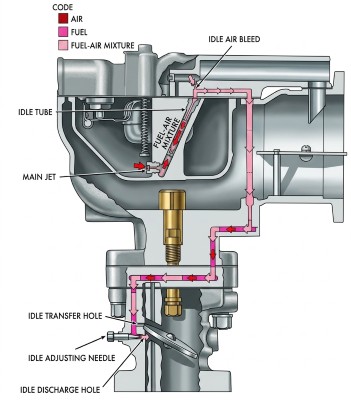
Holley 885 Idle System


At normal cruising speeds, a pressure differential within the venturi causes the main metering system to discharge fuel. However, at idle and low speeds, the engine does not draw sufficient air through the venturi to create a pressure differential strong enough to operate the main metering system. The idle system provides the required fuel for efficient operation while low speed or idle conditions exist. At idle and low speeds, intake manifold vacuum is high, due to the almost closed throttle plates which greatly restrict air flow into the manifold. This high manifold vacuum provides a pressure difference which will operate the idle system.

There are 2 idle passages on the Holley 885, one for each barrel.
At idle, the normal air pressure in the float chamber causes fuel to flow through the idle system to greatly reduced pressure area below the throttle plates. Fuel flows from the float chamber through the main jet and into the bottom of the main well. From the main well, it flows into the idle well. The fuel moves upward through the idle tube in the idle well and passes in to the idle passage in the main body. Directly above the horizontal channel at the top of the idle passage in the main body is the idle air bleed in the main body cover. The air bleed acts as a vent so gas is not siphoned from the idle system and at the same time brings in air to mix with the fuel coming up from the idle tube.

It is very important to make sure the idle air bleed and the idle passage are clear.

After the idle air/fuel is mixed it travels down the idle passage, pulled by manifold vacuum and out the idle discharge hole.

As the engine is starting to rev up the idle transfer hole is uncovered by the throttle valve allowing an additional air/fuel mixture to enter the intake. This is used until the accelerator pump circuit takes over.

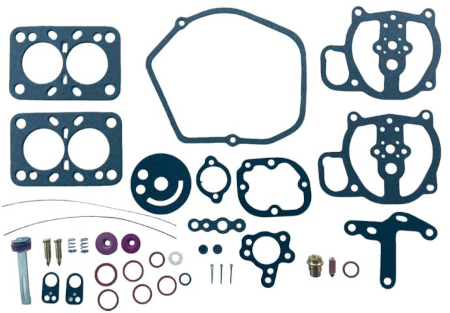
Buy Holley 885 Carburetor Kits

Holley 885 Idle Circuit

How to Adjust the Holley 885 Idle Mixture?

  1. Locate the idle mixture screws on the carburetor. They are typically located on the metering block or the base plate of the carburetor.

  2. Start the engine and let it warm up to operating temperature.

  3. Turn the idle speed screw to set the idle speed to the manufacturer's recommended RPM.

  4. Using a vacuum gauge or a tachometer, adjust the idle mixture screws until the highest vacuum reading or smoothest idle is achieved.

  5. To adjust the idle mixture screws, turn them in (clockwise) until the engine begins to stumble, then turn them out (counterclockwise) until the engine begins to stumble again. Then, turn the screws back in halfway between these two points.

  6. Repeat the process for the second idle mixture screw.

  7. Once you have adjusted both screws, recheck the idle speed and adjust it as needed.

It's important to note that if the idle mixture screws have been tampered with or if the carburetor has been modified, these steps may not apply, and adjustments may need to be made differently. Also, always refer to the manufacturer's instructions for your specific carburetor model.
Can't find what you need? Contact Us
TOP
Logo