
This video gives a brief overview of the Rochester 2G power circuit. Read below for more details.
HOW IT WORKS
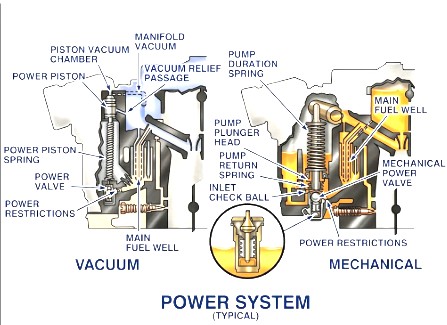
How the Power Circuit Works?
The Rochester 2-Jet carburetor utilizes a dual-action power circuit to provide the necessary fuel enrichment for demanding engine conditions.
1. Vacuum-Sensitive Power System (Light Duty)
- Components: This system primarily involves a power piston and a power valve.
- Operation: Under light engine loads, manifold vacuum is high, holding the power piston in an upward position. When engine load increases and manifold vacuum drops to a predetermined level (indicating a need for more power), spring tension pushes the power piston downwards.
- Fuel Enrichment: This downward movement unseats the power valve plunger, allowing additional fuel to enter the carburetor's main discharge system. This enriches the air/fuel mixture, providing the extra fuel needed for light acceleration or uphill climbs.
2. Mechanically Actuated Power Valve (Moderate to Heavy Loads
- Location: An additional power valve is situated at the bottom of the accelerator pump well.
- Actuation: This valve is mechanically operated by the accelerator pump plunger.
- Purpose: During moderate to heavy engine loads, when the accelerator pedal is depressed further, the accelerator pump plunger not only delivers an initial squirt of fuel but also simultaneously actuates this second power valve. This provides further fuel enrichment beyond what the vacuum-sensitive system alone can supply, ensuring strong performance under higher demands.
Combined System & Calibration
The Rochester 2-Jet's power circuit integrates both vacuum and mechanical power systems. This combination is precisely calibrated at the factory to deliver the optimal air/fuel mixtures required for specific engine applications. No special field adjustments are necessary for the power circuit components after installation.
TECHNICAL HELP
Be sure the piston rod isn't bent. It needs to press straight down on the power valve.
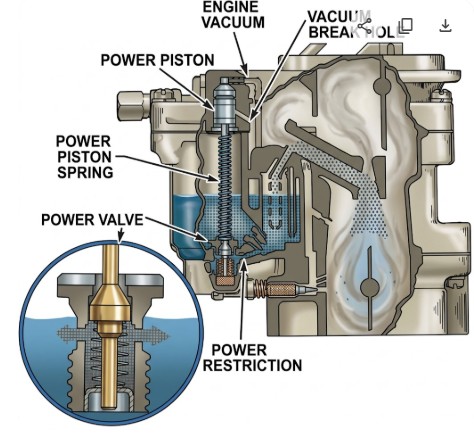
How To Remove The Power Piston?
Removing the power piston from a Rochester 2-Jet (2G, 2GC, 2GV) carburetor typically involves disassembling the carburetor's top section to gain access. The exact method can depend slightly on how the power piston's retainer is secured.
Here's a general guide:
Important Pre-steps:
- Disassemble the Carburetor: You'll need to remove the carburetor from the engine and then carefully separate the air horn (top cover) from the main body. This usually involves removing several screws around the perimeter of the air horn and detaching any linkage (choke, accelerator pump) that connects the air horn to the main body.
- Work in a Clean Area: Use a clean workbench and consider placing parts in a tray or container to prevent small components from getting lost.
Steps to Remove the Power Piston:
-
Locate the Power Piston: Once the air horn is separated from the main body, the power piston assembly is typically located within the air horn (or bowl cover) itself, visible from the underside when the air horn is inverted. It usually consists of a piston, a spring, and a power valve at its base.
-
Identify the Retainer Type:
- Pressed-in or Unstaked: In some cases, the power piston assembly might simply be held in by friction or a lightly pressed-in retainer.
- Staked: Often, the retainer (a washer-like component that holds the power piston in place) is "staked" into the casting. This means small dimples or indentations have been made in the surrounding metal to hold the retainer securely.
-
Removal Method:
-
For Unstaked or Lightly Held Pistons:
- With the air horn inverted, you can often grasp the power piston assembly (specifically the piston portion) with a pair of pliers.
- Carefully and firmly pull the piston straight out from its housing.
-
For Staked Pistons (More Common):
- Identify the Staking: Look closely at the metal around the edge of the retainer washer. You will see small, raised burrs or indentations where the casting has been peened over to secure the retainer.
- Remove the Staking (Carefully!): This is the most delicate part. You will need to gently and carefully remove or flatten these staked points to release the retainer.
- Small Punch/Dremel (Very Fine Bit): Some mechanics use a very small, sharp punch or a tiny grinding bit on a Dremel tool to gently remove or flatten the staked areas. The goal is only to clear the retainer, not to damage the housing itself.
- Repeated Pressing (less common for heavily staked): Some guides suggest repeatedly pressing the spring-loaded rod of the power piston down and allowing it to snap back up. If the staking is light, this repeated action might eventually loosen and pop the piston free. However, for heavily staked retainers, this is unlikely to work and could damage the piston.
- Extract the Piston: Once the staking is sufficiently relieved, grasp the power piston with pliers and carefully pull it out.
-
Important Notes:
- Take Pictures: Before and during disassembly, take plenty of photos from different angles. This will be invaluable during reassembly.
- Refer to a Rebuild Kit Diagram: Most Rochester 2-Jet rebuild kits come with an exploded view diagram. This diagram will clearly show the power piston and its retainer, helping you visualize its position and how it's held.
- Be Gentle: Carburetor castings are often old and can be brittle. Avoid excessive force, especially when dealing with staked components.
- Replacement: When installing a new power piston, ensure the new retainer (if supplied) is properly seated. Many kits include a new retainer which may need to be lightly staked in place again using a small punch to ensure it remains secure.

REPLACEMENT PARTS
Replacement power pistons are avialable for some Rochester 2g carburetors. You need to compare the dimensions provided to be sure you're ordering the correct one. Some 2G carbs use a different power piston that is not available.

The power valve sits on the bottom of the 2 Jet carburetor, between the 2 main jets.
This is for the early 2 Jet carburetors. Part #56-2. 5/16" threaded end.
Even though they look the same, this power valve does not work on the marine 2 jet carburetors, thought we have had customers modify the power valve to work.

There are 3 other power valves to consider.
This power valve is for the later Rochester 2 Jet carburetors. Part 56-41. 3/8" threaded end.

This power valve is also for the later 2 Jet carburetors. Part 56-40 . 3/8" threaded end, with the cone head.

This is the power valve for the Mercarb, 2 BBL marine carburetor. 56-22
These fit the Mercarbs only, not the marine 2G carbs.

