
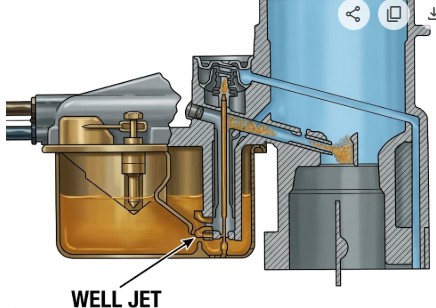
Some units use a well jet in addition to the step-up rod jet. The well jet is located in the bottom of the bowl next to the step-up jet. Other models use an additional fuel feed called the “constant feed.” This is a metered bushing pressed into the casting and allows a calibrated amount of fuel to flow from the bowl into the well at all times.
The well jet (often referred to as the main well jet) on a Carter RBS (Single-Barrel) carburetor plays a critical role in the transition between the idle circuit and the high-speed circuit.
Here is a breakdown of its primary functions:
1. Fuel Metering for the Main System
The well jet is essentially an orifice that meters the amount of fuel entering the main well. As the engine speed increases and the throttle plate opens, the vacuum (pressure drop) created in the venturi begins to pull fuel through this jet. It ensures that the engine receives a calibrated amount of fuel relative to the airflow.
2. Air Bleeding and Atomization
The well jet works in conjunction with a well tube (or emulsion tube). As fuel passes through the jet into the well, air is introduced through air bleeds. This "pre-mixes" the fuel with air, creating an emulsion. This process:
-
Makes the fuel lighter and easier to lift through the discharge nozzle.
-
Ensures better atomization (breaking the fuel into a fine mist) for more efficient combustion.
3. Maintaining the Fuel Curve
By sizing the well jet specifically, Carter engineers "tuned" the carburetor to maintain a consistent air-fuel ratio across different RPM ranges. If the well jet is clogged or the wrong size, you will typically notice:
-
Lean stumble: If the jet is too small or restricted.
-
Excessive richness: If the jet has been modified or "drilled out" too large.
Common Maintenance Tip
Since the Carter RBS is a compact, "low-profile" carburetor, the well jet and its surrounding passages are relatively small. Over time, old fuel can turn into varnish and restrict this jet. If your engine idles fine but bogs or "starves" as soon as you try to accelerate to cruising speeds, a restricted well jet is a likely culprit.
