
Hard Starting
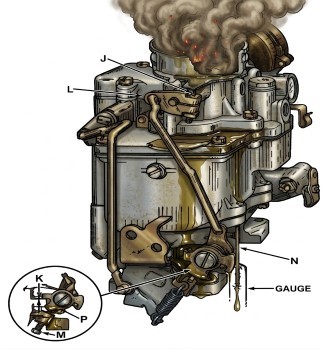
- Choke valve not closing. Is the thermostat closing the valve?
- Look down the carburetor and press the throttle once. You should see gas squirt into the bore. If not, then the accelerator pump circuit is the problem, or there just isn't any gas in the float bowl. When cold the accelerator pump will squirt extra gas into the intake facilitating the cold start.
- Does the engine smell gassy? It might be flooding, or way too rich.
- After turning off the engine look down the carburetor. There should be no gas dribbling out of the venturi. If there is then you have a float bowl vent problem, or a leaky main discharge.
- After the engine is hot and turned off, the carburetor gas may be boiling over causing the float bowl to empty. You would probably smell gas at shut down.
- If you think the engine is flooded then start by holding the throttle fully to the floor and crank the engine for 5 seconds. You may have to do this several times but keep in mind you can burn out the starter if you crank too much.
- Is the choke valve open all the way?
- The fuel filter is plugged. Should be changed every 6 months under normal driving conditions.
- If the car has been sitting for months, then the gas as probably turned to varnish and coated the inside of the carburetor, fuel lines and gas tank. You will most likely smell the varnish.

Flooding, or Running Rich
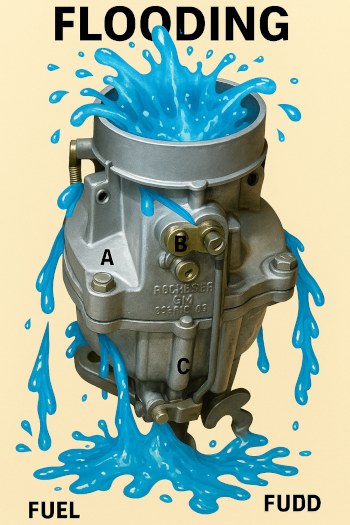
Why is My Carter WCD Carburetor Flooding?
A flooding carburetor is more than just a nuisance; it’s a fire hazard and a major performance killer. If you see fuel dripping from the venturis or coming out of the top of the air horn, your WCD is "overflowing" its fuel bowl.
Here are the most common culprits and how to fix them.
1. Dirty or Damaged Needle & Seat
This is the number one cause of flooding. The needle and seat act as a valve; if it doesn't close completely, fuel keeps pumping into the bowl.
The "Pressure" Mistake: Be extremely careful when adjusting your floats. If you apply pressure to the float while the needle is in the seat, you can easily "ring" or dent the Viton tip (or the brass seat), preventing a Viton-to-metal seal.
Contamination: Even a tiny speck of rust or dirt from the fuel line can lodge in the seat, holding the needle open.
The Test: With the air horn removed and the needle seated, apply light vacuum to the fuel inlet. It should hold steady.
2. Heavy or Leaky Floats
The WCD uses two floats. If they don't stay buoyant, they won't lift the needle into the seat to shut off the fuel.
The "Hot Water" Test: Submerge your brass floats in a bowl of very hot water. The heat expands the air inside; if there is a pinhole leak, you will see a steady stream of bubbles.
Fuel-Logged Floats: If you have older "nitrophyl" (black foam) floats, they can become saturated with modern ethanol fuels over time. If they feel heavy or "soggy," they must be replaced, as they will sit too low in the fuel.
3. Excessive Fuel Pump Pressure
Modern replacement fuel pumps are notorious for putting out too much "muscle" for vintage carburetors.
The Spec: For a Carter WCD, your pressure should ideally be between 3.0 and 4.5 lbs.
The Problem: Many new mechanical pumps put out 7 lbs or more. This creates enough force to physically push the needle off the seat, regardless of how well your float is set. If you have a new pump, testing the pressure with a gauge is a mandatory first step.
4. Incorrect Float Level
If the float level is set too high, the fuel level in the bowl will be too close to the top of the nozzles.
Setting the WCD: On the WCD, you generally measure from the top of the float to the underside of the air horn (with the gasket removed). Check your specific kit instructions for the exact fraction (often 1/4" or 3/16"), as it varies by application.
Binding: Ensure the float arms move freely on the hinge pin. If the arms are rubbing against the side of the bowl, the float can get "stuck" in the down position.
5. Solder Weight (Unique to Brass Floats)
If a previous owner tried to repair a leaky brass float with a soldering iron, they may have added too much weight. A "heavy" float—even if it doesn't leak—will sit lower in the fuel and cause the bowl to overfill. When in doubt, compare the weight of both floats on a gram scale.

Pro Tip for WCD Owners
When reassembling the air horn, ensure the accelerator pump plunger is moving smoothly in its bore. A binding pump arm can sometimes interfere with the float's natural travel.
