
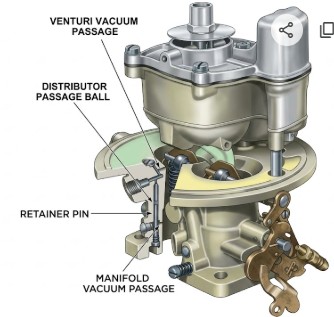
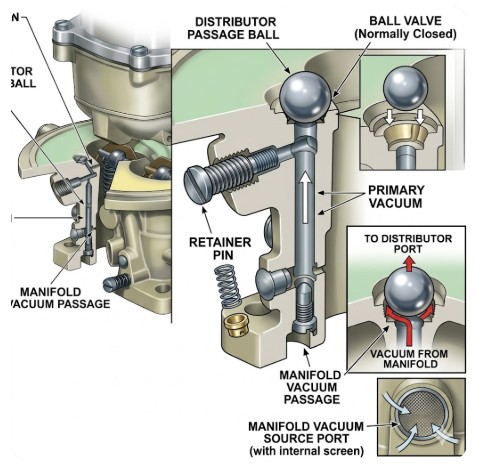
The Holley 1901, famously used on 1950s Ford "Y-block" V8s, is technically unique because it utilizes the Loadamatic ignition system. Unlike most carburetors, which just provide a "ported" vacuum signal to a distributor that has its own internal weights, the 1901's vacuum passages are the entire brain of the engine's timing.
Here is how those passages collaborate to keep your engine running smoothly.
1. The Dual-Signal Design
The 1901 doesn't rely on just one type of vacuum. It blends two signals to "calculate" exactly what the engine is doing:
Venturi Vacuum (Speed Signal): Taken from the narrowest part of the carburetor throat. As engine RPM increases and more air rushes in, this vacuum gets stronger.
Manifold Vacuum (Load Signal): Taken from below the throttle plates. This is strongest when the throttle is closed (idling or coasting) and drops to near zero when you floor it (high load).
2. The Mixing Chamber and Ball Check
Inside the main body, these two passages meet. In your earlier diagram, you noticed the Distributor Passage Ball.
This ball acts as a one-way check valve.
It ensures that the vacuum signal sent to the distributor is always the "dominant" one needed for that specific moment.
If you are at high speed (high Venturi vacuum) but low load (high Manifold vacuum), the ball helps balance these pressures so the distributor receives a steady, high-vacuum signal to advance the timing for fuel economy.
3. The Spark Control Valve (The Regulator)
The most critical part of this system is the Spark Control Valve, usually located on the side of the throttle body.
