
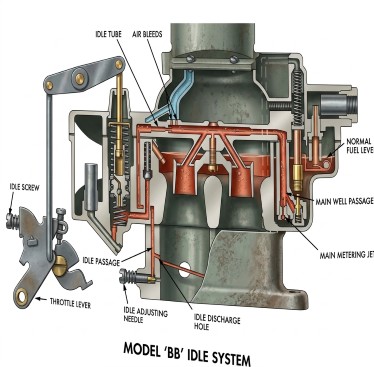
Using the specific path you outlined, here is exactly how the fuel and air travel through the Rochester B series carburetor to maintain a smooth engine idle.
When the engine is idling, the throttle plate is nearly closed, which cuts off air velocity through the center of the carburetor. Because of this, the carburetor relies entirely on high manifold vacuum beneath the throttle plate to draw fuel through this dedicated circuit.
The Rochester B Idle Circuit Path
1. From Bowl to Main Well Support
The journey begins at the bottom of the float bowl. Manifold vacuum pulls liquid fuel from the bowl directly through the main metering jet. From there, the fuel flows into the bottom of the main well support assembly.
2. Up to the Air Horn Crossbar
Because of the strong vacuum signal pulling from the bottom of the carburetor, the solid liquid fuel is forced upward. It travels out of the main well and flows up into the channels located in the air horn crossbar (the casting that spans across the top of the carburetor barrel).
3. Air Bleeding Above the Nozzles
Before the fuel goes any further, it needs to be broken down. Air entering the top of the carburetor is drawn into the calibrated air bleeds, which are located just above the main discharge nozzles. This atmospheric air mixes directly with the solid liquid fuel, turning it into a frothy, highly atomized air-fuel emulsion.
4. Passing Through the Calibrated Idle Tube
This newly mixed air-fuel emulsion is then drawn through the restricted tip of the calibrated idle tube. This tube regulates the exact volume of pre-mixed emulsion allowed to pass forward into the rest of the idle circuit.
5. Down to the Throttle Body
After exiting the idle tube, the emulsion travels horizontally across the air horn and enters a vertical downward passage cast into the float bowl body. It travels all the way down this channel until it reaches the base of the carburetor at the throttle body.
6. Metering by the Idle Mixture Screw
Once the emulsion reaches the bottom of the throttle body, it arrives at the idle discharge hole located right below the closed throttle plate. The volume of this air-fuel mixture entering the engine intake manifold is strictly controlled by the tapered tip of the idle mixture screw.
-
Turning the screw in (clockwise) restricts the passage, leaning out the idle.
-
Turning the screw out (counter-clockwise) opens the passage, enriching the idle mixture.
The Off-Idle Transition
Just above the idle mixture screw sits the off-idle slot (or ports). When you are completely off the gas pedal, air actually enters these upper ports to blend with the idle mixture. However, the second you crack the throttle plate open, these ports are exposed to manifold vacuum, instantly discharging extra fuel to keep the engine from stumbling before the main nozzle takes over.
