
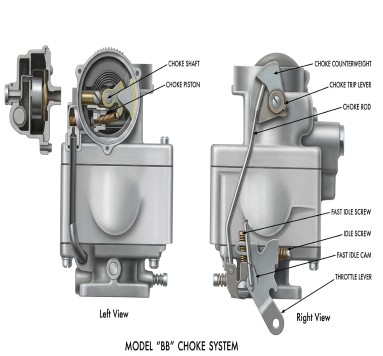
The Rochester Model "BB" Choke System
The Rochester Model "BB" carburetor utilizes a fully automatic choke designed to ensure proper engine starting and smooth driving during cold weather operation
Core Components and Controls
The automatic choke system is composed of several key parts:
-
A thermostatic coil
. -
A choke piston
. -
An offset choke valve
. -
Fast idle cam linkage
.
The system's operation is dictated by a combination of intake manifold vacuum, atmospheric temperature, the physical offset of the choke valve, and heat drawn from the exhaust manifold
Operational Phases
-
Cold Starting: When the engine is cold, the thermostatic coil's calibration holds the choke valve closed
. As the engine cranks, air velocity pushes against the offset choke valve, forcing it to open slightly against the coil's torque . Simultaneously, intake manifold vacuum pulls on the choke piston to open the valve further . The choke valve settles where the vacuum pull and air velocity balance against the coil's torque, providing a richer fuel mixture for starting . -
Warm-Up Period: As the engine warms up, hot air from the exhaust manifold "stove" is drawn into the thermostatic coil housing
. This temperature rise causes the coil to slowly relax its tension, gradually allowing the choke valve to reach the full open position . -
Dynamic Adjustments: The choke piston modifies the choking action during warm-up to account for engine loads
. If vacuum decreases due to acceleration or increased road load, the thermostatic coil momentarily closes the choke valve further to provide a richer mixture . To prevent stalling, a fast idle cam linked to the choke shaft holds the throttle valve open slightly, raising the engine's RPM until the choke fully opens . -
Choke Unloader (Dechoking): To relieve a flooded carburetor, the system features a mechanical unloader
. If the driver fully depresses the accelerator, a tang on the throttle lever contacts the fast idle cam linkage, mechanically opening the choke valve to allow extra air into the manifold .
The Choke Modifier
Some Model "BB" carburetors incorporate an additional component called a choke modifier
-
Its primary purpose is to prevent the engine from "loading up" (receiving excessively rich mixtures) during the warm-up period
. -
The modifier is linked directly to the throttle
. -
If a cold engine experiences a wide throttle opening (such as driving up a steep hill), there may not be enough vacuum to draw sufficient heat to relax the coil
. The throttle movement actuates the modifier, which mechanically rotates the thermostatic coil, relaxing its tension and opening the choke valve enough to prevent loading up .
Troubleshooting and Maintenance Guidelines
When servicing, disassembling, or troubleshooting the Model "BB" choke system, the bulletin specifies the following procedures to ensure proper operation:
-
Cleaning Precautions: You must never immerse the choke coil and housing in carburetor cleaning solvent
. -
Component Inspection: Inspect the choke shaft for wear within its bores; if it is worn excessively, the part must be replaced
. -
Vacuum Integrity: Ensure the 1/2" brass fitting on the choke suction tube is tight
. The choke suction tube nut must be tightened securely to the choke housing to prevent any loss of vacuum . Additionally, inspect the suction tube nut packing; if it is compressed or out of round, it must be replaced . -
Assembly Alignment: When reinstalling the thermostatic coil and cover, you must rotate the cover until the index marks on the cover and the choke housing are perfectly aligned
. -
Linkage Positioning: When installing the trip lever, ensure its tang rests on top of the counterweight tang when the choke valve is fully open
. -
Free Movement: After assembly, always check the choke valve to ensure it moves freely without binding
. -
Fast Idle Cam: Inspect the steps of the fast idle cam for wear
. If wear is present, it should be replaced, as it can disrupt the engine's idle speed during the choking period .
