
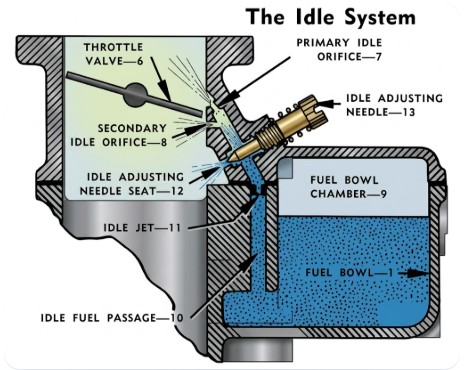
This illustration shows the Marvel Schebler's idle circuit. When the throttle valve #6 is at the position between #7 & #8. This creates a vacuum that pulls fuel from the fuel bowl #1 up through the idle passage #10 and into the throttle bore. This is calibrated by going through the idle jet #11 and the idle adjusting needle #13. At the idle adjusting needle air in mixed with the fuel and air is also mixed with the fuel at the secondary idle orifice #8. The throttle valve does not completely close at idle.
Understanding the Marvel Schebler Carburetor Idle System
The idle system in a Marvel Schebler carburetor plays a critical role in maintaining smooth engine operation at low RPMs or when the throttle is nearly closed. Without it functioning properly, engines may stall, stumble, or run too lean when idling. Here's how the system works and what to watch out for.
How the Idle System Works
When the throttle plate is closed during idle, airflow through the venturi is minimal—too little to draw fuel through the main discharge nozzle. The Marvel Schebler carburetor solves this by routing fuel through a dedicated idle circuit.
Key components of the idle circuit:
-
Idle Jet: Meters the fuel specifically for low-speed operation.
-
Idle Air Bleed: Mixes air with fuel before delivery to improve atomization.
-
Idle Passage: Delivers the air-fuel mix downstream of the throttle plate.
-
Idle Discharge Ports: Small openings near or just below the throttle plate that release the fuel mixture into the intake stream.
Secondary Idle Orifice: When slightly off idle this port introduces more fuel to get over the idle hump.
Fuel is drawn from the float bowl, metered through the idle jet, mixed with air from the idle bleed, and then flows through internal passages. At idle, fuel exits through the idle discharge hole and the transition port, ensuring a smooth and steady idle.
Common Idle Issues and Causes
-
Rough Idle: Clogged idle passages or air leaks around the throttle shaft can cause erratic engine behavior.
-
No Idle: A completely blocked idle jet or passage may prevent fuel from reaching the engine at low throttle.
-
Rich/Lean Idle: Incorrect idle mixture screw settings or vacuum leaks can upset the fuel-air ratio.
Diagnosing Idle System Problems
If your engine idles poorly, here are a few troubleshooting steps specific to the Marvel Schebler idle system:
-
Remove and inspect the idle jet for blockages or corrosion.
-
Spray carb cleaner through the idle passages to verify flow.
-
Check for vacuum leaks at the throttle shaft or intake manifold.
-
Inspect the throttle plate alignment—misalignment can prevent proper idle port function.
-
Adjust the idle mixture screw slowly to achieve highest smooth idle.
Final Thoughts
The Marvel Schebler idle system may appear simple, but its performance is vital to engine smoothness and drivability. Regular cleaning and correct tuning ensure that your carburetor functions as designed. If you're rebuilding a Marvel Schebler unit, pay close attention to the idle circuit passages and components.

