Many things that have been done to lower emissions have enhanced the possibility of dieseling. Higher idle speeds, leaner air-fuel mixtures, retarded ignition timing, higher operating temperature, all contribute to dieseling.
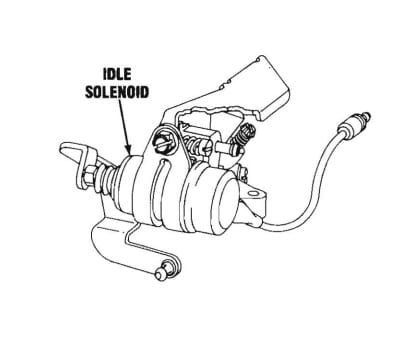
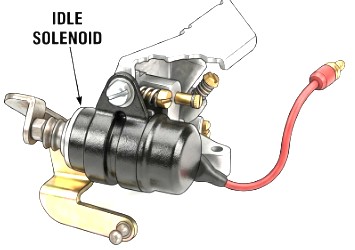
When the ignition is turned on, the solenoid is energized moving the plunger outward. The idle RPM is adjusted at the solenoid. When the ignition is turned on, the solenoid is energized moving the plunger outward. The idle RPS is adjusted at the solenoid. When the ignition is turned off the solenoid is de-energized, the plunger moves inward allowing the throttle valve to close enough to virtually shut off the air supply, causing the engine to stop running immediately.
IDLE SPEED AND MIXTURE
If the idle limiter cap has been removed, refer to the Car manufacturer's service manual for the proper idle mixture procedure.If not available make temporary adjustment as follows:
1. Check ignition timing.
2. With engine at normal operating
temperature, air conditioner turned off. Headlights
turned on, and auto. transmission in "Drive""
3. With the aid of a tachometer adjust throttle
speed screw (L) to the RPM specified on tune-up
decal in engine compartment. NOTE: On models
equipped with the (throttle solenoid) adjust the
throttle speed screw (L) to obtain 500 RPM with
the solenoid wire disconnected at the bullet connector, and transmission in "neutral."
4. Connect the solenoid wire, open throttle and
release to allow the plunger of solenoid to extend
and open throttle.
5. Adjust plunger screw (M), or on late models
adjust the solenoid in or out of bracket to the RP