
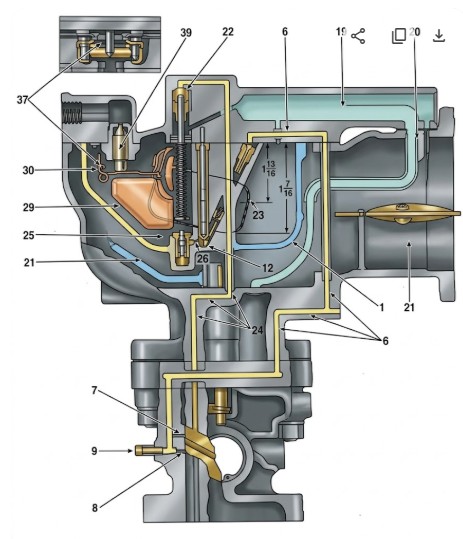
 The content of this guide primarily focuses on the latest versions of the 885-JJ Series Holley Carburetor. Still, much of the content is relevant for both older and newer models of the 885-JJ Series. While all these carburetors share a similar foundation, there are distinctions among specific versions. This manual aims to address the entire 885 range.
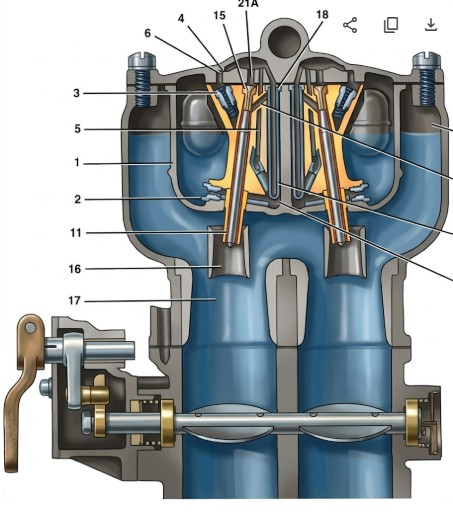
The Holley variants, namely 885-JJS, 885-JJSC, and 885-JJG, are dual-tube down-draft carburetors. Their metering jets and pathways are centrally positioned within the float bowl. This bowl is crafted as an independent component, nested inside the main body and attached to its top cover. Owing to this structure, the fuel remains cool as the primary air flow encircles the float bowl.
The float system includes an enhancement to boost its buoyancy. This is a compact, coiled spring that offsets excessive float movement due to a car's vibrations on uneven roads. Along with the central location of jets and channels, this ensures accurate fuel metering across all operational angles.
Fig B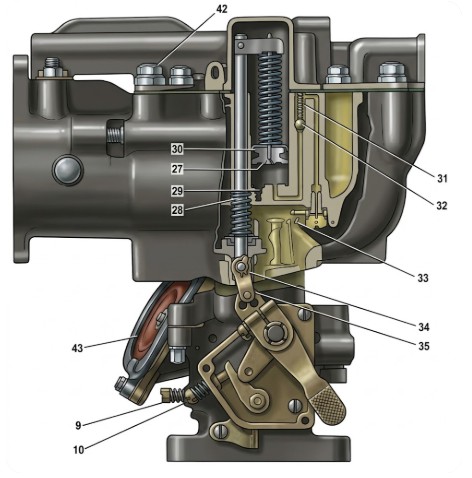
The external throttle lever boasts a robust design and is set apart from the main body. This lever is detached from the governor compartment and positioned on the carburetor's opposing side. (Refer to Figure C.)
Fig C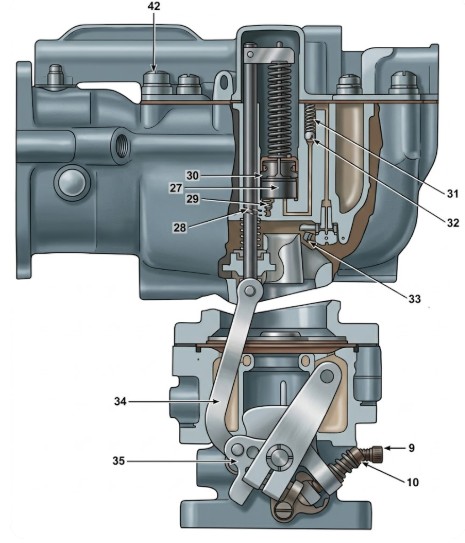
The initial throttle shaft ball bearings have been swapped for a similar but enlarged variant, offering more bearing surface. These bearings are entirely shielded from contaminants and humidity and don't need oiling.
The carburetor design ensures balance by drawing vents and bleeds from the airway in the float bowl and main body cover. This connects to the carburetor's main air inlet, ensuring only filtered air is inducted.
This twin carburetor essentially fuses two carburetor systems into one. It houses distinct venturi tubes, throttle plates, and individual main metering and idling mechanisms for each side. Both sides share a single air and fuel chamber.
FIG D
Its acceleration system features an adjustable pump activated by the throttle, dividing the fuel equally at its exit nozzle.
There's a unique vacuum-activated power valve catering to high speeds and demanding loads during full throttle and low-speed conditions.
Fig E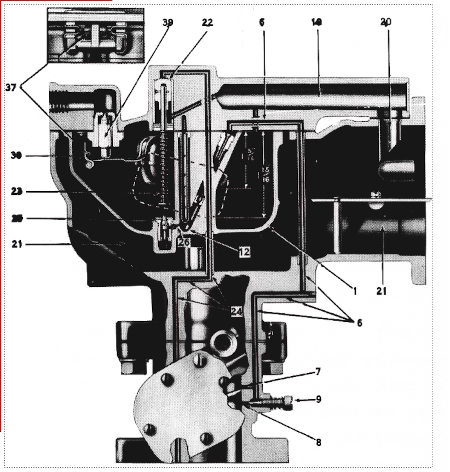
Certain 885-JJ Series Carburetors, specifically JJG & JJSG, utilize the Holley centri-vac governor. This governor has two parts: one integrated into the carburetor throttle body and the other connected to an accessory drive, typically the ignition distributor. Using engine vacuum for power, and a centrifugal valve linked to an accessory or distributor shaft for speed sensing, this governor offers mechanical governor features without intricate linkages. A dedicated service manual offers in-depth details on this governor.
Fig F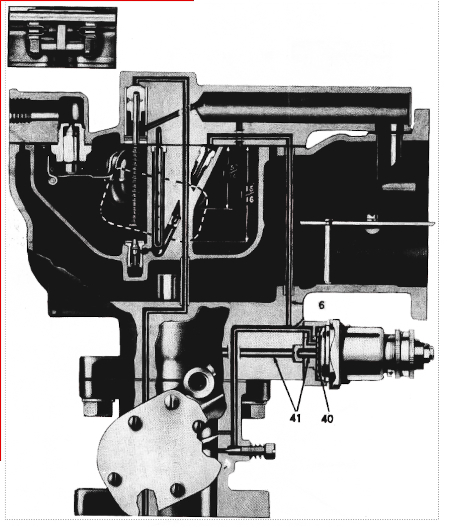
Some 88.5-JJ Series Carburetors come with an anti-dieseling mechanism. This tool, operated by a solenoid and controlled via a dashboard switch, halts the engine if it continues to run after the ignition is off.
The main difference between the Holley 885-JJ and the Holley 885-FFG comes down to their internal configuration, upgrades, and how their governor/internal systems are designed for specific heavy-duty vintage truck applications.
Both belong to the same 2-barrel concentric "Teapot" family—where the fuel bowl is suspended inside the air horn to keep the fuel cool and prevent percolation—but they feature distinct design evolutions:
1. Internal Structure & Venturi Setup
-
885-JJ Series: This is an upgraded, later design. It is built as a true "twin carburetor" cast as one, fusing two distinct carburetor systems together.
It features completely individual venturi tubes, throttle plates, main metering circuits, and idling systems for each side, though they share a single central fuel and air chamber. -
885-FFG Series: This represents the earlier, more classic dual-concentric setup.
While it feeds two barrels, the layout of the internal pathways, metering, and fuel bowl transitions are cast differently compared to the reworked, modular architecture of the later JJ variants.
2. Throttle Bearings & Contamination Sealing
-
885-JJ: Features upgraded, enlarged throttle shaft ball bearings.
They provide a wider bearing surface for durability under heavy fleet use, and they are entirely shielded/sealed against dirt, dust, and humidity, meaning they never require external lubrication. -
885-FFG: Utilizes the older style throttle shaft configuration and standard bushings, which are more prone to wear, vacuum leaks, and moisture intrusion over decades of service.
3. Governor & Control Integration
-
885-FFG (Flyball/Integral Governor): The "FFG" designation explicitly calls out its native design for an integrated mechanical or velocity-style governor setup common on early heavy-duty International Harvester (like the Red Diamond RD372, 406, 450) and Continental engines.
-
885-JJ: Reworked the governor linkages. The external throttle lever is built much more robustly and is completely isolated on the opposite side of the carburetor from the governor compartment. Specific subsets of the JJ series (like the JJSG or JJG) switch over to the Holley Centri-Vac governor system, which relies on an external distributor-driven centrifugal valve rather than purely integral mechanical throttle-body pieces.
4. Anti-Dieseling Mechanism
-
885-JJ: Many models in this series come equipped with an integrated electric anti-dieseling solenoid.
It connects to a dashboard switch to instantly shut down fuel/air flow to prevent the heavy truck engine from "running on" after the ignition key is turned off. -
885-FFG: Relies on standard idle-stop configurations of its era, lacking this specific electric solenoid integration.
Summary for Rebuilding
If you are hunting for parts or a rebuild kit, keep a close eye on your carburetor's stamped List Number. Because the internal castings, gaskets, and throttle body pathways differ, their rebuild kits do not entirely cross over. For instance, an 885-FFG typically takes a kit like the K7127, whereas standard 885/JJ variations require their own specific gasket shapes to properly seal the concentric float bowl to the main body cover.
