
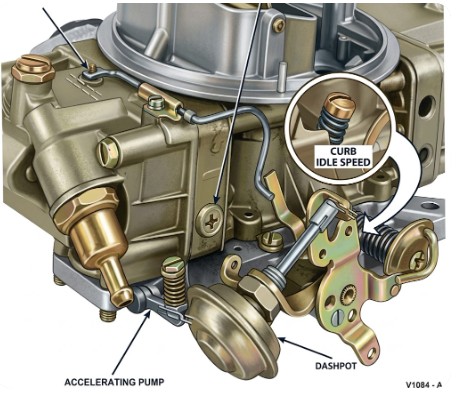
The idle circuit in a Holley 4150 (square-bore) or 4165 (spread-bore) is a low-speed fuel metering system designed to provide the engine with a combustible air-fuel mixture when the throttle plates are nearly closed. Because manifold vacuum is highest at idle, the carburetor relies on this pressure differential to pull fuel through small, precise internal passages rather than through the main boosters.
1. The Flow Path: From Bowl to Bore
The idle circuit operates through a specific sequence of components located primarily within the metering block:
-
Idle Feed Restrictor (IFR): Fuel is drawn from the main well of the metering block through the IFR. This is a small, calibrated orifice (essentially a tiny jet) that determines the maximum amount of fuel available to the idle circuit.
-
Idle Air Bleed (IAB): Located on the top of the carburetor main body, the IAB allows air to enter the circuit. This air mixes with the fuel from the IFR to begin the "emulsification" process (breaking the liquid fuel into tiny bubbles).
-
Idle Channel Restrictor: The emulsified mixture travels down a vertical passage in the metering block. In many performance Holley models, this channel contains a restrictor to further refine the mixture before it reaches the discharge ports.
-
Transfer Slot: This is a vertical slot located in the throttle bore, positioned just above the throttle plates at curb idle. As the throttle begins to open, more of this slot is exposed to manifold vacuum, providing a "transition" of fuel before the main circuit (boosters) takes over.
-
Idle Discharge Port: This is the hole located below the throttle plates. The volume of fuel exiting this port is controlled by the tapered idle mixture screw.
2. The Transfer Slot "Transition"
The transfer slot is perhaps the most critical part of the idle circuit for drivability.
-
At Idle: Only the very bottom of the slot should be exposed to vacuum. If the throttle plates are cranked open too far (to compensate for a high-lift cam or vacuum leak), too much of the transfer slot is exposed. This "uses up" the transition fuel prematurely and can cause the idle mixture screws to become unresponsive.
-
The "Square" Rule: Ideally, for a 4150, about .020" to .040" of the transfer slot should be visible below the throttle plate, looking like a small square when viewed from the bottom.
3. Two-Corner vs. Four-Corner Idle
-
Two-Corner (Standard): Most vacuum secondary 4150s and 4165s utilize a two-corner idle system. Only the primary metering block has mixture screws and a dedicated idle circuit. The secondary side relies on a fixed "idle bypass" to keep the fuel in the rear bowl fresh.
-
Four-Corner (Performance): Many double-pumper 4150s feature four-corner idle. This means both the primary and secondary metering blocks have IFRs, air bleeds, and mixture screws. This setup allows for much finer tuning, especially on engines with large camshafts that have low manifold vacuum.
Two-Corner (Standard): Most vacuum secondary 4150s and 4165s utilize a two-corner idle system. Only the primary metering block has mixture screws and a dedicated idle circuit. The secondary side relies on a fixed "idle bypass" to keep the fuel in the rear bowl fresh.
Four-Corner (Performance): Many double-pumper 4150s feature four-corner idle. This means both the primary and secondary metering blocks have IFRs, air bleeds, and mixture screws. This setup allows for much finer tuning, especially on engines with large camshafts that have low manifold vacuum.
4. 4150 vs. 4165 Differences
While the internal circuitry logic is nearly identical, the physical layout differs slightly:
-
Holley 4150: Features equal-sized primary and secondary bores (square-bore). The metering blocks are standard vertical units.
-
Holley 4165: Designed as a "spread-bore" replacement for Rochester Quadrajets. It has small primaries and very large secondaries. The idle circuit must be tuned more carefully on the small primaries to ensure there isn't a "stumble" when the massive secondaries begin to tip in.
5. Common Circuit Failures
-
Clogged IFR: Because the IFR is so small, even a tiny speck of debris can lean out one side of the engine, causing a rough idle that cannot be fixed by turning the mixture screw.
-
Internal Leaks: A warped metering block or a blown power valve gasket can allow fuel to bypass the idle circuit entirely, causing an un-tunable rich condition.
How To Adjust Idle Mixture
Clogged IFR: Because the IFR is so small, even a tiny speck of debris can lean out one side of the engine, causing a rough idle that cannot be fixed by turning the mixture screw.
Internal Leaks: A warped metering block or a blown power valve gasket can allow fuel to bypass the idle circuit entirely, causing an un-tunable rich condition.
Adjusting the idle mixture on a Holley 4150 (square-bore) or 4165 (spread-bore) carburetor is essential for achieving a smooth idle, crisp throttle response, and proper fuel economy. These models typically feature a "two-corner" or "four-corner" idle system, where fuel is adjusted via needles located on the sides of the metering blocks.
1. Preparation and Initial Setup
Before making adjustments, ensure the engine is in a state where it can provide accurate feedback:
-
Warm up the engine: Bring the engine to full operating temperature so the choke is completely open and the fast-idle cam is disengaged.
-
Check ignition timing: Ensure your timing is set to factory or performance specifications. Incorrect timing will make idle mixture adjustments inaccurate.
-
Set Initial Screws: If the carburetor is fresh or the settings are unknown, gently turn the idle mixture screws clockwise until they lightly seat. Do not over-tighten, as this can damage the needle or the seat. Back them out 1.5 turns as a baseline starting point.
-
Tools: A vacuum gauge is the most accurate tool for this job, though a high-quality tachometer can also work.
2. Connect a Vacuum Gauge
Connect a vacuum gauge to a constant (manifold) vacuum source on the intake manifold or the base of the carburetor. This provides a real-time measurement of engine efficiency.
3. The Adjustment Process
With the engine running in neutral (or "Park" for automatics), follow these steps:
-
Adjust the first screw: Turn one idle mixture screw (on the side of the primary metering block) inward (clockwise) 1/8 to 1/4 turn at a time. This leans the mixture.
-
Monitor the Gauge: Watch the vacuum gauge or tachometer. If the vacuum or RPM drops, you are too lean; turn the screw back out.
-
Find the "Sweet Spot": Turn the screw outward (counter-clockwise) slowly until you reach the highest steady vacuum reading.
-
Balance the sides: Move to the screw on the opposite side of the same metering block and repeat the process. Both screws should end up at approximately the same number of turns out from seated.
-
Four-Corner Note: If you have a performance 4150 with a secondary metering block that also has mixture screws, repeat the process for the two rear screws as well.
4. Final Verification
-
Reset Curb Idle: After adjusting the mixture, your idle RPM may have increased. Use the curb idle speed screw (on the throttle linkage) to bring the RPM back down to your desired idle speed.
-
Re-check Mixture: Changing the curb idle can slightly alter the vacuum signal. It is best practice to give the mixture screws one final "tweak" to ensure you are still at the highest possible vacuum at the new idle speed.
-
The "Lean Best" Setting: Once you find the highest vacuum point, many tuners suggest turning the screws inward (clockwise) just a tiny bit (about 1/16th of a turn) to ensure the engine isn't running excessively rich at idle.
Troubleshooting Tips
-
No Response: If turning the screws has no effect on engine RPM or vacuum, you may have a vacuum leak, a blown power valve, or the throttle blades may be open too far (exposing the transition slots).
-
Erratic Needle: If the vacuum gauge needle is bouncing rapidly, it usually indicates an ignition miss or a valve train issue rather than a carburetor adjustment problem.
What does the transfer slot do on a holley 4150, 4165
The transfer slot is the "bridge" between the idle circuit and the main metering system (the boosters). Its primary job is to provide a smooth transition of fuel as the throttle plates move from a closed position to a partially open state, preventing a lean stumble or "flat spot" during initial acceleration.
Here is a breakdown of exactly how it functions and why its positioning is so critical:
1. The Transition Phase
When an engine is at curb idle, the throttle plates are nearly closed. The engine pulls fuel almost exclusively from the idle discharge port located below the throttle plates.
As you tip into the throttle, the throttle plates open and move past the transfer slot. This exposes the slot to the high manifold vacuum existing below the plates. This vacuum "pulls" an additional volume of the air-fuel emulsion from the same internal passages that feed the idle port. Without this extra fuel, the engine would gulp a sudden breath of air before the main boosters have enough airflow to start spraying, causing the engine to hesitate or "pop" through the intake.
2. The "Square" Rule (Positioning)
For a Holley 4150 or 4165 to idle and transition correctly, the relationship between the throttle plate and the transfer slot is paramount.
-
Correct Setting: At curb idle, only about .020" to .040" of the transfer slot should be visible below the throttle plate. When viewed from the bottom of the carburetor, this exposed portion should look like a perfect square.
-
Too Much Exposure: If the throttle plates are cranked open too far (often to compensate for a large camshaft with low vacuum), too much of the slot is exposed at idle. This "pre-loads" the transition fuel, often making the idle mixture screws unresponsive and causing a rich idle that cannot be adjusted out.
-
Too Little Exposure: If the plates are closed too far, there is a delay between when the plate moves and when it reaches the slot, leading to a lean hesitation right off idle.
3. Relationship to Idle Mixture Screws
It is a common misconception that the idle mixture screws control the transfer slot. In reality, the mixture screws only control the volume of fuel exiting the lower idle discharge port.
The fuel mixture exiting the transfer slot is "fixed." It is determined by the Idle Feed Restrictor (IFR) and the Idle Air Bleed (IAB) inside the metering block. If your transition is lean even with the transfer slot positioned correctly, you usually need to increase the size of the IFR or decrease the size of the IAB.
4. The 4165 (Spread-Bore) Factor
On a Holley 4165, the primary bores are much smaller than a standard 4150. Because these small primaries have higher air velocity at low speeds, the transfer slot timing is even more sensitive. If you are replacing a Quadrajet with a 4165, ensuring that the transfer slot is not "over-exposed" is the first step in preventing the common "off-idle bog" associated with spread-bore swaps.
Summary Checklist for the Transfer Slot:
-
Visible Shape: Should look like a square (.020"-.040") at idle.
-
Secondary Side: On 4150 models with secondary idle speed adjustments, you can "crack" the secondary plates open slightly to give the engine more air, allowing you to close the primary plates and restore the "square" on the primary transfer slot.
-
Symptom of Misalignment: If you have to turn your idle mixture screws all the way in to get the engine to stay running, your throttle plates are likely too far open and exposing too much transfer slot.
What Causes a Rough Idle on the Holley 4150 or 4160?
A rough idle on a Holley 4150 or 4160 carburetor can result from several common issues, including:
- Vacuum Leaks: Air leaks in the intake manifold, carburetor gasket, or vacuum hoses can disrupt the air-fuel mixture, causing a rough idle.
- Incorrect Idle Mixture Settings: Misadjusted idle mixture screws may create a lean or rich condition, leading to instability at idle.
- Dirty or Blocked Air Bleeds: Dirt or debris in the carburetor's air bleeds can disrupt fuel atomization, causing uneven engine performance.
- Faulty Power Valve: A damaged or leaking power valve can allow excess fuel into the intake, affecting idle quality.
- Improper Float Level: Incorrect float settings can cause fuel flooding or starvation, leading to uneven idle.
- Worn Throttle Shaft Bushings: Excessive play in the throttle shaft can result in unmetered air entering the carburetor, affecting idle stability. The best way to test for this is to spray carb cleaner on the ends of the throttle shaft while idling. A change in RPM indicates a vacuum leak here. Keep in mind that the shaft can't fit so tight that it restricts movement.
- Dirty Fuel System: Contaminants in the fuel system can clog jets, passages, or filters, disrupting the carburetor's function. This can be caused by letting the vehicle sit for months at a time which results in the gas turning to varnish coating the inside of the carburetor.
- Ignition Issues: Problems such as weak spark, fouled spark plugs, or incorrect timing can mimic carburetor-related idle problems.
Thoroughly inspecting and cleaning the carburetor, adjusting the idle mixture and float levels, and addressing any vacuum or ignition issues can help restore smooth idle performance.
