| Carter W0 Carburetor Idle System | |
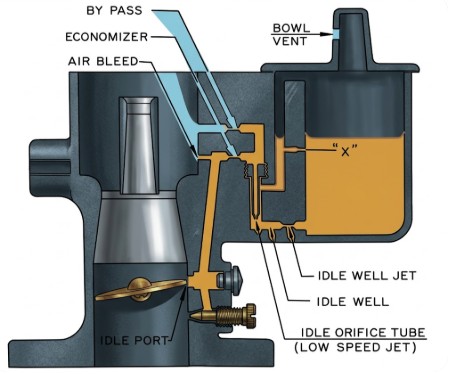
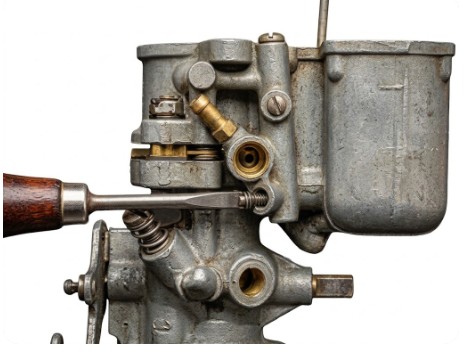
The W0 carburetor idle system is uniquely designed and operates differently compared to the W1, WA1, and WD0 carburetor models. One of the key distinctions is how fuel delivery occurs during idle. In the W0, gasoline is drawn directly from the float bowl, bypassing the metering rod jet, unlike the other models. How the W0 Idle System WorksIn the W0 carburetor, fuel flows by gravity from the float bowl through a restriction in the idle well jet into the idle well, located below the idle orifice tube (also known as the low-speed jet tube). From there, the gasoline travels through the idle tube. After this point, the operation becomes identical to the idle systems used in the W1, WA1, and WD0 carburetors. An accompanying illustration highlights the bypass economizer, bleed, and idle port components. Fuel Supply Path in Other CarburetorsIn the W1, WA1, and WD0 models, the idle tube draws fuel from between the metering rod jet and the nozzle. At dead idle, suction is stronger on the idle system than at the nozzle, directing all fuel through the idle pathway. As the throttle opens, nozzle suction increases while idle port suction decreases. Eventually, nozzle suction overtakes, rendering the idle system inactive. | |
-
Carburetor Parts
- by Make & Model
- Aero Coach Carburetor Parts
- Alfa Romeo
- American Bantam
- American General
- American LaFrance
- American Motors Nash Rambler
- Auburn
- Audi
- Austin
- Autocar
- Available Truck
- BMW
- Bristol
- Buick
- Cadillac
- Checker
- Chevrolet
- Chevrolet/GMC Trucks
- Chord
- Chrysler
- Cortina
- Desoto
- Dodge
- Dodge Truck
- Edsel
- Federal Truck
- Fiat
- Ford/Mercury
- Ford Truck
- Goliath
- Graham Paige
- Hall Scott
- Hillman
- Honda
- Hudson
- Hupmobile
- I.H.C. International
- Innocenti
- Innocenti
- Jaguar
- Jeep/Willys
- Jensen Healey
- Kaiser Frazer
- Lafayette
- Lancia
- LaSalle
- Latham Supercharger
- Legonda
- Lincoln
- Lotus
- Mazda
- Mercedes
- MG
- Morgan
- Morris
- Nissan/Datsun
- Oldsmobile
- Opel
- Packard
- Plymouth
- Plymouth Arrow
- Pontiac
- Riley
- Rover
- Stewart
- Studebaker
- Studebaker Truck
- Terraplane
- Toyota
- Triumph
- Vanden Plas
- Volvo
- White
- Wolseley
Scroll to see more - by Carb Types
- by Part Type
- Accelerator Pump
- Ball Stud
- Brass Fittings
- Bushings
- Carburetor Kits
- Clean Out Plugs
- Clips & Retainers
- EFE Heater Gaskets
- Electric Choke Conversion Kits
- Fuel Filters
- Floats
- Gaskets
- Idle Mixture Screws
- Check Balls & Check Weights
- Fuel & Vacuum Hose
- Jets & Metering Rods
- Needle and Seat
- Power Valves & Jets
- Pull-Off
- Rods & Linkage
- Rubber Caps
- Screws
- Thermostats
- Throttle Position Sensors and Solenoids
- Float Pins
- Springs
- Sediment & Fuel Bowl
- Washers & O-Rings
- Choke & Throttle Shafts
- Carburetor Dashpots
- Carburetor Tubes
- Marine
- Acadia
- Aero
- Aeroceanic Motors
- Aquanautics
- Chris Craft
- Chrysler Marine
- Chrysler Outboard
- Clinton Outboard
- Crosley Marine Carburetor Parts
- Crusader Marine Carburetor Parts
- Daytona
- Dearborn
- Ford Marine
- Gray Marine
- Grumman Allied
- Holley Universal
- Johnson Evinrude Marine Outboard
- Kermath Marine
- Kiekhaefer Carburetor Parts
- Kohler
- Lathrop Marine
- Marine Chokes
- Medalist Marine
- Mercury Marine
- Mercury Marine Outboard
- Mercury Mariner
- Montgomery Ward Sea King Outboard Parts
- Nordberg Marine
- Oldsmobile Marine
- OMC Marine Parts
- Outboard Motors
- Owens
- Palmer Marine
- Pleasure Craft
- Redwing Marine
- Revley Marine
- Salmon Stiles
- Scripps Marine
- Tillotson Marine Outboard
- Universal Motors
- Volvo Penta
- Yamaha Outboard
- Ag & Industrial
- Acadia
- Allis Chalmers
- American Tractor
- Automatic Transportation Company
- Avco
- Baker
- Bardco
- Bay City
- Buda
- Buffalo Springfield
- Burmeister Wain
- Butler Bin
- Case
- Caterpiller
- Champ Lift Truck
- Clark Agriculture
- Chicago Pneumatic
- Chrysler Industrial
- Climax Engineering
- Clinton
- Clyde Iron Works
- Cockshutt
- Continental
- Crosley
- Davey
- Divco
- Duplex
- Earthmaster
- Easthope Brothers
- Eaton Corporation
- Elwell Parker Company
- Fairbanks Morse
- Fairmont
- Fate Root Heath
- Federal Machine
- Ford
- Gibson
- Gordon Smith
- Hercules
- Hobart Brothers
- Hollingsworth
- Hough
- Holtkamp
- Huber
- Hyster
- IHC Carburetor Parts
- Ingersoll Rand Industrial
- Intercontinental
- Jacques
- Jaeger
- John Deere Tractor
- Joy Manufacturing
- Kaiser Industrial
- Kalamazoo Railroad
- Kohler Industrial
- Kurtz Root
- Leroi
- Lincoln Electric Industrial
- Lunnenberg
- Lycoming Industrial
- Massey Ferguson
- Mercury Manufacturing
- Miller Applications
- Minneapolis Moline
- Motor
- Motoresearch
- National Farm Agriculture
- New Holland
- New Idea Farm Equipment
- Novo
- Oliver Carburetor Parts
- Onan Industrial Carburetor Parts
- Owatonna
- Palmer
- Perkins
- Pettibone
- Pioneer Agriculture & Industrial
- Railcar
- Ready Power
- Redwing
- Reiner
- Robinson Machinery
- Russell Agriculture & Industrial
- Schramm
- Seagrave
- Service Caster
- Sullair
- Tenant
- Thermo King
- Thew Shovel
- Toro
- Towmotor
- Toyota Forklift
- Transicold
- Transitier
- Universal Motors
- U.S. Motors
- Volvo
- Waukesha Industiral
- Western Gear
- White Motors Truck Carburetor Parts
- Winpower
- Wisconsin Motors
- Yale and Towne
Scroll to see more - Odds & Ends
- by Make & Model
-
Carburetors
-
Fuel Injector Parts
-
Fuel Injector Cleaning
-
Manuals
-
Technical
-
Swag