How The W-1 Accelerator Pump Circuit Works?
f you’ve ever stomped the gas pedal in a classic 1930s or 1940s Chevrolet and felt the engine respond smoothly without a hint of hesitation, you have the accelerator pump circuit to thank.
The Carter W-1 is a legendary single-barrel carburetor, prized for its mechanical simplicity and reliability. But to understand why the accelerator pump circuit is the unsung hero of this classic carb, we first have to understand the physical problem it solves.
Here is a breakdown of how the accelerator pump circuit operates in a Carter W-1 carburetor.
The Problem: Air is Lighter Than Fuel
When an engine is idling or cruising at a steady speed, the air and fuel mix at a relatively balanced, constant rate. However, when you suddenly open the throttle plates to accelerate, a massive rush of air immediately enters the intake manifold.
Because gasoline is a liquid and far heavier than air, it suffers from "inertia"—it takes a fraction of a second longer to start moving than the air does. Without intervention, this sudden influx of air creates a momentarily lean mixture, causing the engine to stumble, cough, or "bog down" before recovering.
The accelerator pump circuit is designed to bridge this gap. It acts like a mechanical syringe, physically squirting a measured shot of raw fuel directly into the carburetor throat the instant the throttle is opened, keeping the engine fed until the main metering system can catch up.
The Components of the W-1 Pump Circuit
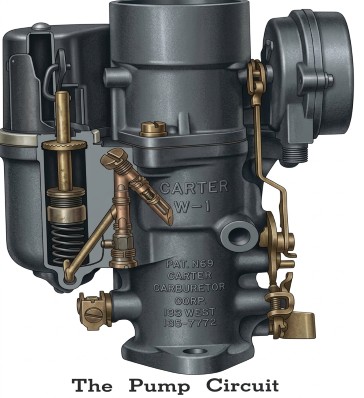
To understand the process, you need to know the players. Inside the Carter W-1, the pump circuit consists of a few distinct parts:
Pump Plunger: A brass shaft with a leather cup (or sometimes a modern synthetic seal) at the bottom, operating inside a dedicated vertical cylinder cast into the float bowl.
Intake Check Valve: A tiny steel ball bearing located at the bottom of the pump cylinder. It allows fuel to enter the cylinder from the float bowl but prevents it from flowing backward.
Discharge Check Valve: Often a pointed needle or another check ball located in the passage leading up to the pump jet. It prevents air from being sucked backward into the pump circuit when it’s not in use.
Pump Jet: A tiny brass nozzle aimed perfectly down the center of the carburetor throat (the venturi).
Throttle Linkage: A mechanical rod connecting the throttle shaft on the outside of the carburetor to the top of the pump plunger.
Step-by-Step Operation
The operation of the circuit happens in two distinct phases: the upstroke (filling) and the downstroke (spraying).
1. The Upstroke (Recharging the Pump)
When you take your foot off the gas pedal, the throttle valve closes. Because the pump plunger is mechanically linked to the throttle, closing the throttle pulls the plunger upward inside its cylinder.
This upward movement creates a low-pressure vacuum inside the cylinder. The suction lifts the intake check valve (the steel ball) off its seat, allowing liquid fuel from the surrounding float bowl to rush in and fill the cylinder beneath the leather cup. Meanwhile, the suction pulls the discharge check valve tightly closed, preventing air from bleeding into the system from the pump jet. The "syringe" is now loaded.
2. The Downstroke (The Squirt)
When you step on the gas pedal, the throttle opens. The linkage immediately forces the pump plunger downward.
The downward pressure of the fuel instantly slams the intake check valve shut, sealing off the exit back to the float bowl. With the fuel trapped and under pressure, it forces the discharge check valve open. The fuel has only one place to go: up the passageway and out of the pump jet, where it sprays directly into the passing airstream. This rich mist of raw fuel vaporizes instantly, giving the engine the precise amount of fuel it needs to accelerate smoothly.
The "Duration Spring"
One of the brilliant design features of the Carter W-1 (and many similar carbs) is the pump spring located on the plunger shaft. When you smash the throttle to the floor, the linkage moves instantly. If the plunger was rigidly attached, it would shoot all the fuel out in a massive, split-second blast.
Instead, the linkage pushes against a spring, which in turn pushes the plunger. This allows the plunger to travel down slightly slower than the linkage moves, turning a sudden "splash" of fuel into a steady, prolonged spray that lasts for a second or two, perfectly matching engine demand.
Seasonal Adjustments
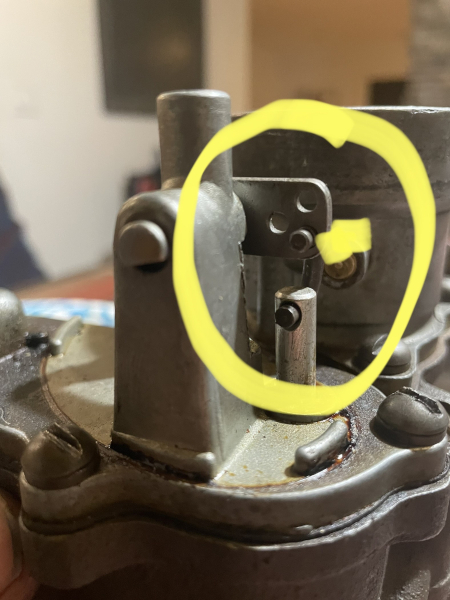
Engineers in the 1930s knew that cold engines need more fuel to accelerate than warm engines. The Carter W-1 features a flat throttle linkage arm with three distinct holes where the pump rod attaches.
Moving the rod to a hole further from the pivot point increases the "stroke" of the plunger:
Short Stroke (Inner hole): Used for hot summer driving, providing a smaller shot of fuel.
Medium Stroke (Center hole): Used for normal, year-round driving.
Long Stroke (Outer hole): Used for freezing winter conditions, giving the engine maximum fuel to prevent stalling when cold.
The Takeaway
The Carter W-1’s accelerator pump circuit is a masterclass in early automotive engineering. Through simple mechanical leverage, a leather cup, and a couple of check balls, it perfectly solves complex fluid dynamics—keeping classic engines running smoothly without a single sensor or microchip in sight.