
Understanding the Rochester BB Part Throttle System
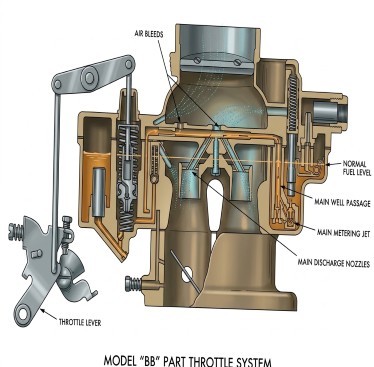
As you open the throttle valves further, manifold vacuum creates a strong suction at the main discharge nozzles, which is amplified by the primary and secondary venturi. This vacuum becomes powerful enough to pull fuel through the main metering jets, up the main well channels, and into the crossbar channels.
During this stage, air is introduced into the fuel mixture via the crossbar bleeds. Once this happens, the carburetor transitions away from the idle system, and the fuel mixture begins discharging directly from the main discharge nozzles.
Ultimately, it is the precise calibration of the main metering jets and the crossbar air bleeds that ensures your carburetor maintains an efficient and economical fuel/air ratio throughout the entire part-throttle driving range.
Main Discharge Nozzles
The main discharge nozzles are the absolute heart of the carburetor's main metering system. They act as the final exit point where fuel transitions from inside the carburetor’s passages into the engine's airstream.
Here is a breakdown of how they operate, how they integrate with the rest of the carburetor, and the physics that make them work.
How the Main Discharge Nozzles Work
The operation of the discharge nozzles relies entirely on the Venturi Effect (Bernoulli's principle). They don't pump fuel; they allow fuel to be pulled into the engine.
1. The Venturi Vacuum
The nozzles are positioned right in the center of the carburetor's venturi (the narrowest part of the barrel). As you open the throttle, the engine draws in more air. When this air hits the narrow venturi, it is forced to speed up. This rapid increase in airspeed creates a low-pressure zone (vacuum) right at the tip of the discharge nozzle.
2. Lifting the Fuel
This localized vacuum is incredibly strong. It literally pulls fuel from the float bowl, through the main metering jets, up the main well, and out through the discharge nozzles.
3. Atomization (The Emulsion Process)
Crucially, the main discharge nozzles do not just dump raw, liquid fuel into the engine. Before the fuel ever reaches the tip of the nozzle, it mixes with air provided by the air bleeds (like the "crossbar bleeds" from your manual).
By the time the mixture exits the main discharge nozzle, it is a highly aerated emulsion—a frothy mist. This atomized mist vaporizes much faster in the intake manifold, ensuring a clean, even burn and better throttle response.
When Do They Operate?
-
At Idle: The discharge nozzles are completely inactive. The throttle valves are nearly closed, so air moves too slowly through the venturi to create suction. Fuel is instead pulled through the idle circuit below the throttle plates.
-
Part-Throttle to WOT: As the throttle opens and airspeed increases, the idle circuit fades out, and the vacuum at the venturi takes over. The main discharge nozzles become the primary source of fuel for the engine.
