
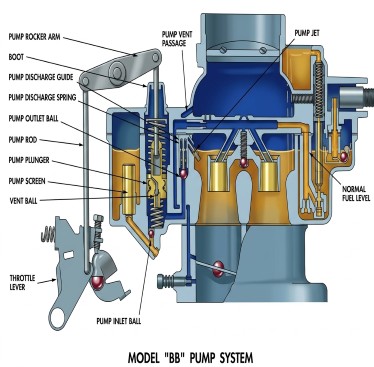
The Accelerating Pump System of the Rochester Model "BB" Carburetor
When an engine's throttle is opened suddenly, the air flow and manifold vacuum change almost instantaneously
Mechanical Operation
The accelerator pump is connected directly to the throttle mechanism, allowing it to move instantly with the slightest change in throttle opening
The physical pumping process happens in two stages:
-
The Intake Stroke: As the pump lifts, fuel passes through the pump inlet screen, unseats the inlet ball, and fills the pump well
. -
The Discharge Stroke: The downward force of the pump plunger during acceleration seats the inlet ball, preventing fuel from flowing backward
. The fuel is forced through the outlet channel, which unseats a spring-loaded outlet ball, and finally discharges through the pump jets directly into the main air stream .
Hot Weather Performance Features
A notable design feature of the Model "BB" pump system is its vented type of pump plunger, which minimizes hard starting and improves initial acceleration in hot weather
When an engine is shut off, the rising heat from the engine manifold often causes the fuel trapped in a carburetor's pump system to boil
Service and Maintenance Guidelines
The Model "BB" carburetor was designed for maximum ease of service, and this extends to the accelerating pump system
-
The pump jets are pressed into the bowl castings at the factory and never need to be replaced or serviced
. -
No targeting of the pump jets is required during adjustment or reassembly
. -
During routine cleaning, the pump plunger must not be immersed in standard carburetor cleaning solvent
. -
The pump plunger should be cleaned using clean gasoline only
. -
The pump plunger assembly utilizes leather; during inspection, if the plunger leather is found to be damaged, the entire plunger must be replaced
.
