
The Carter AFB 4-Barrel Carburetor: Understanding the Secondary System
The Carter AFB (Aluminum Four-Barrel) carburetor is a classic piece of automotive engineering, widely recognized for its role in high-performance vehicles during the muscle car era. While the primary system of the AFB is crucial for everyday driving, the secondary system is what gives the carburetor its performance edge, particularly during acceleration and high-speed driving. In this article, we'll delve into the design, functionality, and significance of the secondary system in the Carter AFB 4-barrel carburetor.
Overview of the Carter AFB 4-Barrel Carburetor
The Carter AFB carburetor was introduced in the 1950s and quickly became a staple in the automotive industry, favored for its lightweight aluminum body, ease of tuning, and reliable performance. It was commonly used by major American automakers, including Chrysler, Ford, and General Motors, in a variety of high-performance vehicles.
The "4-barrel" designation refers to the four throttle bores—two primaries and two secondaries. The primary system is responsible for most driving conditions, delivering fuel and air during idle, cruising, and light acceleration. The secondary system, on the other hand, comes into play during wide-open throttle (WOT) situations, providing the extra fuel and air necessary for maximum power.
The Role of the Secondary System
The secondary system in a Carter AFB carburetor is designed to enhance engine performance when the demand for power exceeds what the primary system can deliver. This typically occurs during rapid acceleration or when the engine is operating at high RPMs. The secondary system consists of two larger throttle bores that open progressively as the engine requires more air and fuel.
Unlike the primary system, the secondaries in the AFB carburetor are controlled by engine vacuum and mechanical linkage. This design ensures that the secondary throttle plates only open when there is a sufficient airflow demand from the engine, preventing unnecessary fuel consumption and maintaining efficient operation.
Operation of the Secondary System
The secondary system in the Carter AFB carburetor is actuated by a combination of vacuum and mechanical forces. When the driver opens the throttle beyond a certain point, the increased airflow creates a vacuum signal that activates a diaphragm or air valve within the carburetor. This action gradually opens the secondary throttle plates, allowing more air to flow into the engine.
Simultaneously, a mechanical linkage connected to the primary throttle plates helps control the rate at which the secondaries open. This ensures that the transition from the primary to the secondary system is smooth, avoiding any hesitation or "bogging" that could occur if the secondaries opened too quickly.
As the secondary throttle plates open, additional fuel is introduced into the airstream via the secondary venturi clusters. These clusters are designed to meter the correct amount of fuel based on the airflow, ensuring that the air-fuel mixture remains optimal for combustion. This process allows the engine to produce more power, particularly at higher RPMs where the demand for fuel and air is greatest.
Tuning the Secondary System
One of the key advantages of the Carter AFB carburetor is its tunability. The secondary system can be adjusted to suit different driving conditions and engine setups. This can be achieved by changing the secondary air valve springs, adjusting the secondary throttle linkage, or modifying the secondary jets.
For enthusiasts looking to extract maximum performance from their engine, fine-tuning the secondary system is crucial. Adjustments can be made to ensure that the secondaries open at the right moment, providing a seamless transition from cruising to full acceleration. This tuning capability makes the Carter AFB carburetor a favorite among hot rodders and performance car builders.
The Importance of the Secondary System
The secondary system in the Carter AFB carburetor plays a vital role in delivering the high-performance characteristics that enthusiasts seek in muscle cars and other powerful vehicles. By providing additional fuel and air when needed, the secondaries allow the engine to reach its full potential, particularly during aggressive driving.
Without the secondary system, the carburetor would be limited in its ability to supply enough fuel and air to meet the demands of a high-performance engine. This would result in reduced power output and a less responsive throttle, detracting from the driving experience.
Conclusion
The Carter AFB 4-barrel carburetor remains a legendary component in the world of automotive performance, with its secondary system being a key factor in its success. By understanding and properly tuning the secondary system, drivers can unlock the full potential of their engines, ensuring that their vehicles perform at their best during acceleration and high-speed driving. Whether used in classic muscle cars or modern hot rods, the Carter AFB carburetor continues to be a symbol of performance and reliability.
AFB AVS Secondary: Understanding the Auxiliary Air Valve
The auxiliary air valve, positioned above the secondary valve, plays a crucial role in regulating the timing of air flow into the secondary system of your carburetor. It's important to note that the auxiliary air valve is designed for specific applications and should not be modified, as many have attempted. Swapping an AFB carburetor from one vehicle, such as a Buick, to another, like a Pontiac, can result in different performance outcomes. For instance, using the incorrect air valve or a modified version can cause a bogging issue when opening the secondary. This problem can also arise if there is an inadequate fuel supply to the secondary.
Since auxiliary air valves are no longer manufactured, it is challenging to determine the correct valve for a specific carburetor model. Therefore, it's essential to avoid unnecessary modifications and ensure that the right components are used for optimal performance.
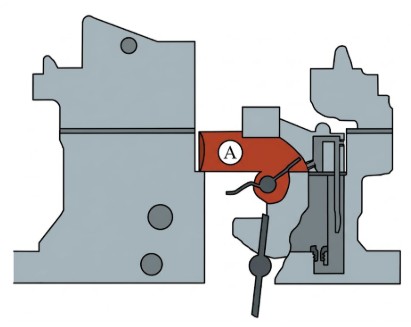
The offset valves (see A in Diagram) above the secondary throttle valves are called
"auxiliary air valves." Counterweights are located on the ends of the auxiliary valve shaft.
The auxiliary valve counterweights operate within a recess inside the carburetor body.
Throttle valves in the secondary side remain closed until the primary valves have been opened a predetermined amount. Air velocity through the carburetor controls the position of the auxiliary valves. The
auxiliary valves open when the force of the air against the offset valves is able to lift the counterweights. If the valve does not come in quickly enough, holes can be drilled in both sides to lighten the weights
and allow the air to more easily pull the valve open. The only problem with this is that the air valve is no longer usable in any other setting. If the valve then comes in too soon split shot lead weights can fill the holes to increase the weight.
When the accelerator is fully depressed, only the primary high speed circuit will function until there is sufficient air velocity to open the auxiliary valves. When this occurs, fuel will then come from the secondary high-speed circuit.



