
How the WCFB Choke Works
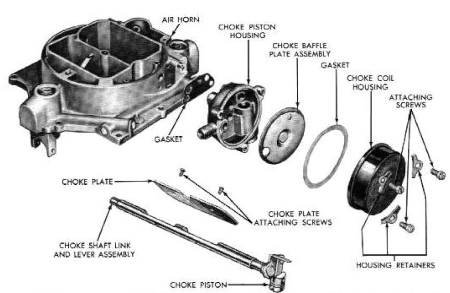


Hard Starting?
- The main discharge check ball may not be sealing.
- The pump well isn't filling up with gas on the up stroke.
- The fuel bowl is too low by possibly a weak fuel pump, or maybe the float setting being way off.
- After turning off a hot engine the gas may be siphoning into the intake. Look down the carb after turning off to see if gas is dribbling out of the venturi.
Adjusting WCFB Electric Choke
Adjusting the electric choke on a Carter WCFB carburetor is a straightforward process, but it needs to be done carefully to ensure reliable cold starts and proper drivability. Here's how you do it:
Tools You’ll Need:
-
Flathead screwdriver
-
A wrench or socket (if needed to loosen the choke housing screws)
-
Optional: Timing light or tach for idle speed adjustments
Steps to Adjust the Electric Choke on a Carter WCFB:
1. Identify the Choke Housing
-
The electric choke housing is a round, usually black or metal disc on the passenger side of the carburetor.
-
It’s held in place by three screws and contains a bi-metal spring that controls the choke plate.
2. Cold Engine Test
-
Make sure the engine is cold, ideally after sitting overnight.
-
Remove the air cleaner so you can see the choke plate in the primary throat of the carburetor.
3. Observe Choke Plate Position
-
The choke plate should be just about fully closed when the engine is cold.
-
If it’s too open or too tight, adjustment is needed.
4. Loosen the Choke Housing Screws
-
Loosen (don’t remove) the three screws that hold the choke housing in place.
-
The housing is adjustable by rotation.
5. Rotate to Adjust
-
Turn the housing clockwise to make the choke richer (more closed when cold).
-
Turn counterclockwise to make it leaner (more open when cold).
-
Make small adjustments, about 1–2 notches at a time.
-
After adjusting, gently hold the throttle open and watch how the choke plate reacts. It should close firmly but not too tight.
NOTE: Clockwise & Counterclockwise might be backwards on some carburetors.
6. Tighten Screws
-
Once you’re satisfied with the choke plate’s cold position, tighten the three screws back down.
7. Check Fast Idle Cam Engagement
-
With the choke closed, the fast idle cam should be positioned to increase idle speed during cold starts.
-
Manually open the throttle to ensure the fast idle cam engages properly.
8. Warm-Up Test
-
Start the engine and observe:
-
The choke plate should gradually open as the engine warms up (within a few minutes).
-
Idle speed should drop as the fast idle cam releases.
-
Final Tips:
-
If the choke opens too slowly, it may run too rich and bog down.
-
If it opens too fast, the engine may stumble or stall when cold.
-
Make sure the electric wire going to the choke receives 12V with the key on (engine running or ignition on).
-
Use a tachometer to fine-tune idle and fast idle RPMs if necessary.
