
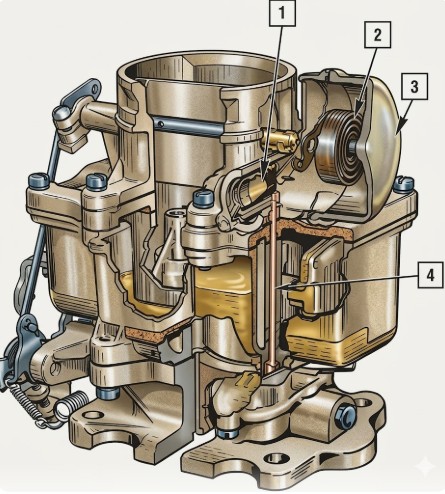
The Climate® Control provides the correct mixture necessary to assure quick cold engine starting and proper warm-up performance. When the engine is cold, tension of the thermostatic coil holds the choke valve closed. When the engine is started, air
velocity against the offset choke valve causes the valve to open slightly against the thermostatic coil tension. Intake manifold vacuum applied to the choke piston also tends to pull the choke valve open.
The choke valve assumes a position, where tension of the thermostatic coil is balanced by the pull of vacuum on the piston and force of the incoming air against the offset choke valve.
When the engine starts, slots located in the choke piston cylinder. In the illustration, are uncovered to allow intake manifold vacuum to draw air, heated by the exhaust manifold, through the choke control housing. The flow of warm air in turn heats the thermostatic coil and causes it to gradually lose its tension until the choke valve reaches full open position. If the engine is accelerated during the warm up period, the corresponding drop in manifold vacuum allows the thermostatic coil to momentarily close the choke, providing the required richer mixture.
The choke baffle plate prevents particles of dirt and carbon (carried in with the hot air) from depositing on the vacuum cylinder walls. This would retard choke piston action and eventually cause the piston to stick.
The Carter WCD is a legendary 2-barrel carburetor, serving as original equipment on decades of classic Buicks, Cadillacs, Pontiacs, and Packards. When dialed in, it's an incredibly reliable fuel mixer. However, after 70+ years of service, the climatic control choke system is often the primary culprit behind hard cold-starts, engine loading, black smoke, and erratic high-idling.
Here is a breakdown of what goes wrong with the WCD choke circuit and how to systematically diagnose and correct it.
Common WCD Choke Failures
Before bending linkages or turning screws, you need to identify the mechanical root cause. The WCD utilizes an automatic choke that balances thermostatic spring tension (which closes the butterfly) against manifold vacuum (which pulls it open as the engine fires).
-
Binding Butterfly / Warped Air Horn: The choke plate should close fully and effortlessly against the air horn when the throttle is opened slightly. If the butterfly sticks, it is usually due to varnish buildup in the air horn. In more severe cases, the air horn casting itself is warped—often caused by decades of over-tightening the air cleaner stud.
-
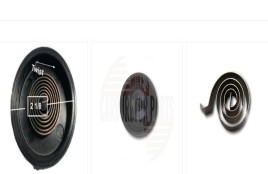
Exhausted Thermostatic Coil: The bimetallic spring inside the black climatic housing loses its tension over time. If the spring is fatigued, it won't hold the butterfly completely closed during a cold crank, preventing the venturi from pulling enough fuel to vaporize in a cold manifold.
-
Rusted Hot Air Tubes: The WCD relies on a hot air tube drawing heat from the exhaust manifold to tell the thermostatic coil when to relax. If this tube is rusted out, broken, or clogged with carbon, the choke will never receive enough heat to open fully, causing the engine to run rich and stall once warmed up.
-
Vacuum Piston Sticking: Inside the choke housing is a small vacuum piston (acting as the choke pull-off) that pulls against the coil tension the moment the engine fires. If carbon or varnish scores the cylinder wall, the piston sticks. The engine will fire, but the choke won't crack open, causing immediate flooding and stalling.
-
Fast Idle Cam Binding: The choke plate is linked to the fast-idle cam.
If the linkage is bent, corroded, or coated in decades of grime, the fast-idle cam won't drop when the thermostatic spring relaxes. The engine will be stuck at a screaming 1,200+ RPM even at normal operating temperature.
Troubleshooting the Choke Circuit
To properly diagnose the system, the engine must be completely cold—ideally having sat overnight. Do not pump the accelerator before beginning.
Remove the air cleaner. Slowly push the throttle linkage all the way open and release it. Look down the air horn. The choke butterfly should now be snapped entirely shut. If it isn't, loosen the three screws on the black choke housing and rotate it counter-clockwise (rich) just until the valve closes lightly, then tighten.
With the engine still cold, press the throttle linkage to wide-open throttle (WOT) and hold it there. The unloader tang on the throttle lever should push the fast-idle cam linkage, forcing the choke butterfly to crack open (usually requires a specific drill bit size of clearance between the plate and the air horn wall, depending on your vehicle's manual). If it stays completely closed at WOT, bend the unloader lip on the throttle lever to achieve the specified clearance.
Start the engine. The exact second the engine catches and manifold vacuum spikes, the small vacuum piston inside the choke housing should immediately pull the butterfly open slightly (about 1/8 to 3/16 inch) against the spring tension. If the plate stays slammed shut and the engine blows black smoke and dies, your vacuum piston is stuck or its vacuum passage is clogged.
Let the engine run for 5 to 10 minutes until the upper radiator hose is hot. Shut the engine off and look at the choke plate. It should be perfectly vertical (wide open). Blip the throttle once; the fast-idle cam should drop away completely, returning the idle speed to the curb idle screw setting. If the plate isn't vertical, check the hot air tube for flow, or consider converting the housing to a 12-volt electric choke stat.
Key insight: Don't chase choke adjustments if the rest of the carburetor isn't sound. If your float levels are set too high, or the idle mixture screws are wildly out of spec, the engine will exhibit symptoms that mimic a malfunctioning choke. Ensure the baseline fuel delivery is solid first.
