
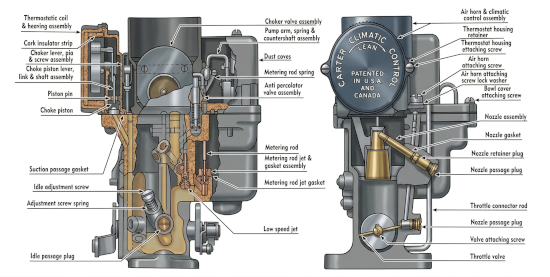
Because it runs great at idle but fails right as you transition into the High-Speed Circuit (around 1/8 to 1/4 throttle), you are likely looking at a metering rod synchronization issue or a vacuum advance problem.
Here is how to troubleshoot the Carter WA-1 without feeling like you're in over your head:
1. The "Quick & Dirty" Accelerator Pump Test
Before diving into the complex stuff, let's rule out the pump.
The Test: With the engine off, remove the air cleaner. Look down into the throat of the carburetor and pull the throttle linkage quickly.
The Result: You should see a strong, immediate "squirt" of gasoline. If it’s a weak dribble or delayed, your accelerator pump isn't providing the "extra gulp" needed for the transition.
The Fix: If it's weak, the leather pump cup might have dried out (even new ones can do this if they sat on a shelf). Sometimes soaking it in a little bit of oil or just driving it more will swell the leather back up.
2. Metering Rod Synchronization (The Likely Culprit)
The Carter WA-1 uses a mechanical metering rod that is physically linked to the throttle. If this rod isn't lifting at the exact right moment, the engine will starve for fuel as soon as you open the throttle plates.
The Problem: Even if Studebaker Parts International did a perfect rebuild, they timed the rod to a "standard" spec. Your specific linkage on a 1941 truck might be slightly worn or bent.
How to Check: Watch the metering rod arm as you move the throttle. It should start to lift the rod instantly as the throttle moves off the idle screw. If there is "slop" or a delay where the throttle moves but the rod stays down, you'll go lean and the engine will stumble.
The Adjustment: There is usually a small T-shaped tool (or a specific measurement) used to sync the rod. Without the tool, you want the rod to be at the "bottom" of its travel exactly when the throttle is closed, and to begin lifting immediately upon acceleration.
3. The Step-Up Piston (The "Vacuum" Factor)
The WA-1 also has a vacuum-operated step-up piston that pushes the metering rod up during high-load/low-vacuum situations (like going up a hill).
The Museum Factor: After 15 years, even a cleaned casting can have a tiny bit of "varnish" or corrosion in the piston well. If that piston is stuck in the "down" position, the engine will run fine at idle but won't get the extra fuel it needs to move the truck's weight.
The Check: With the engine off, see if you can manually move the step-up piston/metering rod assembly up and down. It should move freely with zero resistance. If it feels "crunchy" or stuck, it needs a quick cleaning.
4. Don't Ignore the Distributor
Since the truck sat for 15 years, the Vacuum Advance on the distributor is a prime suspect.
Why: At 1/8 to 1/4 throttle, the carburetor is sending a vacuum signal to the distributor to "advance" the timing. If the diaphragm inside that vacuum pod is cracked (very common after 15 years) or the plate inside the distributor is rusted/stuck, the timing won't advance.
The Symptom: The engine will sound "flat," run rough, and refuse to gain RPMs under load—exactly what you're describing.
The Test: Take the vacuum hose off the carb and suck on it. You should see the plate inside the distributor move. If you can suck air through the hose indefinitely, the diaphragm is blown and needs to be replaced.
My Recommendation: Start with the Vacuum Advance test (Step 4). It’s the most common failure for "Museum Cars" and perfectly matches a "runs great until I try to drive it" scenario.
