
How the Carter BBD Power Circuit Works
1. Normal (Cruise) Operation:
-
At light throttle or steady cruising speeds, the engine creates high vacuum.
-
This vacuum holds the power piston up, which keeps the power valve (or metering rod) in the lean (cruise) position.
-
The carburetor meters fuel through the smaller portion of the metering rods, maintaining a leaner, fuel-efficient mixture.
2. Power Demand (Acceleration/Load):
-
When you press the gas pedal or climb a hill, the engine vacuum drops.
-
As vacuum decreases, it can no longer hold the power piston up.
-
The piston drops, allowing the thicker portion of the metering rod to rise out of the jet.
-
This opens up the main jet and allows more fuel to flow into the venturi.
3. Enriched Mixture:
-
The result is a richer air-fuel mixture, which gives the engine the extra power it needs under load.
-
Once vacuum increases again (like during cruising), the piston is pulled back up and the system returns to lean operation.
Common Power Circuit Problems:
-
Sticking power piston: Can lead to bogging or poor acceleration.
-
Vacuum leaks: Prevent the piston from staying up during cruise.
-
Worn or bent metering rods: Can cause rich or lean mixtures.
-
Dirty or restricted jets: Reduce fuel flow during power demand.
Tips:
-
Always check that the power piston moves freely.
-
Inspect the spring and metering rods during a rebuild.
-
Make sure the vacuum passage to the piston is clean and clear.
In short, the Carter BBD power circuit uses engine vacuum to control fuel enrichment—lean at cruise, rich under load—giving your engine both fuel economy and performance when needed.
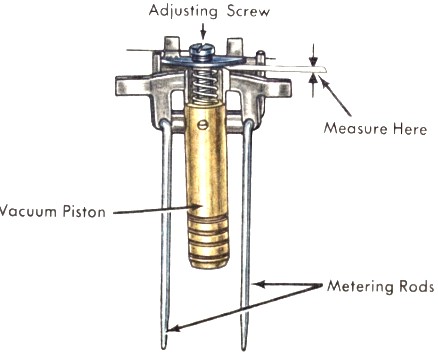
- Remove cover plate from top of air horn
- Adjust piston gap by turning adjusting screw. Correct gap is .040"
- NOTE: turn screw clockwise to make fuel mixture richer. Turn counter-clockwise to lean out fuel mixture
- Remove cover plate and gasket
- Remove rod lifter lock screw and remove step-up piston assembly
- Adjust gap in step-up piston to .035" by turning Allen calibration screw on top of piston
- Record number of turns and direction for readjustment after Vacuum Step-Up Piston Adjustment
- Be sure vacuum piston gap is correctly adjusted
- Back off curb idle adjustment until throttle valves are fully closed
- NOTE: Record number of turns so screw can be reset to original position
- Turn idle screw IN until it just touches stop. Then turn IN one full turn further
- Depress vacuum piston fully while holding moderate pressure on rod lifter tab
- Tighten rod lifter lock screw
- Release piston and rod lifter
- Adjust accelerator pump at this time
- Reset curb idle screw to original position
- Install cover and gasket
- Back off curb idle adjusting screw until throttle valves are completely closed
- NOTE: count turns for resetting reference
- Fully depress step-up piston while holding medium pressure on rod lifter tab
- Tighten rod lifter lock screw
- Release piston and rod lifter
- Reset curb idle screw to original position
- Reste Allen calibration screw to its original position
