
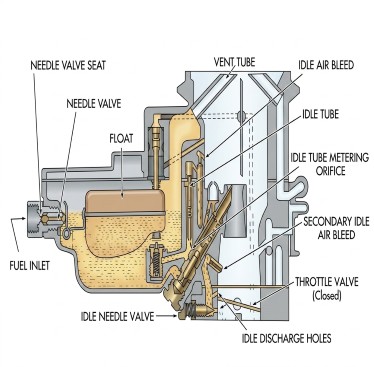
With the throttle valves closed and engine at idle, fuel is metered by the idle tube metering orifice through the idle tube. Air from the idle air bleed is mixed with the fuel at the top of the idle tubes. This mixture of air and fuel runs down the channel and then mixes with air from the secondary idle air bleed and then discharged through the idle discharge holes. The quantity of fuel is metered by the idle mixture screw (idle needle valve). As the throttle valve is opened more, additional fuel is discharged from the upper idle discharge hole.
Rough Idle?
- Adjust idle mixture screw - use a vacuum gauge and adjust for smoothest idle (highest vacuum). Adjust at idle speed. Once the idle is over idle speed then the idle circuit is no longer in play.
- Idle vent dirty, out of adjustment (if so equipped).
- Idle needle worn or damaged. Look for any scores. Polish with a wire wheel.
- Throttle valves not complete closing, bent, sticking open, installed in the wrong bore, or upside down.
- Idle passages dirty, or plugged.
- Power piston vacuum passage plugged or dirty.
- Pump discharge check - out of round, stuck, distorted spring.
- Sticking float valve.
Stromberg WW Parts
Adjusting Idle Mixture Screws Doesn't change RPM
When the idle mixture screws on a Stromberg WW do absolutely nothing, it means the engine isn't using the idle circuit to stay running. It is pulling fuel from somewhere else, completely bypassing the mixture screws.
Here is the diagnostic breakdown of where that fuel is coming from, starting with the most common culprits.
1. Throttle Plates Open Too Far (Transfer Slot Exposure)
This is the most common reason mixture screws go dead. If the idle speed screw is turned in too far, it cracks the throttle plates open past the idle ports and exposes the vertical transfer slots (transition circuits).
Once the transfer slots are exposed, the engine pulls fuel directly from the main circuit. Because the vacuum signal has moved above the idle mixture ports, turning the screws does nothing.
-
The Fix: Back off the idle speed screw until the throttle plates close down to the true idle position. If the engine dies when you do this, you likely have a vacuum leak you were unknowingly compensating for.
2. Vacuum Leaks
A major vacuum leak leans out the mixture so much that the idle circuit can't deliver enough fuel to keep the engine running. To keep it alive, the natural reaction is to crank up the idle speed screw—which brings us right back to exposing the transfer slots.
-
What to check: The WW base gasket is notorious for this. Ensure the base gasket matches the flange perfectly and isn't blocking an idle bleed or leaving a vacuum channel exposed. Check the intake manifold gasket, vacuum advance line, and PCV system.
3. Stuck Power Bypass Valve (Vacuum Piston)
Unlike some other carburetors that use a diaphragm power valve, the Stromberg WW uses a vacuum-operated step-up piston (economizer). High vacuum at idle pulls the piston down against a spring, keeping the power valve closed.
-
If the piston is stuck down due to varnish, or if the spring is too heavy for the engine's current vacuum profile, the power valve stays open at idle.
-
This dumps raw fuel directly into the main well, drowning out any fine adjustments you try to make with the idle mixture screws.
4. Plugged Idle Tubes or Air Bleeds
If the passages feeding the idle circuit are restricted with old ethanol residue, dirt, or gasket material, the circuit is starved.
-
Check the brass idle tubes in the venturi cluster. If they are blocked, no fuel makes it to the mixture screw ports.
-
Check the idle air bleeds. If they are plugged, the idle circuit will siphon straight, un-emulsified fuel, creating a rich condition that the mixture screws might not be able to lean out enough to affect RPM.
5. Flooding / High Float Level
If the float level is set too high, the brass float has sunk, or the needle and seat are leaking, fuel will spill directly out of the main discharge nozzles and into the venturi.
-
The Test: Look straight down the throat of the carburetor while it's idling. At idle, the main boosters should be bone dry. If you see fuel dripping or wetness on the venturi walls, the carburetor is flooding and the engine is drinking that excess fuel instead of pulling from the idle circuit.
