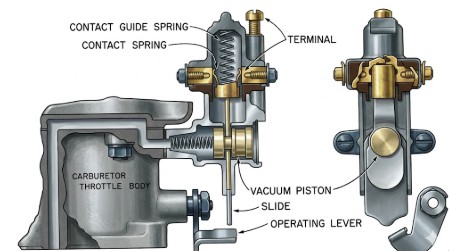
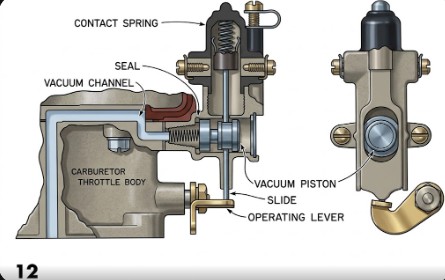
Two types of starting switches are used on the "AA" Series Carburetor. In both types a combination of vacuum and manual control govern the operation of the starting switch which is connected into the cranking motor circuit.
In the slide type shown in Figures 11 and 12, a lever attached to the throttle shaft actuates the switch contacts through a flat slide, a cylindrical contact guide that carries a "U" shaped spring contact to open and close the cranking motor circuit. With the engine stopped and the ignition on, as soon as the throttle is opened, a compression spring above the contact guide moves the slide, contact guide and contact spring
down to engage the stationary contacts in the terminal cover to "CLOSE" the cranking motor circuit.
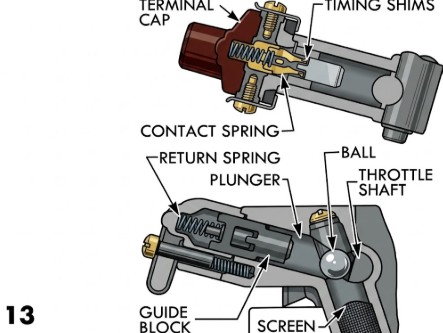
As soon as the engine starts, and the throttle is partially released, the vacuum operated piston is moved in against its seat by manifold vacuum. As the throttle is opened, the slide can move down only to the point of contact with the piston to hold the cranking circuit "OPEN" and prevent cranking the engine. In the ball type shown in Figures 13, 14 and 15, a flat on the throttle shaft actuates the contact spring
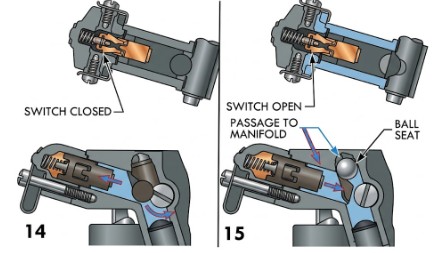
through a ball, a plunger and contact guide. With the throttle closed and the engine stopped, the ball rests on the lower lip of the switch plunger and against the flat on the throttle shaft. A return spring between the contact guide and terminal cap holds the contact spring away from the stationary contact in the terminal cover to "OPEN" the cranking motor circuit, see Figure 13.
As the throttle is opened, the flat on the throttle shaft serves as a cam to push the ball, plunger, contact guide and contact spring to engage the stationary contacts in the terminal cover to "CLOSE" the cranking motor circuit, see Figure 14.
As soon as the engine starts, and the throttle is released, manifold vacuum raises the ball against its seat in the main body flange, and the return spring pushes the contact spring away from the stationary contacts to "OPEN" the cranking circuit, see Figure 15. As long as the engine continues to operate, the ball is held away from the throttle shaft and the cranking circuit remains "OPEN".
As soon as the engine starts, and the throttle is released, manifold vacuum raises the ball against its seat in the main body flange, and the return spring pushes the contact spring away from the stationary contacts to "OPEN" the cranking circuit, see Figure 15. As long as the engine continues to operate, the ball is held away from the throttle shaft and the cranking circuit remains "OPEN"
One model of the Series "AA" Carburetor has a kickdown switch attached to the carburetor, see Figure 13.
The function of this switch is to provide a means of automatically shifting from 4th gear to 3rd gear by merely depressing the accelerator pedal to the floor at car speeds below 50 M.P.H. Depressing the accelerator to the floor when the car speed is below 50 M.P.H. causes a sudden drop in "venturi vacuum" which permits the compression spring (1) to move the piston (2) down and bring the contact (4) between the end of the plunger (3) and the terminal block (5) to complete the circuit. This causes the transmission to shift "DOWN" into 3rd gear where it remains until the accelerator pedal is released, or sufficient "venturi vacuum" is developed to move the piston and contact away from the terminal block. On car speeds above 50 M.P.H. there is sufficient "venturi vacuum" to overrule the compression spring and hold the circuit open to keep the transmission in 4th gear.