
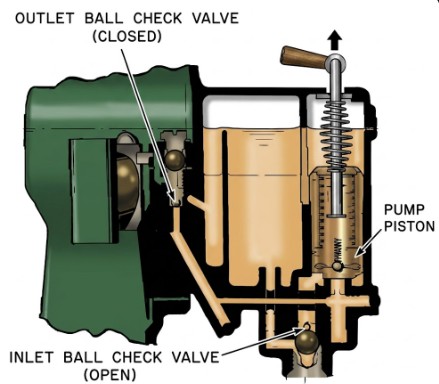
supply.
-
During the Upstroke (Intake): As the Pump Piston moves upward (as shown in your image), it creates a vacuum in the chamber below. This suction lifts the Inlet Ball off its seat, allowing fuel to flow from the float bowl into the pump cylinder.
-
During the Downstroke (Discharge): When you step on the gas and the piston moves down, the fuel pressure forces the Inlet Ball back onto its seat. This seals the path, preventing fuel from being pushed back into the float bowl.
2. The Outlet Ball Check Valve
This ball is positioned in the discharge passage leading to the carburetor throat.
-
During the Upstroke (Intake): While the piston is moving up, the Outlet Ball remains seated (Closed). This prevents air or fuel from being sucked back from the discharge nozzles into the pump cylinder, maintaining the prime.
-
During the Downstroke (Discharge): As the piston moves down, the resulting fuel pressure pushes the Outlet Ball off its seat. This opens the passage, allowing a pressurized stream of fuel to travel to the pump discharge nozzles and into the engine intake.
Comparison of States
| Action | Pump Piston Movement | Inlet Ball Status | Outlet Ball Status |
| Intake | Upward | Open (Fills cylinder) | Closed (Prevents back-suction) |
| Discharge | Downward | Closed (Prevents back-flow) | Open (Feeds nozzles) |
Tech Tip: If you're troubleshooting a "flat spot" or hesitation during acceleration, it’s often because one of these balls isn't seating perfectly due to dirt or corrosion. A quick way to test the discharge side is to ensure the outlet ball drops freely and seats firmly to prevent "percolation" or siphoning when the engine is hot.
What Size Are The Checkballs?
For the Stromberg AAV series (including the AAV-1, AAV-2, and AAV-26), the check balls are typically two different sizes to match their specific passages:
Inlet Ball (Bottom of the pump well): This is a 3/16" steel ball. It is the larger of the two and is responsible for allowing the pump cylinder to fill from the float bowl.
Outlet Ball (Discharge passage): This is a 1/8" steel ball. This smaller ball sits in the discharge channel (often under a brass screw or T-shaped retainer) to prevent fuel from being pulled back out of the discharge nozzles during the intake stroke.
Quick Reference Table
Valve TypeLocationBall DiameterMaterialInletBottom of pump cylinder3/16"SteelOutletMain discharge passage1/8"SteelTech Tip: When rebuilding these, it’s worth double-checking the seats. Since the 1/8" ball is quite small, a tiny speck of debris can keep it from seating, which usually leads to a "hesitation" or "stumble" because the pump doesn't hold its prime. If you find a 5/32" ball in your kit, it’s likely for a different Stromberg model (like some of the BX series), but the AAV almost always sticks to the 3/16" and 1/8" combo.
4
