
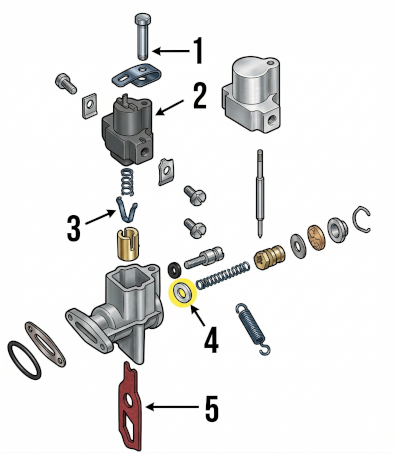
Stromberg 4A Adjustment
To adjust the Stromberg 4A starter switch (often found on Buicks and other GM vehicles from the late 1930s through the early 1950s), you are essentially timing the point where the throttle linkage makes electrical contact to engage the starter.
Because this system is vacuum-assisted, the adjustment ensures the car starts when you floor the pedal, but the starter doesn't "grind" once the engine is running.
1. Preparation & Safety
-
Neutral/Park: Ensure the transmission is in Neutral (manual) or Park (automatic).
-
Ignition Off: Keep the ignition off while making the initial mechanical measurements.
-
Identification: Refer to your diagram: #2 is the switch housing, and #1 is the plunger that the throttle linkage pushes against.
2. The Bench/Static Adjustment
The goal is to ensure the "slide" inside the switch moves far enough to bridge the contacts.
-
Check the Clearance: With the engine off and throttle closed, there should be a small amount of play (usually about 1/16" to 1/8") between the throttle lever and the switch plunger (#1).
-
Adjust the Linkage: If the gap is too large, the car won't start when the pedal is floored. If there is no gap, the starter might engage too early or stay engaged. Adjust the threaded rod or the position of the switch on the carburetor flange to achieve this clearance.
3. The "Cold Start" Test
-
Turn the Ignition On.
-
Depress the Accelerator: Slowly push the pedal toward the floor. The starter should engage when the throttle is approximately 1/3 to 1/2 of the way down.
-
Wide Open Throttle (WOT): The switch must definitely be engaged by the time the throttle hits the floor. If it doesn't engage, move the switch closer to the linkage.
4. The Vacuum Lock-Out (Critical Step)
The Stromberg 4A uses engine vacuum to pull a small ball or piston (inside part #2) out of the way once the engine starts. This prevents the starter from re-engaging if you floor the gas while driving.
-
The Test: Once the engine is running, blip the throttle or push it to the floor. The starter should not engage.
-
If it grinds: The vacuum passage in the carburetor base is likely clogged with carbon. You will need to remove the switch and clean the small hole in the carburetor body with a soft wire.
