

The power system is incorporated into the carburetor to provide a richer mixture for maximum power and high speed operation. The extra fuel for power is supplied by a vacuum controlled power piston in the primary section which automatically operates the power by-pass jets in accordance with throttle opening, see Figure 5. (In the original design, one by-pass jet was used. Later designs used two.)
Intake manifold vacuum is maintained above the vacuum piston through a vacuum channel which leads to the mounting flange of the carburetor. During partial throttle operation, the vacuum above the vacuum piston is sufficient to overrule the compression spring and hold the piston in the "UP" position. When the throttle valves are opened to a point where the manifold vacuum drops to approximately 4 to 5 inches Hg., the compression spring then moves the piston "DOWN" to open the power bypass jet or (jets). and meter additional fuel into the main metering systems.
What is The Purpose of the Spring on The Power Piston?
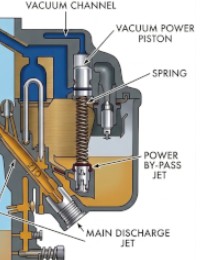
The spring on the vacuum power piston is the mechanical "brain" that decides when the engine needs more fuel for heavy loads or acceleration.
In a Stromberg 4A carburetor, it performs a crucial balancing act against engine vacuum:
1. The Balancing Act (High Vacuum)
When you are idling or cruising at a steady speed, the engine creates high manifold vacuum. This vacuum travels through the vacuum channel and pulls the power piston upward, compressing the spring. While the piston is held up, the power by-pass jet remains closed. This keeps the fuel mixture "lean" for better fuel economy.
2. The "Power" Move (Low Vacuum)
When you step on the gas to pass someone or climb a hill, the throttle plates open wide, and manifold vacuum drops significantly. At this point:
-
The vacuum is no longer strong enough to hold the piston up.
-
The spring takes over and pushes the power piston downward.
-
The bottom of the piston assembly physically pushes open the power by-pass jet.
3. Fuel Enrichment
Once that by-pass jet is forced open by the spring, extra fuel flows into the main discharge jets on the primary side. This richens the air-fuel mixture, providing the extra cooling and combustion energy needed to handle the increased engine load without "stumbling" or "pinging."
In short: The spring is responsible for enabling the power mode. If the spring is too weak, your car will feel sluggish under load; if it's too strong, it will stay in power mode too long and waste fuel.
Troubleshooting Power System
Since the power piston and its spring are the mechanical "switches" for your fuel enrichment, a failure here usually leads to one of two extremes: a car that stumbles under load (too lean) or a car that runs rich and sooty (too much fuel).
Here is how to troubleshoot a stuck power piston or a failed spring in a Stromberg 4A.
1. The "Finger Test" (Physical Inspection)
With the air cleaner removed and the engine off, you can often access the top of the power piston (depending on the specific 4A model variation).
-
The Test: Gently push the piston down with a small tool or finger. It should move freely and spring back up instantly.
-
If it sticks: Carbon deposits or "varnish" from old gasoline have likely gummed up the piston walls.
-
The Fix: Spray a high-quality carburetor cleaner directly into the vacuum cylinder. Work the piston up and down until the movement is silky smooth.
2. The Vacuum Port Check
If the piston moves freely but the car still runs rich at idle, the vacuum channel (seen in your diagram) might be plugged.
-
The Problem: If vacuum can't reach the top of the piston, the spring will keep the piston pushed down, leaving the power jet open 100% of the time.
-
The Fix: Use a thin wire or compressed air to ensure the tiny vacuum passage from the base of the carburetor to the power piston chamber is clear.
3. Inspecting the Spring Rate
Over decades, these springs can heat-cycle and lose their tension, or "set."
-
The Symptom: If the spring is weak, the power circuit won't engage until the vacuum is extremely low, causing a "flat spot" or hesitation when you step on the gas.
-
The Fix: If it looks corroded or distorted, it must be replaced. Note: Never cut or stretch these springs to "tune" them; it ruins the calibrated enrichment point. Unfortunately these spring are not manufactured.
4. The Power By-Pass Jet Seal
Sometimes the piston and spring are fine, but the Power By-Pass Jet (at the bottom of the assembly) is leaking.
-
The Problem: If the tiny plunger inside the jet doesn't seat properly, fuel will leak past it even when the piston is pulled up by vacuum.
-
The Fix: Remove the jet and inspect the seat for debris. Ensure the gasket or O-ring (if equipped) is not brittle or torn.
Troubleshooting Summary Table
| Symptom | Likely Cause | Fix |
| Black smoke / Strong gas smell at idle | Piston stuck DOWN or Vacuum channel plugged. | Clean piston; clear vacuum path. |
| Bogging/Hesitation when accelerating | Piston stuck UP or Weak Spring. | Clean piston; replace spring. |
| Spark plug fouling (Primary side) | Leaking Power By-Pass Jet. | Clean or replace the jet assembly. |
