
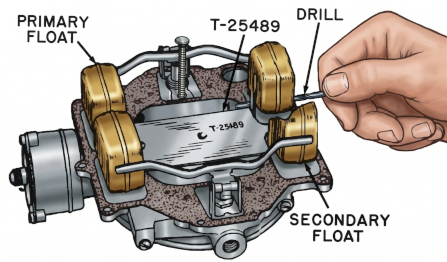
Since specialized vintage tools like the T-25489 gauge are nearly impossible to find today, mechanics use a standard drill bit as a "go/no-go" gauge. This is actually more accurate because drill bits have precise, standardized diameters.
Here is how to adjust the float level on a Stromberg 4A using common shop tools.
1. Preparation & Setup
-
Remove the Air Horn: Take the top section (air horn) off the carburetor. The floats are attached to this top piece.
-
Invert the Air Horn: Flip the assembly upside down. The weight of the floats will now be resting on the needle and seat.
-
Ensure the Gasket is On: The measurement must be taken from the surface of the gasket to the float, not the bare metal. Make sure a new, flat gasket is in place.
2. Select Your "Gauge" (The Drill Bit)
For a Stromberg 4A, the standard float setting is typically 1/8 inch (or .125").
-
Find a 1/8" drill bit.
-
If your specific engine manual calls for a slightly higher or lower level (some Buick manuals specify 9/64"), select the corresponding bit.
3. Measure the Level
-
The Placement: Slide the smooth end (the shank) of the drill bit between the center of the float and the gasket.
-
The Target: The float should just barely touch the drill bit.
-
If the bit won't fit, the float is too low (fuel level will be too high).
-
If there is a gap between the bit and the float, the float is too high (fuel level will be too low).
-
4. Adjusting the Float
Crucial: Never apply pressure to the brass float bulb itself. It is fragile and easily punctured.
-
To Adjust: Use needle-nose pliers to bend the small metal tang (lip) that contacts the needle valve.
-
To Lower the fuel level: Bend the tang toward the needle valve.
-
To Raise the fuel level: Bend the tang away from the needle valve.
-
Check Alignment: Ensure the floats are perfectly vertical. If they are tilted to one side, they will rub against the fuel bowl and stick, causing a flood.
5. The "Slosh" Test
While the floats are out, give them a gentle shake near your ear. If you hear liquid sloshing inside, the brass has a pinhole leak. A "heavy" float will sink, causing the carburetor to overflow regardless of how well you adjust it. If you hear fuel inside, the float must be replaced.
