
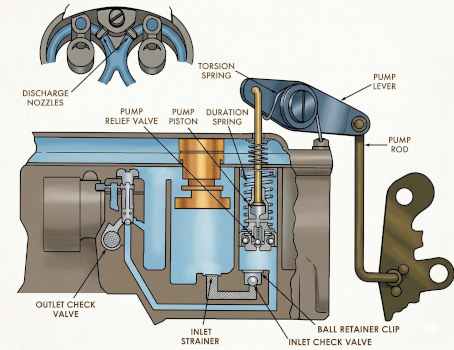
piston prevents an excessive pressure in the system when the throttle is snapped open suddenly, and the pressure reaches a given value. With the return of the accelerator pump lever to the released position, the outlet ball check valve "CLOSES", while the inlet ball check valve "REOPENS", thus permitting fuel from the float chamber to enter and refill the accelerator pump cylinder.
Troubleshooting Stromberg 4A Accelerator Pump
The Stromberg 4A is a sophisticated four-barrel carburetor, and the accelerator pump circuit is a common source of performance issues like "flat spots" or hesitation during acceleration. Because this circuit relies on a series of check balls and a mechanical linkage, troubleshooting requires a methodical approach.
Visual Inspection & Preliminary Checks
Before tearing the carburetor down, perform a "squirt test" with the engine off:
Remove the air cleaner.
Look down into the primary venturi while manually pulling the throttle lever.
The Goal: You should see two strong, immediate streams of fuel.
The Problem: If the stream is weak, delayed, or non-existent, the pump circuit is failing.
Common Troubleshooting Steps
1. Check the Pump Discharge Nozzles
If you have fuel in the bowl but no squirt, the nozzles (shooters) may be clogged with dried fuel or debris.
The Fix: Remove the discharge cluster and use a thin wire or compressed air to ensure the passages are clear.
2. Inspect the Pump Plunger (Leather or Rubber)
The Stromberg 4A uses a plunger that can dry out if the vehicle has been sitting, especially with modern ethanol fuels.
The Problem: A dried or cracked plunger won't create the seal necessary to push fuel through the circuit.
The Fix: If the leather is just dry, you can sometimes add a few drops of oil to expand it. If it’s cracked or worn, it must be replaced.

3. Test the Check Balls (Inlet & Outlet)
The circuit relies on two check balls to ensure fuel moves in only one direction.
Inlet Check Ball: Located at the bottom of the pump well. If it doesn’t seat, fuel will push back into the float bowl instead of out the nozzles.
Outlet Check Ball: Located in the discharge passage. If this sticks, fuel can't reach the nozzles.
The Test: Tap the check balls lightly with a brass drift to ensure they are seating properly. Ensure they move freely and aren't "glued" in place by old varnish.
4. Linkage & Stroke Adjustment
Sometimes the circuit is mechanically fine, but the "timing" is off.
The Problem: There should be no "slop" in the pump linkage. The pump should move the instant the throttle moves.
The Fix: Check the pump rod holes. Most 4A models have multiple holes for seasonal adjustments (Winter/Summer). Moving the rod to the hole furthest from the pivot will provide a larger "shot" of fuel.
Quick Troubleshooting Summary
Check Ball Placement
In the Stromberg 4A (Aeroquad) carburetor, there are typically two different-sized steel check balls used in the accelerator pump circuit. Getting them swapped will cause the car to stumble or "flat spot" during acceleration.
The Bigger Check Ball (3/16")
The bigger check ball is the Intake Check Valve.
-
Location: It goes at the very bottom of the accelerator pump cylinder (the well).
-
Function: It acts as a one-way door. When you let off the gas and the pump plunger moves up, this ball lifts to let fuel into the well. When you hit the gas and the plunger moves down, the pressure forces the ball against its seat, preventing the fuel from simply "leaking" back into the float bowl.
The Smaller Check Ball (1/8")
The smaller check ball is the Discharge Check Valve.
-
Location: It is located in the discharge passage (the vertical channel that leads up to the pump nozzles).
-
Assembly Note: In a Stromberg 4A, this smaller ball is usually followed by a brass or aluminum "weight" (a small metal rod/pin). The ball goes in first, and the weight sits on top of it to help gravity hold the ball down against its seat.
-
Function: It prevents the engine from "siphoning" fuel out of the pump nozzles when you are just cruising at a steady speed.
Pro-Tips for Installation:
-
The "Drop Test": Before final assembly, drop the balls into their respective holes and give them a very light tap with a flat-end punch to ensure they are "seated" properly.
-
Don't Forget the Weight: If you leave the weight out of the discharge passage, the smaller ball will float around, and the carburetor will likely "drip" fuel from the pump nozzles while idling.
-
Test the Pump: After installing the balls and adding a little fuel to the bowl, manually operate the pump. You should see a strong, steady stream from the nozzles without any "back-bubbling" into the fuel bowl.
