
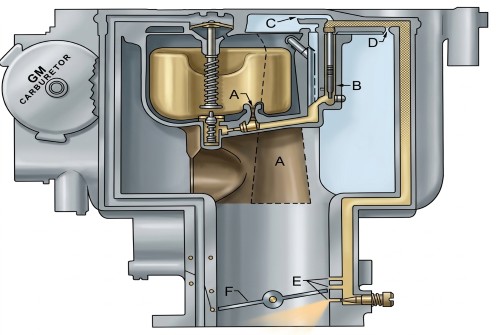
The Rochester AA Carburetor Idle System
The carburetor idle system controls the fuel/air mixture from the engine's initial idle setting up to approximately 30 mph.
1. Fuel Metering and Initial Mixing
The path of the fuel flows through the following steps:
-
Main Metering Jets ("A"): Fuel first passes from the bowl through the centrally located main metering jets into the Idle Tubes ("B").
-
Calibrated Orifices: Each idle tube features a calibrated orifice at the bottom, which precisely controls the amount of solid fuel metered into the idle system.
-
Air Bleeds ("C"): As the solid fuel travels upward to the junction of the bowl and the air horn (cover), air is introduced and mixed with the fuel through two calibrated air bleeds.
2. The Mixture Passage
Once the initial fuel/air mixture is formed, it follows a directed path through the carburetor bodies:
-
The mixture travels horizontally through a cored passage in the air horn cover.
-
Idle Channel Bleed ("D"): Additional air is metered into the stream by the idle channel bleed to further atomize the mixture.
-
Driven by engine manifold vacuum, the mixture continues downward through cored passages in the float bowl housing and into the throttle body.
3. Discharge into the Engine
As the mixture reaches the throttle body, it is introduced to the intake manifold through two sets of ports controlled by the throttle valves ("F"):
-
Idle Adjusting Needles ("E"): At idle, the mixture is metered past the adjustable idle mixture screws to keep the engine running smoothly when the throttle is fully closed.
-
Secondary (Transfer) Idle Holes ("K"): As the throttle valves ("F") begin to open, they expose the secondary top idle holes to the high manifold suction. This discharges additional fuel/air mixture to ensure a smooth transition from idle to the main metering system without stumbling.
Here is a practical troubleshooting guide for the Rochester AA idle system. Because this is a two-barrel, dual-product carburetor, problems in the idle circuit usually manifest as an unmanageable idle, stumbling just off idle, or an engine that refuses to idle down at all.
Rochester AA Idle System Troubleshooting
1. Rough, Eratic, or Unadjustable Idle (Too Rich)
If turning the idle mixture screws ("E") all the way in has no effect on the engine, or if the engine runs excessively rich and smells like raw fuel at idle, look for the following:
-
Plugged Air Bleeds ("C" or "D"): If the main air bleeds at the air horn junction or the idle channel bleeds are clogged with varnish or dirt, the circuit cannot mix air with the fuel. It will draw solid fuel straight out of the bowl via manifold vacuum, causing an extreme rich condition. Fix: Blow out all cored air passages with carburetor cleaner and compressed air.
-
Grooved or Bent Idle Needle Screws: If the tips of the idle adjusting screws are ridged, grooved, or bent from being overtightened, they lose their ability to finely meter fuel. Fix: Inspect the tips; replace the needles if they show a visible ring or damage.
-
Damaged Throttle Body Seats: If a previous rebuilder forced the idle needles tight, the seats inside the cast iron throttle body may be cracked or distorted, allowing fuel to bypass the needles entirely.
-
Heavy or Sunk Float / High Fuel Level: If the float is loaded with fuel or the fuel level is set too high, fuel can slosh over the main nozzles or enter the idle system prematurely, flooding the engine at low RPM.
2. Engine Stalls, Starves, or Won't Idle (Too Lean)
If the engine will only run with the choke partially closed or won't idle unless you keep your foot on the gas pedal, the idle circuit is starving for fuel:
-
Clogged Idle Tube Orifices ("B"): The orifices at the bottom of the idle tubes are very small and easily blocked by fine sediment or tank rust. Even a tiny restriction will starve the entire idle circuit. Fix: Carefully clean the idle tubes. Ensure they are completely clear.
-
Gasket Leaks at Body Junctions: The idle mixture must cross horizontally from the cover through the bowl down to the throttle body. If the air horn gasket or the throttle body gasket is torn, compressed, or mismatched, it will break the vacuum seal, drawing in outside air instead of fuel.
-
Warped Main Body or Air Horn: If the carburetor down-bolts were overtorqued, the casting surfaces can warp, preventing the gaskets from sealing the cored idle passages.
-
Plugged Idle Discharge Holes ("E" or "K"): Carbon deposits from the engine intake can accumulate around the lower throttle plate area, plugging the fine idle holes and the secondary transfer slots.
3. Off-Idle Stumble or Hesitation (Up to 30 MPH)
If the engine idles perfectly but stumbles, hesitates, or sags the moment you step lightly on the gas pedal, the issue lies in the transition zone:
-
Clogged Secondary Top Idle Holes ("K"): Also known as the transfer slots or off-idle ports. If these holes are blocked by carbon or debris, there is a "dead spot" of vacuum transfer between the fully closed idle position and the point where the main metering jets ("A") take over.
-
Incorrect Throttle Valve Position / Worn Shafts: If the throttle shaft or the bushings in the throttle body are badly worn, it allows unmetered "false air" to leak past the shaft. This destroys the precise vacuum signal needed to pull fuel from the secondary idle holes ("K") just as the plates crack open.
-
Misaligned Throttle Plates: If the throttle plates ("F") are not perfectly centered or are binding in the bores, they may expose the transfer holes prematurely or not quickly enough, disrupting the transition flow.
A Quick Bench Tip for Cleaning: When rebuilding the AA, always verify that cleaner sprayed into the idle tube ("B") exits freely out of both the idle needle hole ("E") and the transfer hole ("K") in the throttle body. If it doesn't flow through, the internal cored passage is still blocked.
