
Understanding the Rochester Model AA Automatic Choke System
Getting a vintage engine to start smoothly in freezing weather requires a delicate mechanical dance. Without a choke system, a cold engine would stall out instantly from a lean fuel-to-air ratio, because fuel struggles to vaporize when the metal intake components are cold.
The Rochester Products Carburetor (specifically the Model AA) solves this with a cleverly automated, thermostatically operated choke system. Rather than relying on a manual cable pulled by the driver, it seamlessly balances mechanical forces, heat, and engine vacuum to regulate airflow during the warm-up period.
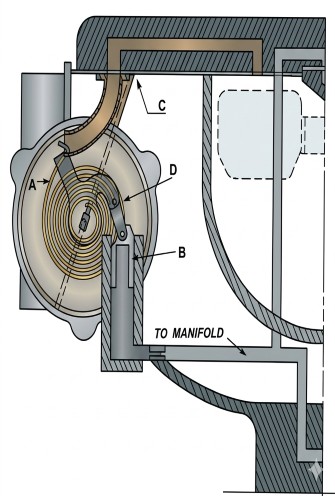
Here is a breakdown of how the Rochester AA choke operates, using the components illustrated in the system diagram.
The Core Components
The automatic choke system relies on four primary interconnected parts:
Thermostatic Coil (A): A temperature-sensitive, coiled bimetallic spring housed in a protective cover. It acts as the "brain" of the system, expanding or contracting based on ambient and exhaust heat.
Choke Piston (B): A small piston residing in a cylinder that is linked directly to the intake manifold vacuum via a precisely calibrated hole.
Choke Valve (C): A butterfly valve located at the top of the carburetor air horn. Crucially, this valve is offset—meaning the shaft does not pass exactly through the center, leaving one side larger and subject to air velocity forces.
Choke Valve Shaft (D): The central hinge pinned to the choke valve, connected via linkages to both the thermostatic coil and the choke piston.
Phase 1: The Cold Start
When the engine is completely cold, the bimetallic thermostatic coil (A) contracts. It is calibrated to exert enough force on the choke valve shaft (D) to hold the choke valve (C) firmly closed. This restricts incoming air, ensuring that when the engine cranks, it draws a highly concentrated, rich fuel mixture into the cylinders to guarantee a successful start.
As soon as the engine fires up, two immediate forces prevent it from instantly flooding with fuel:
Air Velocity: Incoming air slams against the offset design of the choke valve. Because one side of the valve is larger than the other, the rushing air forces the valve to crack open slightly.
Manifold Vacuum: Simultaneously, the running engine generates high vacuum in the intake manifold. This suction travels through a calibrated channel to the underside of the choke piston (B). The vacuum pulls the piston downward.
Because the piston is hinged to the choke valve shaft, this downward pull fights against the tension of the thermostatic coil. The choke valve quickly assumes a balanced, partially open position where the closing torque of the cold coil perfectly matches the opening pull of the vacuum and air velocity. This provides a controlled, slightly leaned-out mixture ideal for initial idling.
Phase 2: Compensating for Acceleration and Load
An engine's needs change dynamically even before it reaches full operating temperature. If a driver accelerates during the warm-up period, the engine requires a momentary surge of extra fuel.
The Rochester choke piston handles this automatically by responding to changes in engine load:
Under acceleration, the throttle plates open wide, causing a sharp drop in intake manifold vacuum.
With less vacuum pulling down on the choke piston (B), the piston relaxes.
This allows the thermostatic coil (A) to temporarily overpower the system and momentarily close the choke valve (C) a bit further.
The restricted airflow momentarily enriches the fuel mixture, preventing the engine from stumbling or hesitating during cold acceleration.
Phase 3: Coming Up to Temperature
As the engine continues to run, hot air heated by the exhaust manifold is drawn directly into the housing cover surrounding the thermostatic coil.
As this heat transfers to the thermostatic coil (A), the bimetallic metal begins to relax and lose its tension. With the closing force of the coil diminishing, the constant pull of the manifold vacuum and incoming air velocity gradually force the choke valve (C) into a fully upright, open position.
Once fully warm, the choke valve stays wide open, allowing unrestricted airflow into the carburetor for normal, efficient driving.
Troubleshooting Guide: Rochester Model AA Automatic Choke
When a vintage Rochester Model AA automatic choke malfunctions, the engine will usually let you know immediately. A choke that stays closed too long causes flooding, heavy black smoke, and fouled spark plugs. Conversely, a choke that opens too quickly (or won't close at all) causes hard cold starts, severe hesitation, and stalling.
Because this system relies on a delicate balance of heat, vacuum, and mechanical linkage, troubleshooting is a process of elimination.
1. The Choke Won't Close (Hard Starting / Stalling When Cold)
If the engine cranks endlessly or stalls immediately after a cold start, the choke valve is likely staying open.
Check for Mechanical Binding: With the engine dead cold and off, manually push the choke valve (C). It should move freely without sticking. If it drags, inspect the choke valve shaft (D) and connecting linkages for dirt, varnish, or physical damage. Clean them thoroughly with carburetor cleaner (do not oil them, as oil attracts dirt and gums up).
Inspect the Thermostatic Coil (A): Remove the choke thermostat cover. Inspect the bimetallic spring inside. Is it broken, unhooked from the internal lever, or corroded? If the coil has lost its tension or is fractured, it cannot force the valve closed.
Verify Index Alignment: The choke cover has indexing marks to adjust tension. If the cover was previously removed, it may be rotated too far in the "rich" or "lean" direction. Loosen the retaining screws and rotate the housing according to factory specifications to increase cold tension.
2. The Choke Won't Open (Black Smoke / Flooding / Poor Fuel Economy)
If the engine starts fine but begins to chug, blow black exhaust smoke, or load up with fuel as it warms up, the choke is failing to open.
Check the Exhaust Heat Supply: The thermostatic coil relies on hot air drawn from the exhaust manifold heater stove.
Feel the fresh air metal tube leading to the choke housing after the engine has run for a few minutes. It should be hot to the touch.
If it remains cold, the heat riser tube is likely rusted out, clogged with carbon, or disconnected. Without exhaust heat, the coil will never relax, keeping the choke closed permanently.
Test the Choke Piston (B) for Vacuum Leaks: The choke piston is supposed to instantly pull the choke slightly open upon startup.
If the calibrated vacuum hole in the carburetor body is plugged with carbon, the piston won't move. Clean the passage.
Inspect the piston and its cylinder wall. If the piston is scored or tightly gummed up with varnish, it will seize in the bore and fail to pull against the thermostatic coil.
3. Engine Hesitates or Stumbles Under Acceleration (During Warm-Up)
If the vehicle starts and idles fine when cold, but bogging down or hesitations occur when pressing the gas pedal before the engine is fully warm, the dynamic compensation is failing.
Faulty Choke Piston (B) Fitment: During acceleration, manifold vacuum drops, which should allow the piston to relax and briefly enrich the mixture. If the piston is sticking slightly in its bore, it won't react quickly enough to the drop in vacuum, leading to a temporary lean stumble.
Incorrect Coil Tension Balance: If the thermostatic coil (A) is adjusted too weak, it won't have the strength to momentarily close the offset valve when vacuum drops. Try slightly richening the choke housing adjustment (rotating it one notch at a time) to see if cold acceleration improves.
