
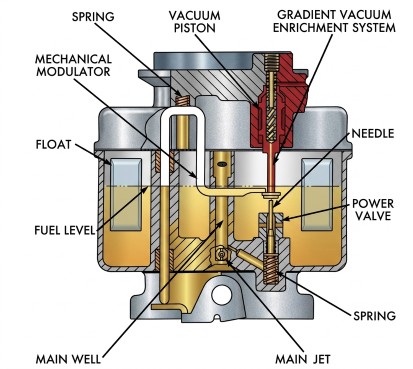
On the Holley 1945—the single-barrel workhorse found on many classic Chrysler Slant-6 engines—the power piston assembly is the heart of the power enrichment circuit. Its job is to mechanically richen the fuel mixture when engine load increases and manifold vacuum drops, ensuring the engine doesn't lean out and stumble under acceleration or heavy loads.
The system relies on a constant tug-of-war between engine vacuum and a calibrated spring.
How It Operates
The power piston assembly sits in a well in the main body/air horn and consists of a vacuum-operated piston, a return spring, and an attached rod that extends downward to ride against a power valve (often a ball-check or pin-style valve in the bottom of the bowl).
Here is exactly how it functions across different engine loads:
1. High Vacuum (Cruising or Idling)
When you are idling or cruising down the highway at a steady speed, the engine creates high manifold vacuum.
-
This vacuum is routed through a dedicated passage straight to the bottom of the power piston chamber.
-
The strong suction pulls the power piston downward, compressing the power piston spring.
-
In this downward position, the rod attached to the piston moves away from (or releases pressure on) the power valve assembly.
-
This keeps the power valve closed. Fuel flows only through the main metering jet, keeping the mixture lean and efficient for light-load driving.
2. Low Vacuum (Acceleration or Heavy Load)
When you step on the gas pedal to accelerate, pass another vehicle, or climb a hill, the throttle plate opens wide, and manifold vacuum drops drastically.
-
With the drop in vacuum, there is no longer enough suction to hold the piston down against the spring force.
-
The calibrated spring wins the tug-of-war and pushes the power piston upward.
-
As the piston moves up, its attached pin/rod unseats or depresses the power valve mechanism in the fuel bowl.
-
This opens an extra fuel passage, allowing additional fuel to bypass the main jet and flow directly into the main well, enriching the mixture to handle the heavy engine load.
Common Issues to Watch For
Because this circuit relies entirely on a precise vacuum balance and smooth mechanical movement, it is a frequent culprit when a Holley 1945 isn't acting right:
-
Stuck Piston: If varnish, dirt, or old fuel residue causes the power piston to bind or stick in its bore, it can cause major performance issues. If it sticks down, the engine will suffer a severe lean stumble or hesitation under load. If it sticks up, the power circuit stays open constantly, causing an incredibly rich idle, fouled spark plugs, and terrible fuel economy.
-
Leaky Vacuum Passage: If the gasket between the main body and the air horn isn't sealing perfectly around that tiny vacuum passage, the piston won't get enough vacuum signal to stay down. The spring will keep the power valve open, causing a persistent rich condition.
-
Mismatched or Weak Spring: During a rebuild, if the spring is distorted or replaced with an incorrect tension rating, the piston will tip into the "power" phase either too early or too late, disrupting the transition from the cruise circuit to the power circuit.
