
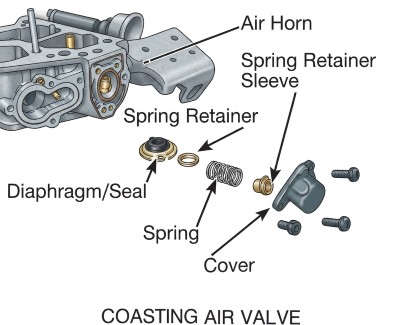
When you roll off the throttle while the engine is running at high RPM, the butterfly valve slams shut. This creates an extremely high vacuum in the intake tract downstream of the throttle. That severe vacuum pulls a massive rush of unmetered air and fuel through the idle and low-speed circuits, creating an overly lean mixture that fails to burn completely in the cylinder. This unburned fuel then ignites when it hits the hot exhaust headers, causing a loud pop or backfire.
How It Works
During Deceleration (Vacuum Spike): High intake vacuum pulls against a rubber diaphragm inside the valve, overcoming a small internal spring to open an air passage. This bypasses the main air circuit and dumps extra air directly into the pilot/idle circuit or downstream of the throttle to enrich the mixture just enough to prevent misfires during high-vacuum braking.
During Normal Riding / Acceleration: Vacuum drops back to normal levels, and the internal spring pushes the diaphragm back, closing the valve so standard idle and progression circuits operate without interference.
Common Failure Symptoms
Loud popping or backfiring from the exhaust every time you decelerate or roll off the throttle.
A slight hesitation or unstable idle if the rubber diaphragm develops a pinhole or tear, which creates a continuous vacuum leak.
Verification: To check if the valve is functioning properly, inspect the rubber diaphragm behind the small cover plate on the side of the carburetor for tears, stiffness, or cracks, and ensure the tiny air passages and O-rings are completely clean and free of varnish.
Mikuni Enrichment Valve
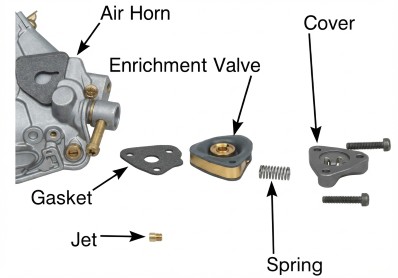
When applied to an automotive application—such as vintage imported cars, dune buggies, or utility vehicles retrofitted with Mikuni side-draft or flat-slide carburetors (like popular dual-Mikuni HSR or SBN setups)—the enrichment valve serves as the manual choke system required to start a cold engine.
Because cars require more pulling leverage and distance from the driver's seat than a motorcycle, automotive Mikuni setups typically replace the pull-knob on the side of the carb with a remote cable-operated choke pull routed to the dashboard.
Automotive Function & Operation
Cold Starts: When you pull the dash choke cable on a freezing morning, it mechanically lifts the plungers on the carburetors. This opens the dedicated enrichment passages, delivering the extra liquid fuel required to overcome fuel condensation on cold intake manifold walls.
Idling and Warm-Up: As the engine fires and runs, the enricher keeps the mixture rich enough to prevent stumbling or stalling while the heavy cast-iron or aluminum engine block absorbs heat.
Pushing the Cable In: As the engine reaches operating temperature, pushing the dash knob back in seats the plungers. This shuts off the auxiliary fuel circuit, returning the carburetors to their normal idle and progression jets.
Key Considerations for Car Installations
Multi-Carburetor Synchronization: If your vehicle runs dual Mikunis (common on modified inline-four or six-cylinder engines), both enrichment valves must open and close identically. If one cable or plunger is out of adjustment, one cylinder bank will pull rich while the other runs lean, leading to a rough, lurching warm-up idle.
Plunger Tip Wear: In automotive engine bays, radiant heat from exhaust headers can bake the tiny rubber tips on the enricher plungers over time. If these tips harden or crack, they won't seat fully, causing the engine to run permanently rich, wash down cylinder walls with gas, and tank your fuel economy.
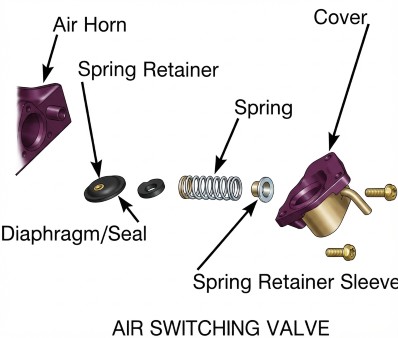
The term air switching valve (frequently tied to secondary air supply or emissions systems associated with Mikuni-equipped setups) serves an emissions-control and exhaust-cleanup function rather than a fuel-metering one.
Depending on the specific machinery configuration, it typically points to one of two related emission components:
1. Secondary Air Switch / Reed Valve Vacuum Control
On many multi-cylinder powersports and vintage vehicle engines utilizing Mikuni constant-velocity (CV) carburetors, an air switching valve (often vacuum-operated) controls the flow of fresh air from the airbox into the exhaust port or reed-valve assembly.
-
The Goal: It injects fresh air into the exhaust stream specifically during high-vacuum states (like deceleration) to help completely oxidize and burn off any residual, unburned hydrocarbons before they escape out the tailpipe.
-
The Valve's Role: It uses intake manifold vacuum signals (tied via a small rubber hose directly to a nipple on the carburetor throat) to open or close, ensuring air is only introduced when engine operating conditions call for it.
2. Air Cut-Off Valve (Frequently Interchanged Term)
Because riders and mechanics frequently blend terms, what some call an "air switching" or "air cut" valve is actually the coasting air cut-off valve located directly on the side of the Mikuni body.
-
The Goal: As noted with decel popping, this internal spring-and-diaphragm assembly switches an auxiliary air passage on during sudden throttle closures to prevent an ultra-lean decel misfire.
Verification: If you are tracing a rubber line coming off a nipple on your Mikuni carburetor body to an external disc-shaped or canister-like valve, check whether it routes to an emissions reed-valve cover on the engine head (Air Switching / Emission Control) or simply modulates a bypass circuit entirely within the carburetor body (Air Cut-Off).
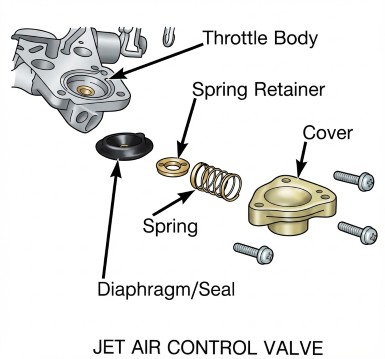
Depending on the specific Mikuni model and application, an air control valve typically refers to one of two distinct components responsible for managing auxiliary airflow:
1. The Pilot Air Screw / Idle Air Control Screw
On many Mikuni smoothbore, flat-slide (like the HSR series), or VM round-slide carburetors, what is often called an air control or pilot air screw regulates the amount of atmospheric air blended into the idle and low-speed fuel circuit.
-
Function: Located near the intake bell or the mouth of the carburetor, it fine-tunes the idle mixture by metering air rather than fuel. Turning it out introduces more air (leaning the idle mixture), while turning it in restricts air (richening the mixture).
2. The Diaphragm-Actuated Air Cut-Off / Control Valve
On vacuum-operated CV (Constant Velocity) Mikunis, an external housing covers an air cut-off or control valve driven by manifold vacuum.
-
Function: It temporarily routes metered air into specific internal bypass circuits during high-vacuum transition states (such as snapping the throttle shut) to prevent lean backfiring and stabilize low-speed engine transitions.
Verification: If you are looking at a small brass screw recessed into the body near the air filter side, you are adjusting the pilot air mixture. If you are looking at a small plate secured by two screws with a rubber vacuum line attached to it, you are looking at the diaphragm-operated air control/cut-off valve.
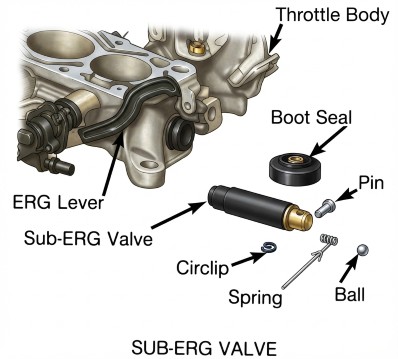
A Mikuni sub-EGR valve (often part of a secondary emissions control layout on small-displacement engines, motorcycles, or specialized industrial applications utilizing Mikuni-associated fuel and vacuum components) helps manage Exhaust Gas Recirculation (EGR).
Its core function is to route a precise, metered amount of inert exhaust gas back into the engine's intake stream to lower peak combustion temperatures and minimize harmful nitrogen oxide (NOx) emissions.
How It Works
-
Exhaust Reintroduction: Under specific throttle openings and engine load conditions, the valve opens to let a small percentage of exhaust gases mix with the incoming fresh air-fuel charge.
-
Temperature Suppression: Because exhaust gas is inert, it absorbs heat and dilutes the available oxygen. This slows down the combustion burn rate and drops peak cylinder temperatures below the threshold where NOx formation spikes (typically above 2,700°F or 1,500°C).
-
The "Sub" Designation: In setups utilizing a primary EGR valve or a multi-stage emissions control system, a sub-EGR valve often acts as a auxiliary switching or vacuum-regulating valve. It ensures EGR is only active during mid-range cruising speeds—staying completely closed at idle and wide-open throttle to preserve smooth engine performance and drivability.
Common Failure Symptoms
-
Rough Idling or Stalling: If carbon buildup causes a sub-EGR valve to stick partially open, hot exhaust leaks into the engine even at idle, causing a severe vacuum leak effect, rough running, or sudden stalls.
-
Engine Hesitation or Knocking: If it fails to open when required, combustion temperatures rise, which can lead to spark knock, detonation, or hesitation under load.
Verification: Check the small vacuum lines routing to the sub-EGR diaphragm to ensure they are secure and free of cracks, and inspect the valve housing for carbon deposits that might prevent the internal pintle from seating correctly.
Mikuni Accelerator Pump Diaphragm

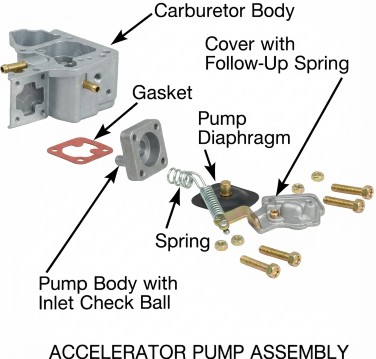
The accelerator pump on a Mikuni carburetor (most notably found on flat-slide performance models like the Mikuni HSR series) is designed to eliminate the momentary hesitation or "bog" that happens when you snap the throttle open quickly.
How It Works
The Problem It Solves: When you twist the throttle wide open instantly, the sudden influx of air rushes into the engine faster than the liquid fuel can catch up. Air is light and moves immediately, but fuel is heavy and takes a split-second longer to respond, creating a temporary lean stumble.
The Mechanical Shot: Connected directly to the throttle linkage, a small diaphragm pump physically squirts a precise, metered stream of raw liquid fuel directly into the carburetor bore (or down the intake tract) the exact moment you rotate the throttle. This bridges the gap, enriching the mixture instantaneously so the engine accelerates without missing a beat.
Key Maintenance & Tuning Aspects
Linkage Adjustment: Mikuni HSR pumps feature an adjustable timing screw and arm. If the pump actuates too early or too late, you'll experience a flat spot during acceleration.
Clogged Nozzles: Because the pump uses a tiny nozzle tip and check valve, letting old fuel sit can varnish it shut. If the nozzle clogs, you will lose the fuel stream and immediately notice a hesitation when snapping the throttle open.
