
- Adjust the idle mixture. Use a vacuum gauge connected to any vacuum source off the intake and adjust the idle mixture screw until you get a smooth vacuum reading.
- Adjust the idle mixture at idle speed only. Above that and the idle circuit is bypassed.
- If adjusting the idle mixture doesn't change the RPM, then you have a problem in the carburetor, such as the idle passage being blocked.
- Check the passage from the idle mixture hole at the bottom of the bore all the way to to the venturi. This passage provides air to the fuel and must be clear. Blowing compressed air through the passage is the best way.
- The venturi gasket needs to be sitting flat and they sometimes need to be trimmed.
- Clear all of the small passages in the venturi.
- Check for vacuum leaks. Spray carb cleaner around the mounting, intake and any other vacuum source. If the RPM smooths out, you have found the problem.

It’s a common point of confusion because the Mercarb is a direct descendant of the Rochester 2GC, which almost always has two idle mixture screws. The shift to a single screw was a specific design choice by Mercury Marine to simplify the tuning process and ensure a more balanced idle across both cylinders.
Here is the technical reason for the single-screw setup:
1. The Common Idle Channel
While a standard 2-barrel carburetor typically has two independent idle circuits (one for each venturi), the Mercarb uses a common plenum or cross-over channel in the throttle body.
-
The Path: Fuel and air are drawn through the idle tubes in both barrels as usual, but before the mixture reaches the discharge ports, the two streams merge into a single internal passage.
-
The Control: The single idle mixture screw is placed at the end of this merged passage. It acts as a "master valve" that regulates the volume of the pre-mixed air/fuel entering the intake for both barrels simultaneously.
2. Simplicity and "Synch"
In a marine environment, engine vibration and the need for easy field maintenance are major factors.
-
Balancing: With a two-screw system, a technician has to balance the two screws to ensure both barrels are contributing equally to the idle. If they are uneven, the engine can "hunt" or vibrate excessively.
-
The Mercarb Solution: By merging the circuits internally, Mercury eliminated the need for balancing. As long as the internal passages are clean, both barrels get an identical mixture, and the user only has one point of adjustment to find the "sweet spot" for RPM and vacuum.
3. The Importance of the Base Gasket
Because of this "merged" design, the base gasket is more critical on a Mercarb than on almost any other carburetor.
-
If you use a thin, standard Rochester 2GC gasket on a single-screw Mercarb, it often fails to seal the specific vacuum channels required for that common idle circuit.
-
This usually results in an engine that won't respond to the mixture screw at all or has a persistent "lean sneeze" at idle because it's sucking air from the wrong side of the throttle plates.
Identifying the Difference
If you're ever looking at a pile of cores and trying to distinguish them quickly:
-
Rochester 2GC: Two mixture screws, usually in the base or lower body.
-
Mercarb: One mixture screw, located in the center-front of the throttle body base.
This design stuck around until the introduction of the TKS (Turn Key Start) models, which moved away from traditional idle mixture screws entirely in favor of fixed jets and the thermal enrichment system we discussed earlier.

Idle Adjustment
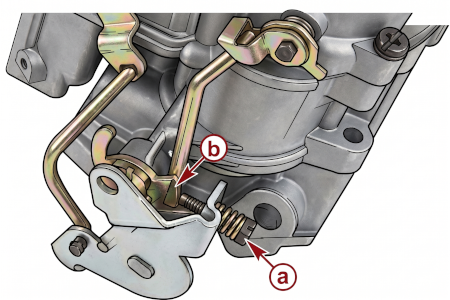
- Choke should be wide open
- Idle screw sits against the fast idle cam. With the choke valve open, the cam should be at the lowest point.
- Adjust idle with warm engine to operating RPM, 550-600 RPM
Adjusting the Mercarb Idle Mixture
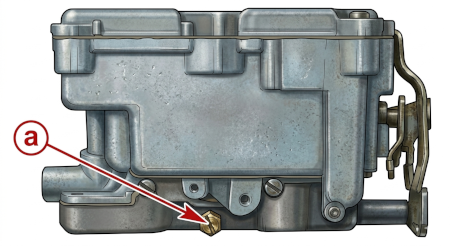

- Warm up the engine
- Turn the idle mixture screw counter clockwise 1/2 turn. It may be turned too far from the start.
- Turn the idle mixture screw clockwise 1/4 turn at a time, waiting for the RPM to settle out.
- When the RPM starts to drop turn the screw counter clockwise 1/4 turn.
