
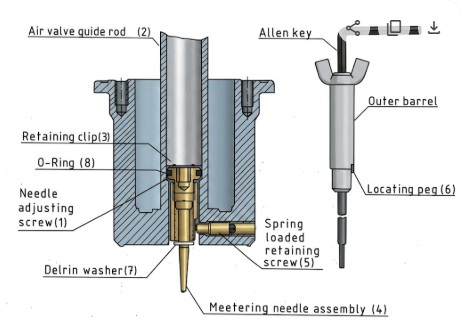
How to Adjust a Zenith Stromberg Metering Needle
Step 1: Identify Needle Type
Zenith Stromberg's came with either:
-
Fixed needles (non-adjustable)
-
Adjustable needles, which allow mixture tuning
Fixed needles are secured in the air piston with a locking screw and can’t be adjusted unless replaced with a different profile.
Adjustable needles are mounted with a spring-loaded collet and can be raised or lowered for tuning.
Step 2: Gain Access to the Needle
-
Remove the air cleaner.
-
Remove the top dome (air piston housing) carefully.
Be sure not to damage the diaphragm. -
Gently pull the air piston assembly out of the carb body.
The metering needle extends from the bottom.
Step 3: Determine Adjustment Method
For Adjustable Needles (Spring Clip Type):
-
Hold the piston upside down.
-
Locate the needle secured by a slotted ring or spring clip.
-
Press the needle inward slightly (you’ll feel spring tension), and rotate:
-
Clockwise (down) to lean the mixture (less fuel)
-
Counterclockwise (up) to richen the mixture (more fuel)
-
-
Rotate in small increments (1/8 turn) and re-test.
For Fixed Needles:
These cannot be adjusted. To change fuel mixture:
-
Adjust the jet size (if replaceable)
-
Swap in a different profile needle (requires model-specific tuning)
Step 4: Reinstall and Test
-
Carefully reinsert the piston and diaphragm into the carb.
-
Reinstall the dome and tighten screws evenly.
-
Start the engine and let it warm up.
-
Test idle quality, throttle response, and plug color:
-
White plugs = too lean
-
Black, sooty plugs = too rich
-
Tan/gray = optimal
-

Tips for Success
-
Always make sure the piston moves freely after reassembly.
-
If engine surges, hesitates, or smells rich/lean, revisit the needle setting.
-
Make one adjustment at a time and test drive after each change.
Needle Profile Notes
Zenith Stromberg needles are available in different profiles (B1AF, B2AF, etc.), each designed for specific engines and fuel demands. Make sure you're using the correct one for your vehicle and altitude.
