
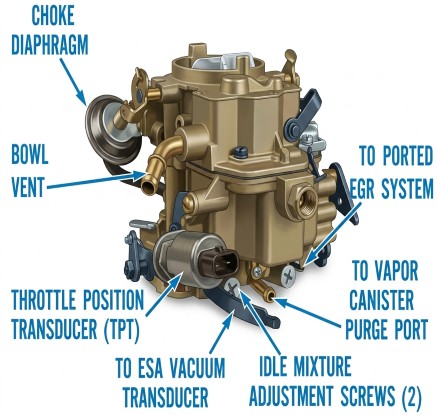
How Does the Vapor Canister Work?
Here is the mechanical breakdown of how those two circuits interact with the canister.
1. The Bowl Vent (Engine Off)
When the engine is shut down, residual engine heat causes the fuel sitting in the float bowl to expand and evaporate.
-
How it routes: The 2280 has a vent tube protruding from the upper main body. A rubber hose connects this tube directly to the vapor canister.
-
The Vent Valve: Depending on the exact year and Chrysler emission package, the 2280 utilizes either a mechanically linked vent valve (actuated by the throttle linkage) or an electric solenoid vent valve.
-
Operation: When the throttle is completely closed (engine off or idling), this valve opens. The expanding vapors travel down the hose and are absorbed by the activated charcoal inside the canister.
-
Crucial cutoff: As soon as the throttle plates open off-idle, the vent valve must close, forcing the carburetor to vent internally. If the external bowl vent stays open while driving, it alters the atmospheric pressure over the fuel in the bowl, throwing off the air/fuel mixture and potentially causing a vacuum leak.
2. The Purge Port (Engine Running)
The stored vapors in the canister need to be cleared out (purged) so the charcoal can absorb more vapors during the next heat soak.
-
The Signal Port: Look at the throttle body of the 2280, usually on the lower right side near the idle mixture screws. There is a nipple dedicated to the vapor canister purge.
-
Ported Vacuum: This port relies strictly on ported (timed) vacuum, meaning it pulls zero vacuum at idle.
-
Operation: As the throttle plates open for cruising, the port is exposed to manifold vacuum. This vacuum signal travels down a small hose to a diaphragm-operated purge valve located on top of the charcoal canister.
-
The Sweep: The vacuum pulls the purge valve open, allowing fresh air to be drawn up through the bottom filter of the canister. This air sweeps the stored hydrocarbons out of the charcoal and routes them through a larger hose—typically spliced into the PCV line or directly into a manifold vacuum port—where they are drawn into the combustion chambers and burned.
Troubleshooting the 2280 EVAP Circuit
When diagnosing a 2280 with a stumble, surge, or hot-start issue, the EVAP system is a frequent culprit:
-
Purge Valve Diaphragm Leak: If the diaphragm inside the canister's purge valve ruptures, the 2280's ported vacuum line will pull a continuous, unmetered vacuum leak as soon as you touch the throttle, resulting in an off-idle stumble. You can test this by pulling the signal line off the canister and applying a vacuum pump to see if the valve holds pressure.
-
Sticking Vent Valve: If the mechanical or electric bowl vent valve gets stuck shut, vapors build up in the bowl during heat soak and are forced down the main air bleeds or discharge nozzles, causing a flooded engine and a hard hot-start.
-
Charcoal Saturation: If the float is set too high or the needle and seat fail, raw liquid fuel can push out of the bowl vent and travel down into the canister. Once the charcoal is saturated with liquid fuel (instead of just vapor), it acts as a massive rich-condition vacuum leak when the purge valve opens.
What Are the Symptoms of a Charcoal Canister Being Saturated
When a charcoal canister becomes saturated with liquid fuel, it effectively turns into an unregulated, massive enrichment circuit.
Normally, when the purge valve opens, manifold vacuum draws fresh air up through the canister to sweep out stored vapors. The carburetor is factory-calibrated to expect this slight introduction of air. But when the canister is filled with raw gas, that vacuum pulls a heavy slug of liquid fuel or hyper-concentrated vapor directly into the intake manifold, completely bypassing the carburetor's main metering circuits.
Here is exactly how the engine will react:
1. Severe Off-Idle Stumble or Bog
Because the purge valve is triggered by ported vacuum, it opens the moment the throttle blades expose the transfer slots. Just as the engine needs a precise transition mixture to accelerate, it instead inhales a massive gulp of raw fuel from the canister. The engine will choke on the excessively rich mixture, resulting in a severe bog, hesitation, or even a complete stall when pulling away from a stop.
2. Cruising Surge
If the engine pushes past the initial off-idle stumble, it will likely exhibit a rolling surge at steady cruising speeds. At cruise, ported vacuum is high and the purge valve is wide open. The engine is continuously drawing random, varying amounts of raw fuel vapor from the saturated charcoal. The air/fuel ratio fluctuates wildly rich, causing the engine to "hunt" or surge rhythmically as it struggles to burn the excess fuel.
3. Compounded Hot-Start Flooding
A canister that is waterlogged with liquid fuel can no longer perform its primary job: absorbing bowl vapors after the engine is shut off. During a heat soak, the expanding vapors from the float bowl have nowhere to go. They will often back up into the air cleaner housing or push past the throttle plates directly into the manifold, heavily flooding the engine and making hot restarts incredibly difficult.
4. Black Smoke and Fouled Plugs
The persistent rich condition during the purge cycle will quickly blacken the spark plugs with dry, sooty carbon. You will also likely see puffs of black smoke from the tailpipe during acceleration as the unburned fuel is expelled.
5. Raw Fuel Dripping
Activated charcoal can only hold so much liquid. Once it reaches capacity, gravity takes over. You will smell a strong odor of raw gas near the front of the vehicle, and you may physically see liquid fuel dripping out of the fresh-air intake filter located on the very bottom of the canister housing.
The Quick Isolation Test: If you suspect a saturated canister is causing a stumble or surge, simply disconnect the main purge hose from the manifold (or PCV line) and cap the vacuum port on the engine. If the drivability issues immediately disappear on your test drive, the canister is either saturated or the purge valve diaphragm has ruptured.
In almost all cases, a fuel-saturated charcoal canister cannot simply be dried out—it needs to be either replaced or manually rebuilt.
While it might seem logical that you could leave it in the sun or blow compressed air through it to evaporate the gas, the internal design of the canister makes this ineffective.
Here is why "drying it out" fails:
-
Carbon Degradation: Activated charcoal is highly porous, which is how it traps vapors. When liquid fuel floods those micropores, it breaks down the carbon pellets. Instead of drying back into hard pellets, the carbon often turns into a sludgy paste or breaks down into a fine black dust.
-
Filter Destruction: Inside the plastic housing, there are foam or fiberglass filter pads located at the top and bottom to keep the carbon granules from being sucked into the engine. Liquid gasoline is highly corrosive to these specific filters and will dissolve them.
-
The Ingestion Risk: If you attempt to reuse a canister that has been saturated and dried, the lack of intact internal filters means engine vacuum will suck that degraded carbon dust straight up the purge line. This will clog the purge valve, plug vacuum ports, and introduce abrasive carbon dust directly into the engine's intake manifold.
Your Options
If you have isolated a saturated canister as the source of your drivability issues, you have two paths forward:
1. Replacement (Preferred) If an OEM or aftermarket replacement is still available for the vehicle, buying a new canister is the easiest and most reliable fix.
2. The DIY Rebuild (For Obsolete Parts) For many vintage trucks and cars from the 70s and 80s, direct replacement canisters have been discontinued. In this scenario, enthusiasts often rebuild them:
-
Opening: The plastic housing is cut open, usually along the factory top seam.
-
Gutting: The ruined carbon and dissolved foam are completely cleaned out.
-
Refilling: The canister is refilled with fresh activated carbon (readily available in bulk as aquarium filter carbon).
-
Refiltering: New filter pads are cut from fuel-resistant materials (like Scotch-Brite pads or specific fuel-grade foams) and placed at the top and bottom.
-
Sealing: The housing is glued or plastic-welded back together using a chemical-resistant epoxy.
