
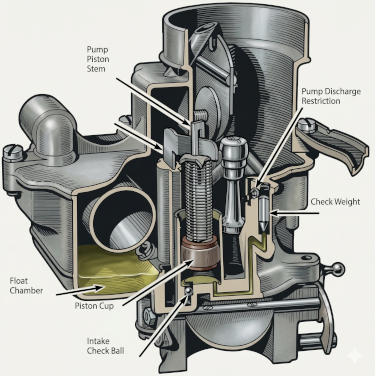
The Holley 847 accelerator pump system is designed to compensate for the brief lag that occurs when air flow through the carburetor increases faster than fuel can move through its passages. Without it, you’d experience a lean stumble or hesitation every time you hit the throttle. Here’s how it works:
How It Operates
-
Throttle Movement and Pump Piston:
When the throttle is opened, the pump rod—linked directly to the throttle lever—pushes the accelerator pump piston downward. A spring under the piston compresses as this happens, storing energy and ensuring a controlled, even fuel delivery. -
Fuel Discharge:
As the piston moves down, it forces fuel from the pump well through the pump discharge passage. The pump discharge needle valve opens under pressure, allowing fuel to spray into the carburetor throat, enriching the air-fuel mixture exactly when it’s needed. -
Check Valves for Control:
-
A pump inlet ball check valve at the base of the pump well lets fuel enter from the float chamber when the piston rises but prevents reverse flow when it descends.
-
A pump discharge needle valve prevents fuel from being siphoned at higher engine speeds when the pump is not in use, sealing the system until the next throttle movement.
-
-
Spring-Overriding Feature:
The design includes a spring-overriding function that prolongs the fuel discharge slightly. Instead of dumping all the fuel in one squirt, it stretches out the shot for smoother, stumble-free acceleration.
Why It Matters
This system bridges the gap between idle/low-speed operation and the main metering system’s response, making acceleration seamless. If the accelerator pump isn’t working (e.g., damaged piston cup, blocked discharge passage, or missing check ball), the engine will stumble or bog when the throttle is opened.
