
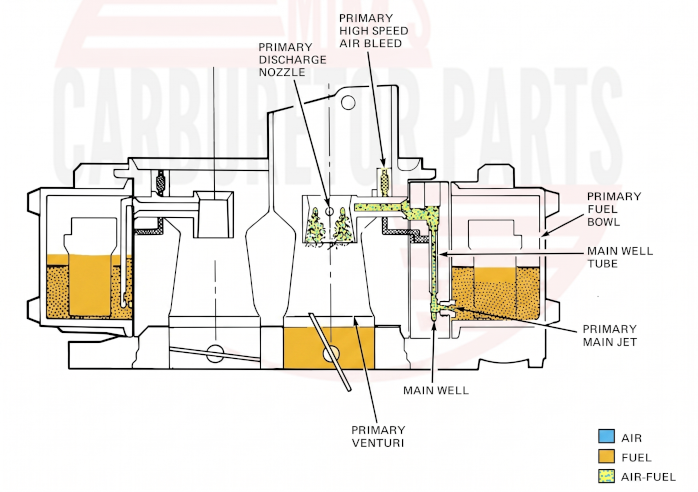
The Holley 4180 main metering system is the primary fuel delivery circuit responsible for supplying the engine with a metered air-fuel mixture during normal cruising and light-to-moderate acceleration.
It transitions into operation as the throttle plates open far enough for the venturi effect to take over from the idle and transfer circuits.
1. The Venturi Effect and Pressure Differential
As the throttle plates open, air rushes through the Primary Venturi. The narrowed shape of the venturi causes the air to speed up, which creates a low-pressure zone (a vacuum) at the Primary Discharge Nozzle.
Since the fuel in the Primary Fuel Bowl is at atmospheric pressure (vented to the outside), this pressure difference "pushes" the fuel from the bowl through the system and out into the air stream.
2. Fuel Metering (The Main Jet)
Fuel first passes through the Primary Main Jet. This is the "gatekeeper" of the system. The size of the hole in this jet determines the maximum amount of fuel that can enter the main metering circuit.
-
Larger jet: Richer mixture.
-
Smaller jet: Leaner mixture.
 Buy Jets
3. The Main Well and Emulsification
After passing the jet, fuel enters the Main Well. This is where the magic happens to ensure the fuel burns efficiently:
-
The Main Well Tube: Fuel rises up through this tube toward the discharge nozzle.
-
Primary High-Speed Air Bleed: Located at the top of the carburetor, this small passage allows a metered amount of air to enter the main well.
-
Emulsification: The air from the bleed mixes with the liquid fuel inside the main well tube. This creates an "emulsion"—a frothy mixture of air and tiny fuel bubbles. This lightens the fuel, making it easier to atomize and ensuring it doesn't leave the nozzle in heavy, "wet" droplets.
4. Discharge and Atomization
The frothy air-fuel mixture travels to the Primary Discharge Nozzle (often called the "booster"). Because of the vacuum created by the venturi, the mixture is pulled out and sprayed into the center of the air stream.
As it hits the high-speed air moving through the barrel, the fuel further breaks down into a fine mist (atomization) and travels down the intake manifold into the cylinders.
Summary of Component Roles
| Component | Function |
| Fuel Bowl | Maintains a constant reservoir of fuel for the circuit. |
| Main Jet | Restricts the total volume of fuel flow. |
| High-Speed Air Bleed | Introduces air into the fuel to begin the mixing process. |
| Main Well Tube | Houses the air-fuel emulsion before it reaches the nozzle. |
| Discharge Nozzle | The exit point where the mixture enters the engine's air stream. |
