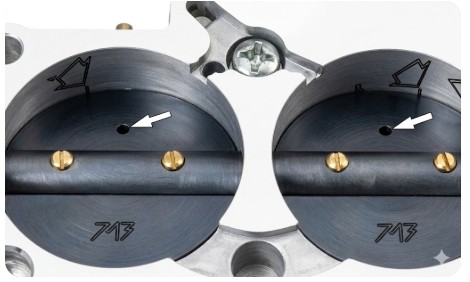
Holley 4150, 4160 Idle
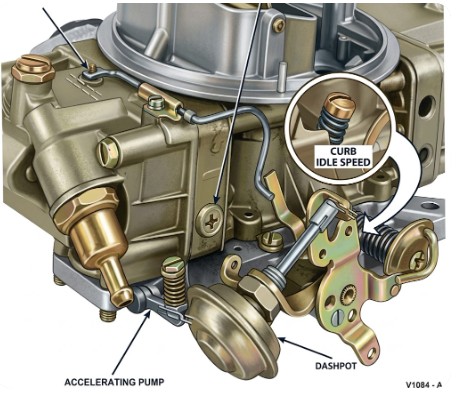
Setting Curb Idle
For a standard Holley 4160, the curb idle RPM is typically set between 600 and 800 RPM in neutral (or park for an automatic transmission, and with manual transmissions in neutral).
However, the exact target idle speed depends entirely on your specific engine build, camshaft profile, and transmission type:
Stock Passenger Car Engines: Usually adjusted to 600 – 700 RPM.
Performance or Modified Camshafts: Often require a higher idle speed—between 800 – 1,000 RPM—to maintain stable engine vacuum and prevent stalling when put into gear.
How to Adjust It
Ensure the engine is fully warmed up and the choke is completely open.
Locate the idle speed screw (also known as the curb idle screw) on the primary throttle lever.
Turn the screw clockwise to increase the RPM or counter-clockwise to lower it until you reach your target idle speed.
Check the idle with the transmission in drive (if automatic, with the parking brake securely engaged and wheels chocked) to ensure it doesn't drop too low under load.
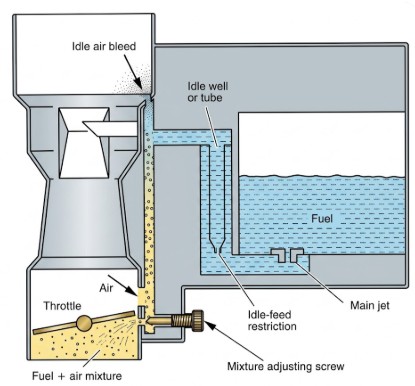
How to Adjust Idle Mixture

To ensure optimal performance from your engine, always confirm it has reached its peak operating temperature, with the choke fully open. Any attempt to adjust the idle mixture with the choke partially engaged is futile. Further, ensure the idle speed screw isn’t in contact with the choke's fast idle speed cam. To make this a seamless process, you'll need a vacuum gauge linked to the manifold vacuum.
Mastering the art of measuring idle quality is paramount. Every internal combustion engine relies on a certain degree of idle manifold vacuum, stemming from the cylinders' demand against a closed throttle. While there are several methods to measure engine vacuum, the most prevalent reads the vacuum as negative pressure, depicted in inches of mercury (“Hg). Often, vacuum/pressure gauges are shown in either “Hg or centimeters of mercury (cmHg).
Generally, production and mild-performance engines idle between 12 to 18 “Hg. A stable gauge needle is what you're aiming for. Beware: an erratic reading might signal a significant issue, like a leaky intake valve, which can disrupt your engine's harmony. Thus, always ensure your engine's health before tweaking the idle mixture.
Wondering why timing is essential before carburetor tuning?
Prioritize checking the position of each idle mixture screw before you ignite the engine. To do this, rotate every idle mixture screw clockwise, noting the turns until it lightly sits. This typically ranges from 1 to 2 turns out from full seating. Exercise caution to avoid causing damage. Ensure all screws are adjusted uniformly to guarantee a balanced output from the carburetor's idle circuit. A starting point is typically 1 to 1½ turns out.
Once your engine is idling (preferably in Park with the emergency brake on), set the idle speed, aiming for about 850 rpm. Adjust using the idle speed screw located on the primary throttle linkage on the carburetor's driver side.
Your focus should then be on the driver-side idle mixture screw, adjusting it clockwise about 1/8th of a turn and keeping an eye on the vacuum gauge. If there's an increase in engine vacuum or speed, adjust the opposite side by the same measure, and evaluate. If the vacuum reduces after the first adjustment, revert to the base setting and turn the screw out by around 1/8th of a turn.
This preliminary sequence aims to optimize the idle mixture screws on the carburetor for the best possible idle vacuum. In the event the idle speed surpasses the intended rpm post-adjustment, revert to the initial engine speed by adjusting the idle speed screw counterclockwise. This might slightly lower the idle vacuum, but it's an expected part of the process.
Idle mixture screws aren't making any difference in RPM?
Improper Baseline Setting: The initial position of the mixture screws might be far from their optimal setting, so minor adjustments don't manifest any change.
Carburetor Issues: Dirt, debris, or old fuel could be clogging the carburetor's idle passages, preventing proper fuel and air mixing.
Vacuum Leaks: An external vacuum leak can prevent the engine from responding to adjustments in the idle mixture. Vacuum leaks can be around the base of the carburetor, intake manifold gaskets, or any of the vacuum lines and fittings.
Idle Circuit Blockage: Over time, the carburetor’s idle circuit can become blocked or restricted. In such cases, adjusting the screw might not have the desired effect because the fuel can't flow as intended.
Idle RPM Set Too High: If the idle speed is set too high, the throttle plates might be open past the transition slot, causing the engine to run off the main metering circuit rather than the idle circuit. Thus, adjustments to the idle mixture won't have a pronounced effect.
Faulty Idle Mixture Screws: Over time and with repeated adjustments, the tips of the screws can wear out or become damaged. Damaged screws won't effectively control the fuel mixture.
Other Mechanical or Electrical Issues: Factors like a faulty ignition system, malfunctioning spark plugs, or incorrect timing can overshadow any adjustments made to the idle mixture.
When faced with such a situation, it's essential to methodically troubleshoot each potential cause. Starting with a clean, well-maintained carburetor and ensuring there are no vacuum leaks are fundamental first steps.