
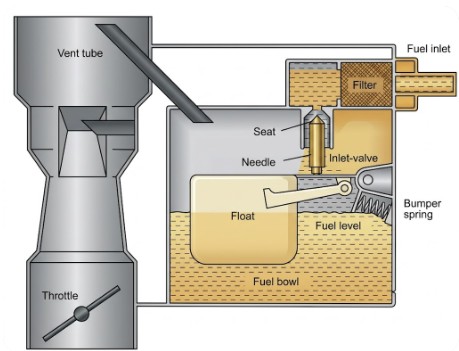
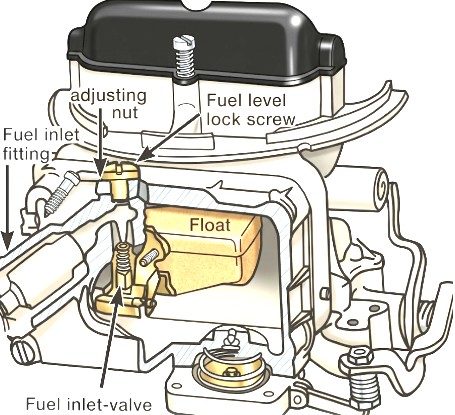
Think of the float and needle valve assembly as the "toilet tank" mechanism of the carburetor. Its job is to maintain a constant reservoir of fuel in the float bowl, ensuring the engine has a steady supply without the bowl overflowing.
Here is the breakdown of how these two components interact:
The Buoyancy Principle
The float is a light, hollow component (usually made of brass, plastic, or nitrophyl) that sits inside the fuel bowl. As fuel enters the bowl from the fuel pump, the level rises, and the float begins to rise with it.
The float is attached to a lever or hinge. Resting on this lever is the needle valve, a small metal pin with a tapered tip (often made of Viton or stainless steel).
The Balancing Act
The interaction between these two parts creates a self-regulating loop:
-
When the bowl is empty: The float drops to the bottom. This pulls the needle away from its seat (the orifice where fuel enters), leaving the "door" wide open. Fuel rushes into the bowl.
-
As fuel rises: The rising fuel lifts the float. Because of the lever action, the float pushes the needle upward into the seat.
-
Reaching the "Set Point": Once the fuel reaches a specific height—predetermined by the "float level" setting—the float exerts enough upward pressure to seat the needle firmly. This overcomes the pressure from the fuel pump and stops the flow entirely.
-
During Engine Operation: As the engine consumes fuel, the level in the bowl drops slightly. The float dips, the needle moves away from the seat just enough to let a small amount of fuel in, and the level stabilizes.
Critical Factors for Balance
For this system to work correctly and keep the fuel flow balanced, two things must be perfectly calibrated:
-
Float Level: If the float is set too high, the needle won't seat until the bowl is nearly overflowing, causing a "rich" condition or flooding. If it's too low, the engine may "starve" for fuel during high-demand periods.
-
Fuel Pressure: The float can only exert so much upward force. If the fuel pump pressure is too high (standard carburetors usually want about 4 to 6 psi), it can force the needle off its seat regardless of where the float is, leading to a consistent drip or flood.
When these two parts are in harmony, the fuel level stays at a consistent height, allowing the atmospheric pressure and engine vacuum to pull the exact amount of fuel needed through the carburetor's circuits.
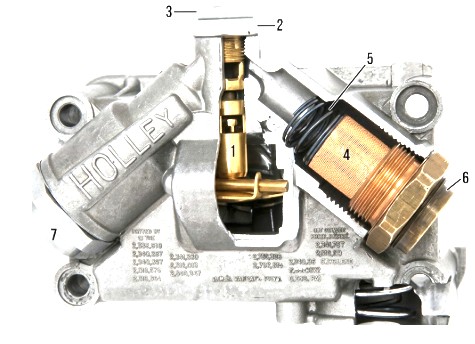
 Side hung float in the secondary fuel bowl shows float (1), adjustable needle /seat assembly (2), adjusting nut (3), lock screw (4), plastic baffle to direct inlet fuel (5), float bumper spring (6), sight plug for fuel level checking (7), and hole for transfer tube which brings fuel to secondary bowl from inlet on primary bowl (8). When correct, half round float is adequate for all but the most severe cornering loads like those generated in auto crossing, or racing.
Differences in the type of fuel inlet needle & seat:
The fuel inlet needle and seat assembly is the "gatekeeper" of your Holley carburetor. In the 4150 (double pumper) and 4160 (vacuum secondary) series, the design of these needles has evolved primarily around how you adjust the fuel level in the bowls.
Here is a breakdown of the two primary types and their characteristics.
1. Externally Adjustable Needle & Seat
This is the most common design found on performance Holley carburetors. It allows you to set the float level without removing the fuel bowl or even turning off the engine (though caution is required).
-
Identification: You will see a large flat-head screw and a hex nut protruding from the top of the fuel bowl.
-
Mechanism: The needle and seat are a self-contained threaded cartridge. Turning the nut raises or lowers the entire assembly relative to the float arm inside.
-
Pros: Extremely convenient for tuning. You can watch the fuel level through the "sight plug" on the side of the bowl and adjust it until the fuel just touches the bottom of the hole.
-
Components: * The Seat: The threaded brass housing.
-
The Needle: Usually tipped with Viton (a synthetic rubber) for a superior seal, though stainless steel tips are used for high-flow or alcohol applications.

-
2. Internally Adjustable (Non-Adjustable) Needle & Seat
These are typically found on "budget" 4160 models, OEM-style carburetors, or older 1850 series units.
-
Identification: The top of the fuel bowl is smooth. There are no adjustment screws visible from the outside.
-
Mechanism: The needle and seat are tucked away inside the bowl. To adjust the fuel level, you must remove the fuel bowl entirely and physically bend the tang on the float arm.
-
Pros: Less prone to leaks since there are fewer external gaskets and O-rings. It also prevents "tinkerers" from messing with the factory settings.
-
Cons: Tuning is a "guess and check" process. You have to take the bowl off, bend the metal, reassemble, and check again.

Needle Tip Material Types
Regardless of whether they are adjusted internally or externally, the material of the needle tip is crucial for performance:
| Material | Best Use Case | Characteristics |
| Viton (Rubber) | Standard Gasoline | Most common; very forgiving of tiny debris and provides the best seal. |
| Steel Tip | Racing / Alcohol | Required for E85 or Methanol fuels which can eat away at standard Viton. |
| Large Orifice | High Horsepower | A wider "seat" hole (e.g., .110" or .120") allows more fuel volume to enter the bowl quickly. |
