
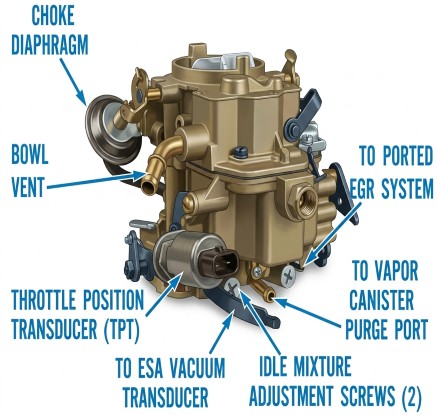
How Does The Throttle Position Sensor Transducer (TPT) Work?
The Throttle Position Transducer (TPT) on a Holley 2280 carburetor is a critical component primarily found on late 1970s and early 1980s Chrysler vehicles equipped with the Electronic Spark Control (ESC), commonly known as the "Lean Burn" system.
It serves as an early, analog predecessor to the modern Throttle Position Sensor (TPS). Instead of controlling fuel injection, its sole purpose on these carbureted engines is to help the computer control ignition timing.
Here is a breakdown of exactly how it operates mechanically and electrically.
1. The Core Function
The TPT acts as a communication bridge between the driver's right foot and the vehicle's spark control computer. It constantly monitors two main factors:
-
Throttle Angle: How far open the throttle plates are.
-
Rate of Change: How quickly the throttle is opening or closing.
2. Mechanical Operation
The TPT is mounted on the exterior of the Holley 2280's main body and is physically connected to the throttle shaft via a small adjustable linkage.
-
Inside the TPT housing is an electromagnetic coil, and extending from the bottom is a metallic core (or plunger).
-
As you press the accelerator pedal, the throttle shaft rotates to let air into the engine.
-
This rotation physically moves the linkage, which pushes or pulls the metallic core deeper into, or further out of, the transducer's internal coil.
3. Electrical Operation
Unlike a standard potentiometer (which uses a wiper dragging across a resistor to change voltage), the Chrysler TPT operates as an inductive linear transducer.
-
The spark control computer sends a base electrical signal to the TPT coil.
-
As the metal plunger moves through the magnetic field of the coil, it changes the coil's inductance.
-
This physical movement alters the electrical signal returning to the computer.
-
A slow, steady press of the pedal yields a gradual change in the signal, while stomping the gas produces a rapid spike.
4. How the Computer Uses the Data
The Lean Burn computer takes the analog signal from the TPT and combines it with readings from the vacuum transducer and the distributor pick-up (engine RPM).
-
Cruising: If the TPT shows the throttle is holding steady, the computer advances the spark timing for maximum fuel economy and a "lean" air/fuel burn.
-
Accelerating: If the TPT senses a sudden opening of the throttle, the computer immediately retards the ignition timing. This prevents the engine from pinging (detonation) under the sudden load before the carburetor's mechanical accelerator pump can deliver the extra fuel.
Common Symptoms of a Failing TPT
Because the TPT involves moving parts, the internal coil or the mechanical linkage can wear out over time. If the transducer fails, sticks, or falls out of adjustment, the computer will receive erratic signals. This typically results in:
-
Severe hesitation or stumbling when trying to accelerate.
-
The system defaulting to a "limp-in" mode with locked, retarded timing, leading to sluggish performance and poor fuel economy.
-
Engine pinging under heavy load due to the computer failing to retard the timing fast enough.
TPT Adjustment
When to Adjust the TPT
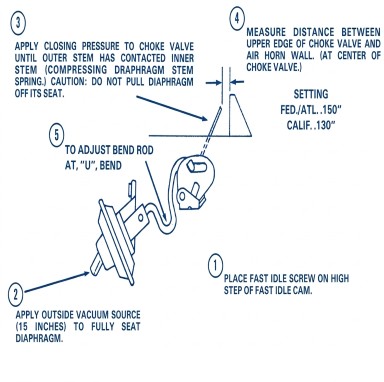
You will need to perform a TPT adjustment in any of the following scenarios:
-
After Adjusting the Curb Idle: This is the most common reason. Changing the curb idle speed physically alters the resting position of the throttle plates. If you change the idle without readjusting the TPT, the computer will think the throttle is slightly open when it is actually closed.
-
Following a Carburetor Rebuild or Replacement: Anytime the carburetor is disassembled, removed, or swapped, the physical relationship between the throttle shaft linkage and the transducer core is disrupted.
-
Replacing Components: If the TPT itself, the carburetor baseplate, or the spark control computer is replaced.
-
Troubleshooting Drivability Issues: If vacuum leaks, ignition timing, and accelerator pump function (ensuring, of course, proper cup seating without expander springs where applicable) have been ruled out, but the engine still suffers from an off-idle stumble.
The Adjustment Principle
The goal of the adjustment is to set the metallic core (plunger) to a highly specific depth within the transducer body while the engine is at its normal, warm operating curb idle.
Depending on the exact year and engine pairing for the Holley 2280, the factory service manual usually dictates one of two methods:
-
The Mechanical Gap Method: This involves loosening the locknut on the TPT linkage and using a specific gauge block (or often a precisely sized drill bit, like a 33/64") placed between the transducer core and the transducer body to set a physical gap.
-
The Voltage Method: On some later systems, it requires back-probing the TPT connector with a multimeter and adjusting the linkage until a specific baseline voltage is achieved at curb idle.

