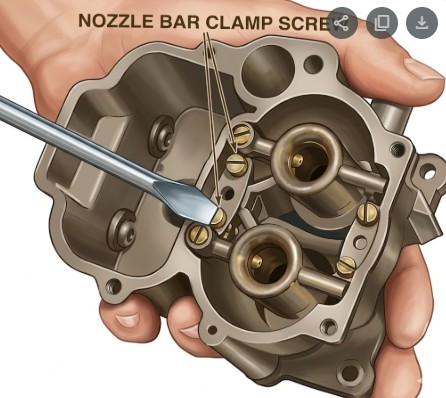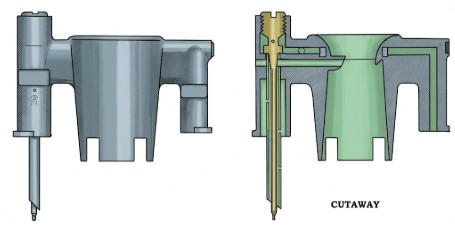
The venturi in the Holley 2110 carburetor (a single-barrel unit often called the "Bug" or "Two-Barrel") is a restricted passage that uses the Venturi Effect to draw fuel into the engine's air stream.
In diagram, the venturi is the hourglass-shaped narrowing in the center of the main body (labeled "CUTAWAY" on the right). Here is exactly what it does:
1. Increases Air Velocity
As the engine's pistons move down, they "pull" air through the carburetor. When that air hits the narrow section of the venturi, it is forced to speed up significantly. This transition from a wide opening to a narrow restriction converts potential energy (pressure) into kinetic energy (speed).
2. Creates a Low-Pressure Vacuum ("Signal")
According to Bernoulli’s Principle, as the speed of a fluid (air) increases, its pressure decreases. This creates a zone of low pressure—a vacuum—right at the narrowest part of the venturi. In carburetor tuning, this vacuum is often called the "signal."
3. Meters and Pulls Fuel
The main discharge nozzle (the tube seen in the cutaway) is positioned right in the center of this low-pressure zone.
-
The Science: The fuel in the bowl is under atmospheric pressure. Because the pressure inside the venturi is much lower than the pressure in the fuel bowl, the fuel is literally pushed/sucked out of the nozzle and into the air stream.
-
The Result: The faster the engine runs and the more air it pulls, the stronger the vacuum becomes, which automatically pulls more fuel to maintain the correct air-fuel ratio.
4. Atomizes the Mixture
The high-velocity air rushing past the nozzle doesn't just grab the fuel; it "shreds" it. The venturi helps break the liquid gasoline into a fine mist (atomization). Smaller droplets vaporize more easily, leading to a more efficient and complete burn inside the combustion chamber.
Why the 2110 is unique
The Holley 2110 is a relatively simple "fixed-venturi" carburetor. Unlike some performance carburetors that use "boost venturis" (smaller venturis suspended inside a larger one to multiply the vacuum signal), the 2110 relies on its cast-in main venturi. This makes it very reliable but also means the venturi size is a compromise:
-
Too small: Good low-end throttle response but restricts high-RPM power.
-
Too large: Great high-end power but sluggish response and poor fuel "signal" at low speeds.
In the Holley 2110, that long, slender component passing through the center of the venturi is formally known as the Main Discharge Nozzle (though it contains the "jetting" logic for the main circuit).
Its job is to act as the "delivery straw" that bridges the gap between the fuel bowl and the rushing air. Here is the breakdown of its specific functions:
What is the jet in the venturi.
1. The Delivery Point
The tip of this nozzle is positioned precisely at the narrowest part of the venturi. Because this is the area of highest air velocity and lowest pressure, the nozzle is where the fuel actually enters the air stream. Without this "jet" extending into the center, the fuel would just sit in the bowl.
2. Fuel Metering (The "Main Jet")
While the nozzle is the physical tube, its flow is restricted by a Main Jet (usually located at the bottom of the assembly or inside the bowl). This jet acts as a gatekeeper, ensuring that only a specific, measured volume of fuel can enter the tube based on how much air the engine is pulling.
3. Pre-Atomization (Emulsion)
If you look closely at the cutaway, the tube isn't just a hollow pipe; it often has small holes along its sides. These are air bleed holes.
-
As fuel is pulled up the tube, air is mixed into the liquid gasoline before it leaves the nozzle.
-
This creates a "frothy" mixture of air and fuel (an emulsion), which is much easier to break into a fine mist once it hits the venturi than a solid stream of liquid would be.
4. Preventing "Dribble"
The height and angle of the nozzle are engineered to prevent fuel from simply leaking out when the engine is at idle. It requires a specific amount of "venturi vacuum" (usually above off-idle speeds) to overcome gravity and pull the fuel up and out of the nozzle.
Summary of the Flow
-
Air enters the top of the carburetor.
-
The Venturi squeezes the air, creating a vacuum.
-
This vacuum pulls on the Main Discharge Nozzle.
-
Fuel (already mixed with a little air from the bleeds) exits the nozzle tip.
-
The fuel and air mix completely to become the combustible charge that enters your cylinders.