
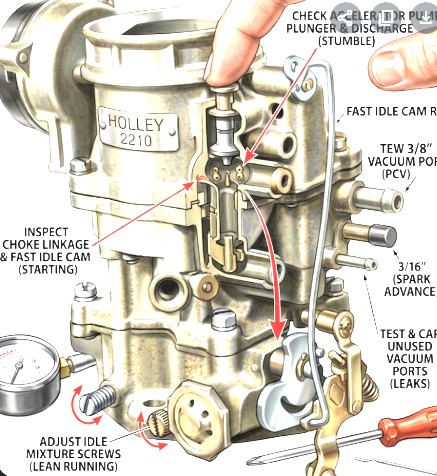
Troubleshooting the Holley 2210 Carburetor
The Holley 2210 is a two-barrel, vacuum-governed carburetor frequently found on International Harvester and some Chrysler products. Because it uses a modular design with a main body and a separate fuel bowl, specific leak points and vacuum issues are common.
1. Difficulties Starting (Engine Cold)
-
Choke Plate Position: The choke should be fully closed when the engine is cold and the throttle is cracked once. If it’s hanging open, check the choke thermostatic coil (the black cap) for tension or a broken spring.
-
Fast Idle Cam: Ensure the fast idle screw is resting on the high step of the cam. If the engine won't stay running, the fast idle speed may be set too low.
-
Choke Pull-Off (Vacuum Break): Once the engine starts, the vacuum diaphragm should pull the choke plate open slightly (the "choke break" measurement). If the diaphragm is ruptured, the engine will flood and stall immediately after starting.
2. Hesitation or "Stumble" Under Acceleration
-
Accelerator Pump Cup: The Holley 2210 uses a plunger-style accelerator pump. If the pump cup is worn or dried out, it won't provide the necessary squirt of fuel.
Note: As we've discussed with similar vintage units, if you are using a leather pump cup, do not use an expander spring; however, ensure the leather is supple and flared slightly for a good seal.
-
Pump Linkage: Check that the pump arm moves the instant the throttle is touched. Any "play" in the linkage will cause a flat spot.
-
Check Ball/Weight: If the pump is working but the fuel is returning to the bowl instead of exiting the discharge nozzles, the check ball or weight may be stuck or missing.
3. Rough Idle or Stalling at Stoplights
-
Vacuum Leaks: This is the most common issue. Check the base gasket and the gasket between the main body and the throttle body. Use a vacuum gauge; a steady, low reading usually indicates a leak.
-
Idle Mixture Adjustment: The 2210 has two idle mixture screws at the base. Turn them in until they lightly seat, then back them out 1.5 to 2 turns as a starting point. Adjust for the highest vacuum reading or smoothest idle.
-
Idle Tubes: The small idle tubes inside the venturi cluster are easily clogged by modern fuel deposits. If the car won't idle unless the choke is partially closed, these tubes likely need cleaning with a thin wire.
4. Flooding and Fuel Leaks
-
Fuel Inlet Needle & Seat: Dirt or "scale" from old fuel lines can get trapped in the needle, preventing it from seating.
-
Float Level: If the fuel level is too high, fuel will spill over the venturis. Set the float level to factory specs (usually measured with the air horn inverted).
-
Main Body Warp: Because the 2210 has a long, relatively thin main body, over-tightening the mounting bolts can cause the casting to warp, leading to persistent internal vacuum or fuel leaks.
Quick Reference Specs
| Component | Typical Setting |
| Float Level | 7/32" (Check specific application) |
| Idle Mixture | 1.5 - 2 Turns Out |
| Choke Setting | Index Mark or 1 Lean |
Pro Tip: When rebuilding, pay close attention to the economizer valve (power valve) located in the bottom of the bowl. If the diaphragm is ruptured, it will pull raw fuel directly into the intake, causing an extremely rich condition that cannot be adjusted out with the idle screws.
