
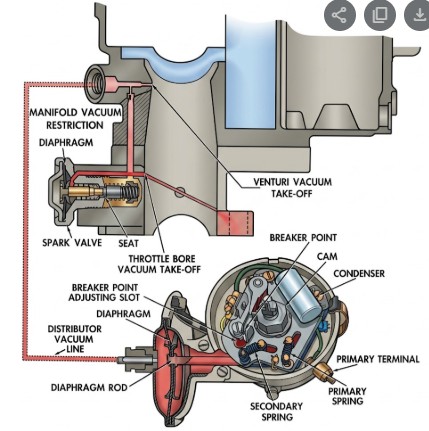
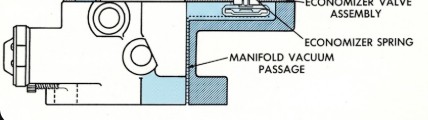
The Holley 2110 (often found on Ford Y-block engines from the 1950s) utilizes a Spark Control Valve (SCV) to manage vacuum advance. This system is unique because it doesn't rely on simple manifold vacuum; instead, it uses a "Loadomatic" distributor that lacks centrifugal advance weights, meaning the carburetor has to do all the work of timing the engine based on load.
Here is the technical breakdown of how that valve operates:
1. The Purpose of the SCV
In a Loadomatic system, the distributor needs a specific vacuum signal to advance the timing. Under light loads (cruising), you need more advance; under heavy loads (acceleration), you need less. The Spark Control Valve acts as a modulator between the venturi vacuum and the manifold vacuum to provide the distributor with the correct "net" signal.
2. The Internal Components
The valve is a small, screw-in diaphragm assembly located on the side of the carburetor body. It consists of:
-
A calibrated spring: This holds the valve closed under normal conditions.
-
A diaphragm: This reacts to the difference in pressure.
-
An internal needle and seat: This opens or closes the passage to the manifold vacuum source.
3. Functional Stages
-
Idle and Low Speed: At idle, the throttle plates are closed. There is very little air rushing through the venturi, so venturi vacuum is low. The SCV remains closed, and the distributor receives a very weak signal, keeping the timing retarded for a smooth idle.
-
Normal Cruising (Part Throttle): As you open the throttle, air velocity through the venturi increases, creating venturi vacuum. This vacuum pulls on the SCV diaphragm. At the same time, the relatively high manifold vacuum helps "prime" the signal. The SCV modulates these two sources to send a steady, high-vacuum signal to the distributor for maximum fuel economy.
-
Heavy Acceleration (High Load): When you floor it, manifold vacuum drops nearly to zero. The pressure differential across the SCV diaphragm changes. The internal spring overcomes the vacuum, and the valve closes. This cuts off the manifold vacuum assist, leaving only the venturi vacuum (which is also low at low RPM). This drops the total vacuum signal to the distributor, retarding the spark to prevent "pinging" or detonation under load.
4. Common Failure Points
If your Y-block is stumbling or lacks power under load, the SCV is a prime suspect:
-
Ruptured Diaphragm: If the diaphragm leaks, it creates a vacuum leak and the distributor won't advance properly.
-
Wrong Distributor Match: A common mistake in restoration is using a later-model distributor (with centrifugal weights) with an SCV-equipped carburetor. These two systems are incompatible; the SCV carburetor will provide too much advance too quickly for a mechanical-advance distributor.
-
Stuck Valve: Old fuel varnish can gum up the needle, preventing it from reacting to vacuum changes.
Tech Tip: You can identify the SCV by the small, 1-inch diameter hex-shaped "pod" screwed into the side of the main body near the fuel bowl. If you are running a 1957 or later distributor, the SCV should typically be plugged or bypassed to prevent timing issues.
